


Moving around the molecule: relationship between chemical structure and in vivo activity of synthetic cannabinoids
- PMID: 24071522
- PMCID: PMC3944940
- DOI: 10.1016/j.lfs.2013.09.011
Moving around the molecule: relationship between chemical structure and in vivo activity of synthetic cannabinoids
Abstract
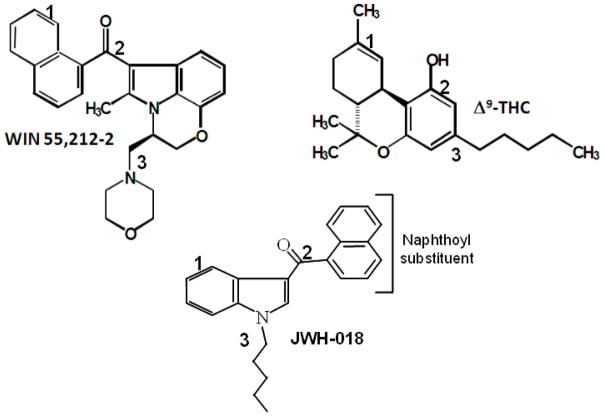
Originally synthesized for research purposes, indole- and pyrrole-derived synthetic cannabinoids are the most common psychoactive compounds contained in abused products marketed as "spice" or "herbal incense." While CB1 and CB2 receptor affinities are available for most of these research chemicals, in vivo pharmacological data are sparse. In mice, cannabinoids produce a characteristic profile of dose-dependent effects: antinociception, hypothermia, catalepsy and suppression of locomotion. In combination with receptor binding data, this tetrad battery has been useful in evaluation of the relationship between the structural features of synthetic cannabinoids and their in vivo cannabimimetic activity. Here, published tetrad studies are reviewed and additional in vivo data on synthetic cannabinoids are presented. Overall, the best predictor of likely cannabimimetic effects in the tetrad tests was good CB1 receptor affinity. Further, retention of good CB1 affinity and in vivo activity was observed across a wide array of structural manipulations of substituents of the prototypic aminoalkylindole molecule WIN55,212-2, including substitution of an alkyl for the morpholino group, replacement of an indole core with a pyrrole or phenylpyrrole, substitution of a phenylacetyl or tetramethylcyclopropyl group for JWH-018's naphthoyl, and halogenation of the naphthoyl group. This flexibility of cannabinoid ligand-receptor interactions has been a particular challenge for forensic scientists who have struggled to identify and regulate each new compound as it has appeared on the drug market. One of the most pressing future research needs is determination of the extent to which the pharmacology of these synthetic cannabinoids may differ from those of classical cannabinoids.
Keywords: Alkylindoles; Aromatic stacking; Cannabinoids; Herbal marijuana; Indoles; JWH-018; Pyrroles; Review; Spice; Synthetic cannabinoids.
© 2013.
Conflict of interest statement
The authors do not have any real or perceived conflicts of interest with regard to the data presented in this manuscript.
Figures


References
-
- Aung MM, Griffin G, Huffman JW, Wu M, Keel C, Yang B, Showalter VM, Abood ME, Martin BR. Influence of the N-1 alkyl chain length of cannabimimetic indoles upon CB(1) and CB(2) receptor binding. Drug Alcohol Depend. 2000;60:133–40. - PubMed
-
- Breivogel CS, Childers SR. Cannabinoid agonist signal transduction in rat brain: comparison of cannabinoid agonists in receptor binding, G-protein activation, and adenylyl cyclase inhibition. J Pharmacol Exp Ther. 2000;295:328–36. - PubMed
-
- Brents LK, Gallus-Zawada A, Radominska-Pandya A, Vasiljevik T, Prisinzano TE, Fantegrossi WE, Moran JH, Prather PL. Monohydroxylated metabolites of the K2 synthetic cannabinoid JWH-073 retain intermediate to high cannabinoid 1 receptor (CB1R) affinity and exhibit neutral antagonist to partial agonist activity. Biochem Pharmacol. 2012;83:952–61. - PMC - PubMed
-
- Compton DR, Aceto MD, Lowe J, Martin BR. In vivo characterization of a specific cannabinoid receptor antagonist (SR141716A): inhibition of delta 9-tetrahydrocannabinol-induced responses and apparent agonist activity. J Pharmacol Exp Ther. 1996;277:586–94. - PubMed
-
- Compton DR, Gold LH, Ward SJ, Balster RL, Martin BR. Aminoalkylindole analogs: cannabimimetic activity of a class of compounds structurally distinct from delta 9-tetrahydrocannabinol. J Pharmacol Exp Ther. 1992;263:1118–26. - PubMed
Publication types
MeSH terms
Substances
Grants and funding
LinkOut - more resources
Full Text Sources
Other Literature Sources
