


Density dependence in Caenorhabditis larval starvation
- PMID: 24071624
- PMCID: PMC3784960
- DOI: 10.1038/srep02777
Density dependence in Caenorhabditis larval starvation
Abstract
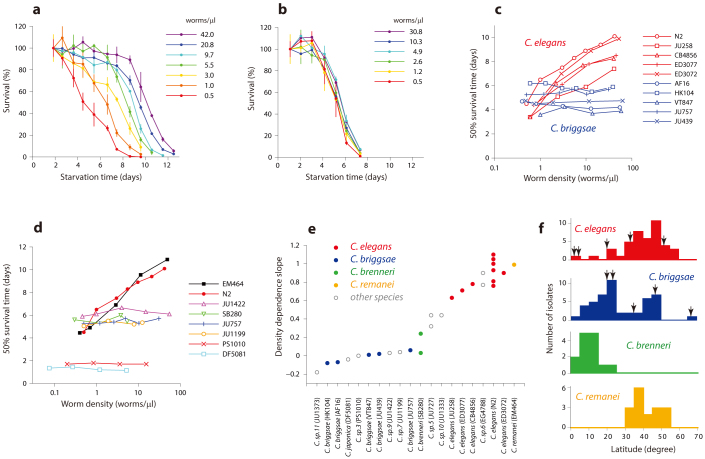
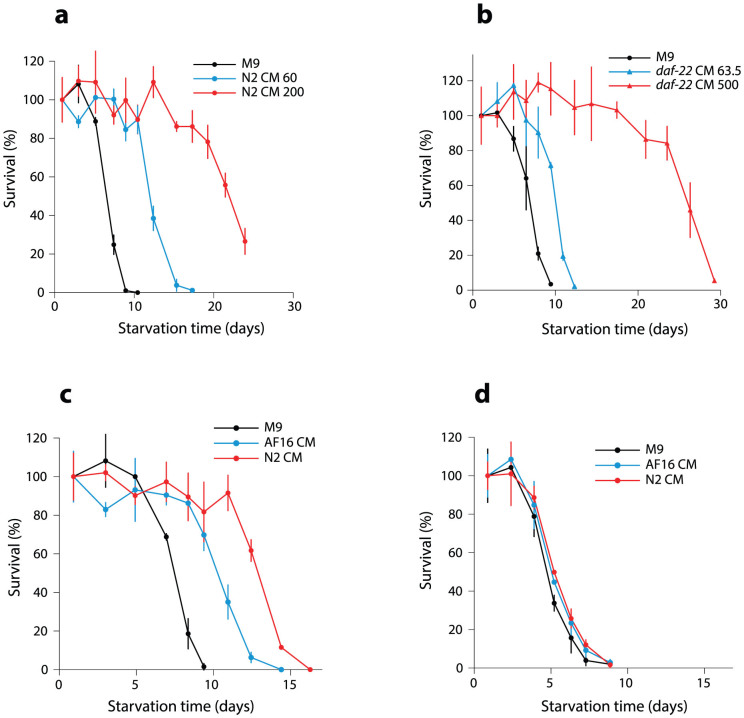
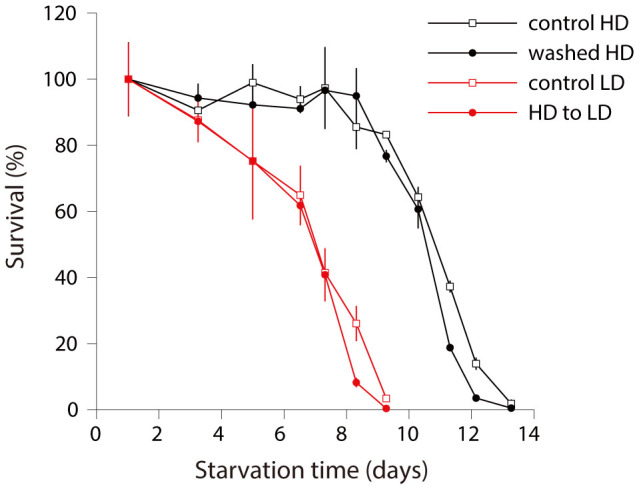
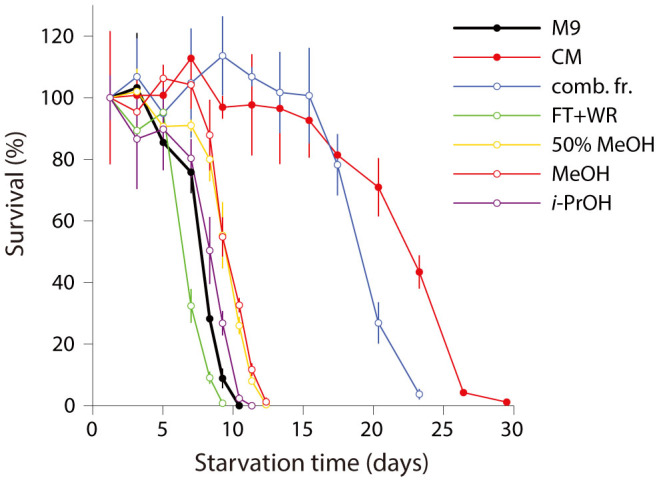
Availability of food is often a limiting factor in nature. Periods of food abundance are followed by times of famine, often in unpredictable patterns. Reliable information about the environment is a critical ingredient of successful survival strategy. One way to improve accuracy is to integrate information communicated by other organisms. To test whether such exchange of information may play a role in determining starvation survival strategies, we studied starvation of L1 larvae in C. elegans and other Caenorhabditis species. We found that some species in genus Caenorhabditis, including C. elegans, survive longer when starved at higher densities, while for others survival is independent of the density. The density effect is mediated by chemical signal(s) that worms release during starvation. This starvation survival signal is independent of ascarosides, a class of small molecules widely used in chemical communication of C. elegans and other nematodes.
Figures
References
-
- Eijkelenboom A. & Burgering B. M. FOXOs: signalling integrators for homeostasis maintenance. Nature Rev. Mol. Cell Biol. 14, 83–97 (2013). - PubMed
-
- van der Horst A. & Burgering B. M. Stressing the role of FoxO proteins in lifespan and disease. Nature Rev. Mol. Cell Biol. 8, 440–450 (2007). - PubMed
-
- Avogaro A., de Kreutzenberg S. V. & Fadini G. P. Insulin signaling and life span. Pflugers Ar. Eur J. Physiol. 459, 301–314 (2010). - PubMed
-
- Taguchi A. & White M. F. Insulin-like signaling, nutrient homeostasis, and life span. Ann. Rev. Physiol. 70, 191–212 (2008). - PubMed
Publication types
MeSH terms
Grants and funding
LinkOut - more resources
Full Text Sources
Other Literature Sources
