


Gender differences in salary in a recent cohort of early-career physician-researchers
- PMID: 24072109
- PMCID: PMC3816636
- DOI: 10.1097/ACM.0b013e3182a71519
Gender differences in salary in a recent cohort of early-career physician-researchers
Abstract
Purpose: Studies have suggested that male physicians earn more than their female counterparts. The authors examined whether this disparity exists in a recently hired cohort.
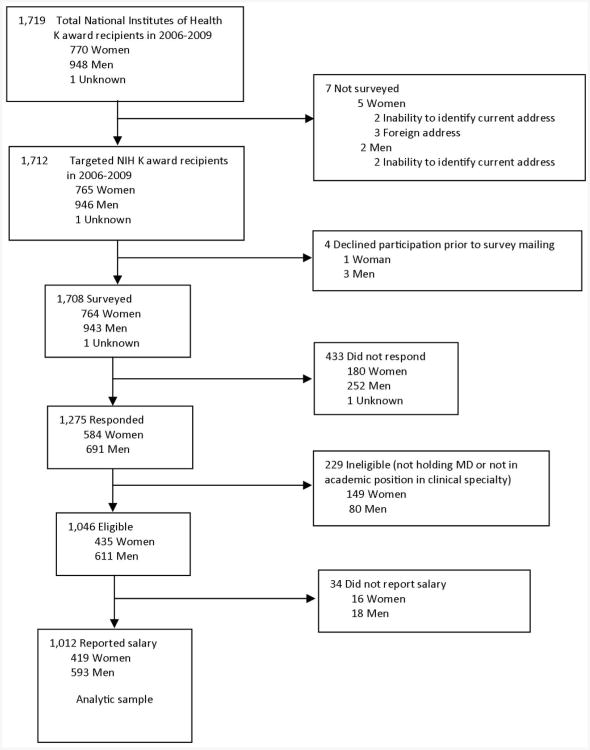
Method: In 2010-2011, the authors surveyed recent recipients of National Institutes of Health (NIH) mentored career development (i.e., K08 or K23) awards, receiving responses from 1,275 (75% response rate). For the 1,012 physicians with academic positions in clinical specialties who reported salary, they constructed linear regression models of salary considering gender, age, race, marital status, parental status, additional doctoral degree, academic rank, years on faculty, specialty, institution type, region, institution NIH funding rank, K award type, K award funding institute, K award year, work hours, and research time. They evaluated the explanatory value of spousal employment status using Peters-Belson regression.
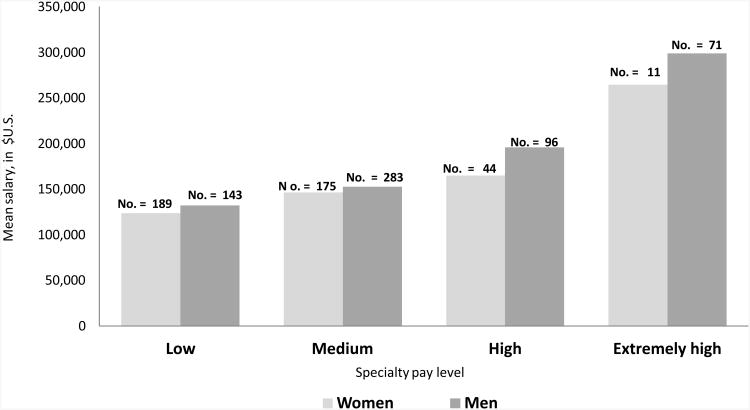
Results: Mean salary was $141,325 (95% confidence interval [CI] 135,607-147,043) for women and $172,164 (95% CI 167,357-176,971) for men. Male gender remained an independent, significant predictor of salary (+$10,921, P < .001) even after adjusting for specialty, academic rank, work hours, research time, and other factors. Peters-Belson analysis indicated that 17% of the overall disparity in the full sample was unexplained by the measured covariates. In the married subset, after accounting for spousal employment status, 10% remained unexplained.
Conclusions: The authors observed, in this recent cohort of elite, early-career physician-researchers, a gender difference in salary that was not fully explained by specialty, academic rank, work hours, or even spousal employment. Creating more equitable procedures for establishing salary is important.
Figures
Comment in
-
Gender-based salary disparities: it pays to take a closer look.Acad Med. 2014 Aug;89(8):1094. doi: 10.1097/ACM.0000000000000379. Acad Med. 2014. PMID: 25072451 No abstract available.
-
In reply to Ambati.Acad Med. 2014 Aug;89(8):1094. doi: 10.1097/ACM.0000000000000383. Acad Med. 2014. PMID: 25072452 No abstract available.
References
-
- Jagsi R, Griffith KA, Stewart A, Sambuco D, DeCastro R, Ubel PA. Gender differences in the salaries of physician researchers. JAMA. 2012;307:2410–2417. - PubMed
-
- Ash AS, Carr PL, Goldstein R, Friedman RH. Compensation and advancement of women in academic medicine: Is there equity? Ann Intern Med. 2004;141:205–212. - PubMed
-
- Kaplan SH, Sullivan LM, Dukes KA, Phillips CF, Kelch RP, Schaller JG. Sex differences in academic advancement: Results of a national study of pediatricians. N Engl J Med. 1996;335:1282–1289. - PubMed
-
- Kehrer BH. Factors affecting the incomes of men and women physicians: An exploratory analysis. J Hum Resour. 1976;11:526–545. - PubMed
-
- Wright AL, Schwindt LA, Bassford TL, et al. Gender differences in academic advancement: Patterns, causes, and potential solutions in one U.S. college of medicine. Acad Med. 2003;78:500–508. - PubMed
Publication types
MeSH terms
Grants and funding
LinkOut - more resources
Full Text Sources
Other Literature Sources
