


The effect of motivational interviewing on medication adherence and hospitalization rates in nonadherent patients with multi-episode schizophrenia
- PMID: 24072808
- PMCID: PMC3796095
- DOI: 10.1093/schbul/sbt138
The effect of motivational interviewing on medication adherence and hospitalization rates in nonadherent patients with multi-episode schizophrenia
Abstract
Background: Medication nonadherence in patients with schizophrenia presents a serious clinical problem. Research on interventions incorporating motivational interviewing (MI) to improve adherence have shown mixed results.
Aims: Primary aim is to determine the effectiveness of a MI intervention on adherence and hospitalization rates in patients, with multi-episode schizophrenia or schizoaffective disorder, who have experienced a psychotic relapse following medication nonadherence. Secondary aim is to evaluate whether MI is more effective in specific subgroups.
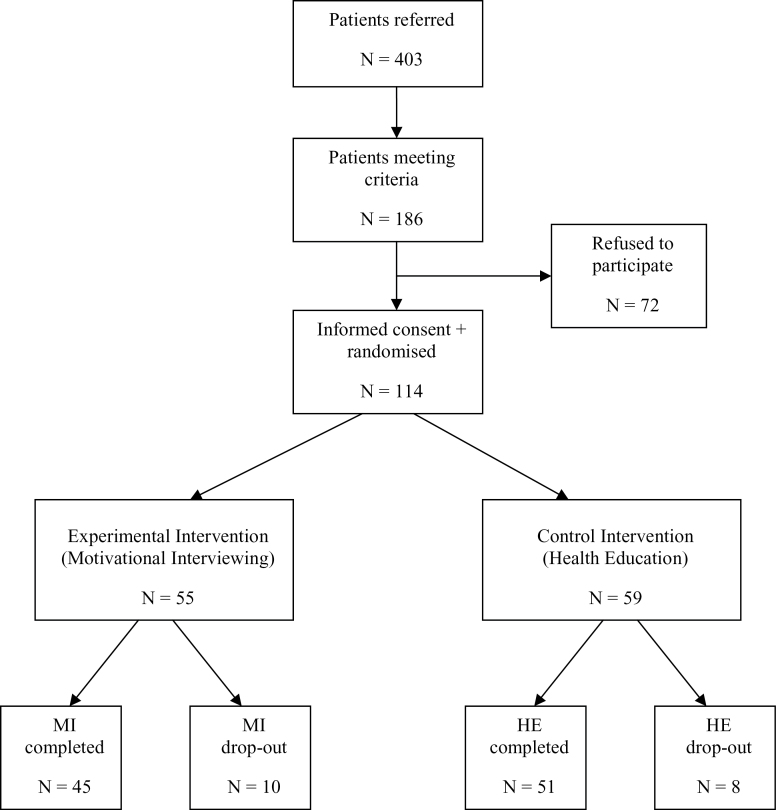
Methods: We performed a randomized controlled study including 114 patients who experienced a psychotic relapse due to medication nonadherence in the past year. Participants received an adapted form of MI or an active control intervention, health education (HE). Both interventions consisted of 5-8 sessions, which patients received in adjunction to the care as usual. Patients were assessed at baseline and at 6 and 12 months follow-up.
Results: Our results show that MI did not improve medication adherence in previously nonadherent patients who experienced a psychotic relapse. Neither were there significant differences in hospitalization rates at follow-up between MI and HE (27% vs 40%, P = .187). However, MI resulted in reduced hospitalization rates for female patients (9% vs 63%, P = .041), non-cannabis users (20% vs 53%, P = .041), younger patients (14% vs 50%, P = .012), and patients with shorter illness duration (14% vs 42%, P = .040).
Conclusions: Targeted use of MI may be of benefit for improving medication adherence in certain groups of patients, although this needs further examination.
Keywords: RCT; intervention study; medication adherence; motivational interviewing; schizophrenia.
References
-
- Lacro JP, Dunn LB, Dolder CR, Leckband SG, Jeste DV. Prevalence of and risk factors for medication nonadherence in patients with schizophrenia: a comprehensive review of recent literature. J Clin Psychiatry. 2002;63:892–909 - PubMed
-
- Weiden PJ, Olfson M. Cost of relapse in schizophrenia. Schizophr Bull. 1995;21:419–429 - PubMed
-
- Robinson D, Woerner MG, Alvir JM, et al. Predictors of relapse following response from a first episode of schizophrenia or schizoaffective disorder. Arch Gen Psychiatry. 1999;56:241–247 - PubMed
-
- Heeg B, Buskens E, Knapp M, et al. Modelling the treated course of schizophrenia: development of a discrete event simulation model. Pharmacoeconomics. 2005;23(s uppl 1):17–33 - PubMed
-
- Barkhof E, Meijer CJ, de Sonneville LM, Linszen DH, de Haan L. Interventions to improve adherence to antipsychotic medication in patients with schizophrenia–a review of the past decade. Eur Psychiatry. 2012;27:9–18 - PubMed
Publication types
MeSH terms
LinkOut - more resources
Full Text Sources
Other Literature Sources
Medical
Miscellaneous
