


Reducing inequities in neonatal mortality through adequate supply of health workers: evidence from newborn health in Brazil
- PMID: 24073222
- PMCID: PMC3779240
- DOI: 10.1371/journal.pone.0074772
Reducing inequities in neonatal mortality through adequate supply of health workers: evidence from newborn health in Brazil
Abstract
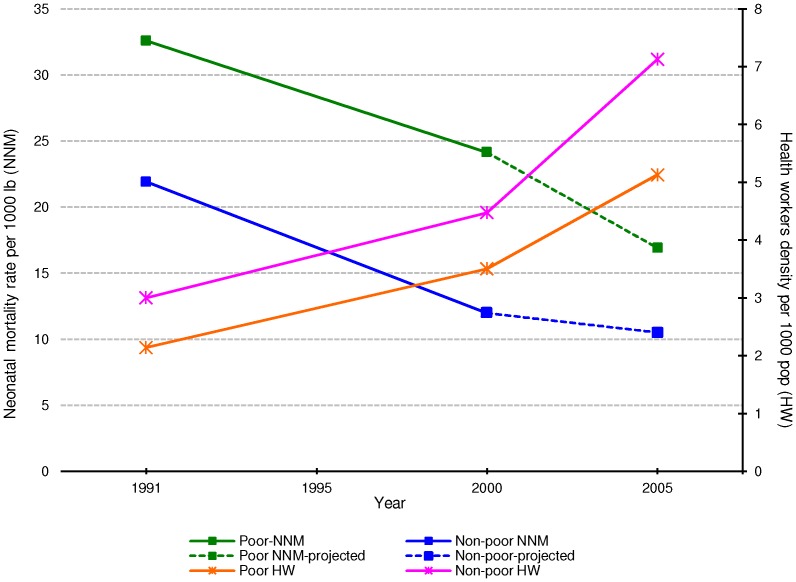
Introduction: Progress towards the MDG targets on maternal and child mortality is hindered worldwide by large differentials between poor and rich populations. Using the case of Brazil, we investigate the extent to which policies and interventions seeking to increase the accessibility of health services among the poor have been effective in decreasing neonatal mortality.
Methods: With a panel data set for the 4,267 Minimum Comparable Areas (MCA) in Brazil in 1991 and 2000, we use a fixed effect regression model to evaluate the effect of the provision of physicians, nurse professionals, nurse associates and community health workers on neonatal mortality for poor and non-poor areas. We additionally forecasted the neonatal mortality rate in 2005.
Results: We find that the provision of health workers is particularly important for neonatal mortality in poor areas. Physicians and especially nurse professionals have been essential in decreasing neonatal mortality: an increase of one nurse professional per 1000 population is associated with a 3.8% reduction in neonatal mortality while an increase of one physician per 1000 population is associated with a 2.3% reduction in neonatal mortality. We also find that nurse associates are less important for neonatal mortality (estimated reduction effect of 1.2% ) and that community health workers are not important particularly among the poor. Differences in the provision of health workers explain a large proportion of neonatal mortality.
Discussion: In this paper, we show new evidence to inform decision making on maternal and newborn health. Reductions in neonatal mortality in Brazil have been hampered by the unequal distribution of health workers between poor and non-poor areas. Thus, special attention to a more equitable health system is required to allocate the resources in order to improve the health of poor and ensure equitable access to health services to the entire population.
Conflict of interest statement
Figures
References
-
- World Health Organization, UNICEF (2012) Countdown to 2015 maternal, newborn and child survival:Building a Future for Women and Children. Geneva, Switzerland: World Health Organization and UNICEF.
-
- Bryce J, Daelmans B, Dwivedi A, Fauveau V, Lawn JE, et al.. (2008) Countdown to 2015 for maternal, newborn, and child survival: the 2008 report on tracking coverage of interventions. Lancet 371: 1247–1258 available from: ISI:000254878900026. - PubMed
-
- Boerma JT, Bryce J, Kinfu Y, Axelson H, Victora CG (2008) Mind the gap: equity and trends in coverage of maternal, newborn, and child health services in 54 Countdown countries. Lancet 371: 1259–1267 available from: ISI:000254878900027. - PubMed
-
- World Health Organization (2006) The World Health Report - Working Together for Health. Geneva, Switzerland: World Health Organization.
-
- Anand S. (2010) Measuring health workforce inequalities: methods and application to China and India. Human Resources for Health Observer [No. 5]. 2010. Geneva, Switzerland: Department of Human Resources for Health, World Health Organization.
Publication types
MeSH terms
LinkOut - more resources
Full Text Sources
Other Literature Sources
