Comparative Study
. 2013 Sep 20;8(9):e75091.
doi: 10.1371/journal.pone.0075091. eCollection 2013.

Increased neurofilament light chain blood levels in neurodegenerative neurological diseases

Affiliations
Comparative Study

Increased neurofilament light chain blood levels in neurodegenerative neurological diseases

Johanna Gaiottino et al. PLoS One. .

Abstract

Objective: Neuronal damage is the morphological substrate of persisting neurological disability. Neurofilaments (Nf) are cytoskeletal proteins of neurons and their release into cerebrospinal fluid has shown encouraging results as a biomarker for neurodegeneration. This study aimed to validate the quantification of the Nf light chain (NfL) in blood samples, as a biofluid source easily accessible for longitudinal studies.

Methods: We developed and applied a highly sensitive electrochemiluminescence (ECL) based immunoassay for quantification of NfL in blood and CSF.

Results: Patients with Alzheimer's disease (AD) (30.8 pg/ml, n=20), Guillain-Barré-syndrome (GBS) (79.4 pg/ml, n=19) or amyotrophic lateral sclerosis (ALS) (95.4 pg/ml, n=46) had higher serum NfL values than a control group of neurological patients without evidence of structural CNS damage (control patients, CP) (4.4 pg/ml, n=68, p<0.0001 for each comparison, p=0.002 for AD patients) and healthy controls (HC) (3.3 pg/ml, n=67, p<0.0001). Similar differences were seen in corresponding CSF samples. CSF and serum levels correlated in AD (r=0.48, p=0.033), GBS (r=0.79, p<0.0001) and ALS (r=0.70, p<0.0001), but not in CP (r=0.11, p=0.3739). The sensitivity and specificity of serum NfL for separating ALS from healthy controls was 91.3% and 91.0%.

Conclusions: We developed and validated a novel ECL based sandwich immunoassay for the NfL protein in serum (NfL(Umea47:3)); levels in ALS were more than 20-fold higher than in controls. Our data supports further longitudinal studies of serum NfL in neurodegenerative diseases as a potential biomarker of on-going disease progression, and as a potential surrogate to quantify effects of neuroprotective drugs in clinical trials.


Conflict of interest statement

Competing Interests: J. Gaiottino reports no disclosures; N. Norgren is employed by UmanDiagnostics AB, Sweden; R. Dobson, J. Topping, A. Nissim, A. Malsapina, J.P. Bestwick, A.U. Monsch, A. Regeniter report no disclosures; R.L. Lindberg has received research support from the Swiss MS Society, Swiss National Science Foundation, European FP6 and IMI JU programs, Roche Postdoc Fellowship Program (RPF-program), unrestricted research grants from Novartis and Biogen. L. Kappos reports, the University Hospital Basel as employer of Dr. Kappos has received and dedicated to research support fees for board membership, consultancy or speaking, or grants, in the last 3 years from Actelion, Advancell, Allozyne, Bayer, Bayhill, Biogen Idec, BioMarin, CSL Behring, Eli Lilly, European Union, GeNeuro, Genmab, Gianni Rubatto Foundation, Glenmark, Merck Serono, MediciNova, Mitsubishi Pharma, Novartis, Novartis Research Foundation, Novonordisk, Peptimmune, Roche, Roche Research Foundation, Sanofi-Aventis, Santhera, Swiss MS Society, Swiss National Research Foundation, Teva, UCB, and Wyeth. D. Leppert is an employee of F. Hoffmann-La Roche Ltd. A. Petzold reports no disclosure. G. Giovannoni has received research grant support from Bayer–Schering Healthcare, Biogen–Idec, GW Pharma, Merck Serono, Merz, Novartis, Teva and Sanofi–Aventis. He has received personal compensation for participating on Advisory Boards in relation to clinical trial design, trial steering committees and data and safety monitoring committees from: Bayer–Schering Healthcare, Biogen–Idec, Eisai, Elan, Fiveprime, Genzyme, Genentech, GSK, Ironwood, Merck–Serono, Novartis, Pfizer, Roche, Sanofi–Aventis, Synthon BV, Teva, UCB Pharma and Vertex Pharmaceuticals. J. Kuhle has received research support from the Swiss MS Society, Swiss ALS Society, Protagen AG, Roche and Novartis and served in scientific advisory boards for Genzyme/Sanofi-Aventis, Merck Serono and Novartis Pharma. His work is supported by an ECTRIMS Research Fellowship Programme and by the “Forschungsfonds” of the University of Basel, Switzerland. This does not alter the authors' adherence to all the PLOS ONE policies on sharing data and materials.

Figures

Figure 1
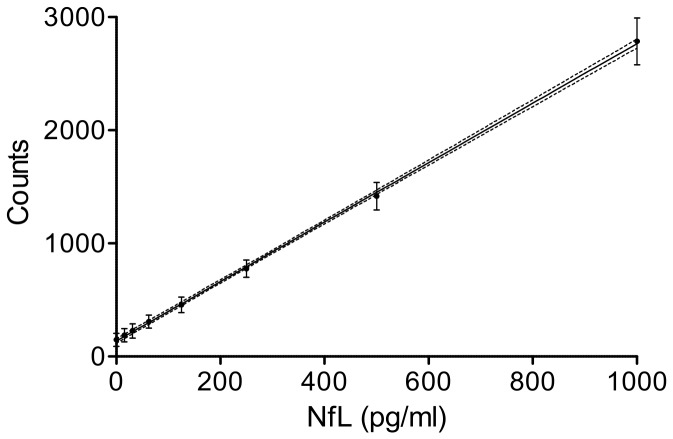
Figure 1. Reproducibility of the standard curve.
Reproducibility of 20 consecutive standard curves. The graph shows the mean counts (dots) ± SD (bars), linear regression line and 5% and 95% confidence interval curves (broken lines) (R2=0.99).
Figure 2
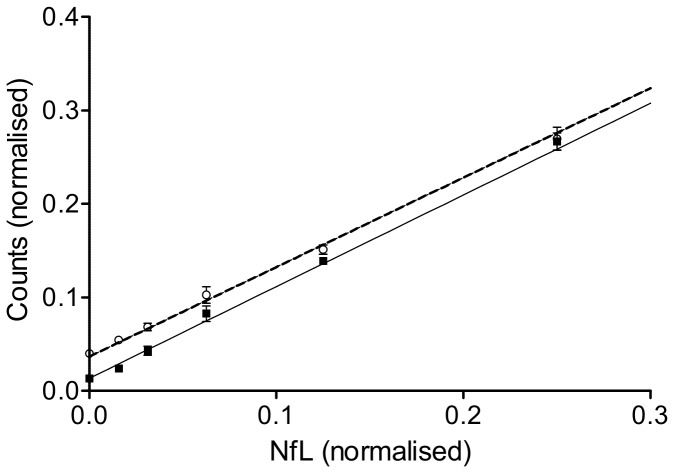
Figure 2. Parallelism between standards and serum dilutions.
Parallelism for NfL between standards (open line, open dots) and serum (closed line, black squares). The linear regression lines, mean (open dots or black squares) and ±SD are shown.
Figure 3
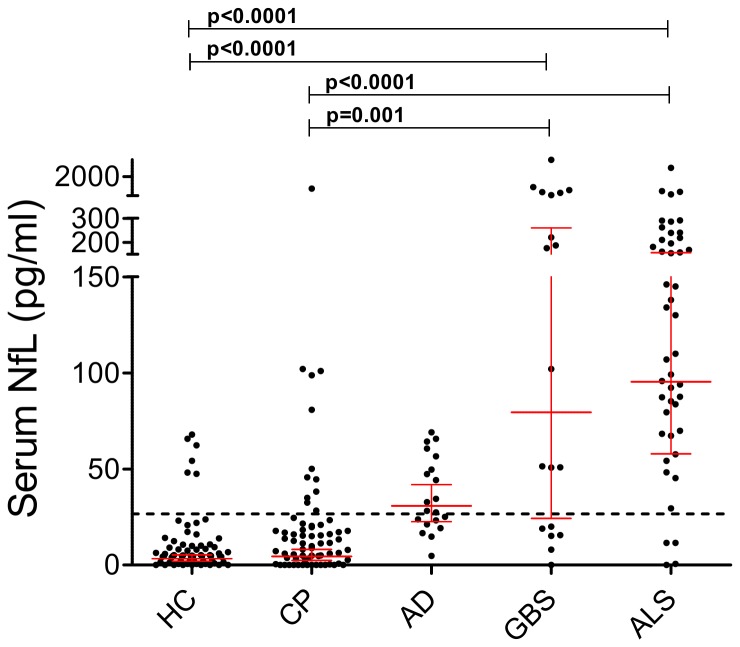
Figure 3. Serum NfL levels in the two reference groups (healthy controls, HC and control patients, CP) and neurological disease groups.
Patients with a Guillain-Barré syndrome (GBS) (79.4 pg/ml) or Amyotrophic lateral sclerosis (ALS) (95.4 pg/ml) had higher values compared with HC (3.3 pg/ml; p<0.0001, respectively) and CP (4.4 pg/ml, p<0.0001 and p=0.001). Significances for comparisons between patients with Alzheimer’s disease (AD) and HC (p<0.0001) and AD and CP (p=0.002) were lost after age corrections. The horizontal dotted line represents the upper reference range (cut-off value) of 26.6 pg/ml. Geometric mean and 95% CI are displayed. Dots represent individual samples. P-values are adjusted for age and corrected by Bonferroni method.
Figure 4
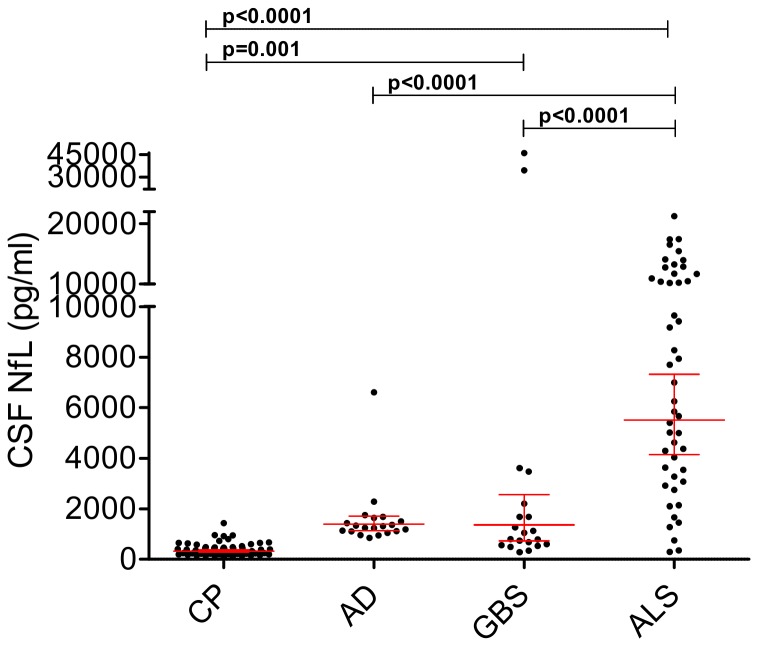
Figure 4. CSF NfL levels in the reference group (control patients, CP) and neurological disease cohorts.
Patients with Amyotrophic lateral sclerosis (ALS) (5513 pg/ml) or a Guillain-Barré syndrome (GBS) (1361 pg/ml) had higher levels than CP (324 pg/ml, p<0.0001 and p=0.001). In addition ALS had higher levels than patients with Alzheimer’s disease (AD) (1361 pg/ml) and GBS (p<0.0001, respectively). Geometric mean and 95% CI are displayed. Dots represent individual samples. P-values are adjusted for age and corrected by Bonferroni method.
Figure 5
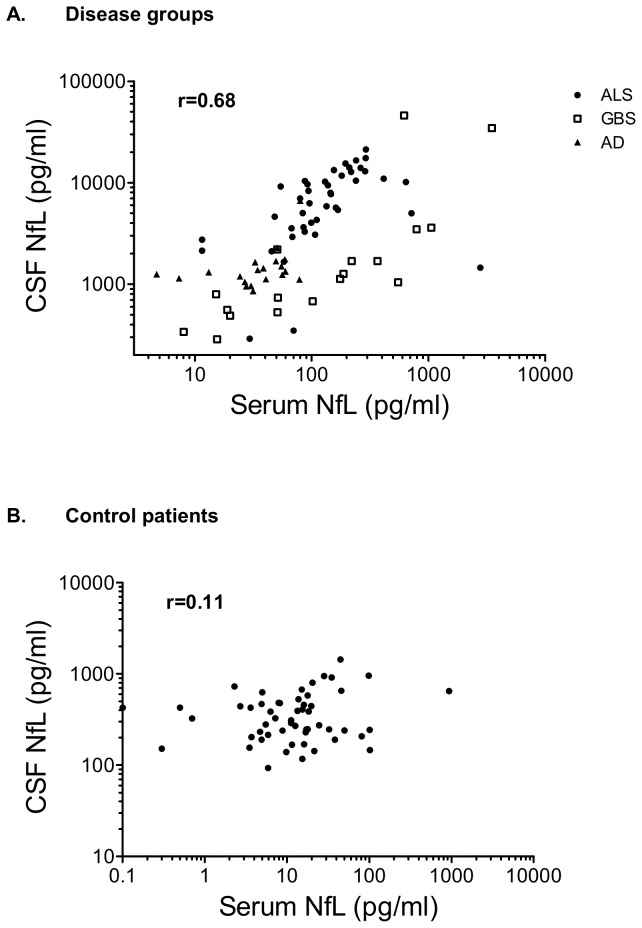
Figure 5. Correlation of serum and CSF NfL measurements.
Serum and CSF measurements of NfL correlated in the disease groups (A): Alzheimer’s disease (AD) (r=0.48, p=0.033), Guillain-Barré syndrome (GBS) (r=0.79, p<0.0001) and Amyotrophic lateral sclerosis (ALS) (r=0.70, p<0.0001): overall: r=0.68, p<0.001. Conversely this was not seen in the control patients (CP) (r=0.11, p=0.3739) (B).

References

    1. Petzold A (2005) Neurofilament phosphoforms: surrogate markers for axonal injury, degeneration and loss. J Neurol Sci 233: 183-198. doi:10.1016/j.jns.2005.03.015. PubMed: 15896809. - DOI - PubMed
    1. Brettschneider J, Petzold A, Junker A, Tumani H (2006) Axonal damage markers in the cerebrospinal fluid of patients with clinically isolated syndrome improve predicting conversion to definite multiple sclerosis. Mult Scler 12: 143-148. doi:10.1191/135248506ms1263oa. PubMed: 16629417. - DOI - PubMed
    1. Deisenhammer F, Egg R, Giovannoni G, Hemmer B, Petzold A et al. (2009) EFNS guidelines on disease-specific CSF investigations. Eur J Neurol 16: 760-770. doi:10.1111/j.1468-1331.2009.02595.x. PubMed: 19475759. - DOI - PubMed
    1. Giovannoni G (2010) Cerebrospinal fluid neurofilament: the biomarker that will resuscitate the 'Spinal Tap'. Mult Scler 16: 285-286. 16/3/285 [PII]; doi:10.1177/1352458510361358 - DOI - PubMed
    1. Gunnarsson M, Malmeström C, Axelsson M, Sundström P, Dahle C et al. (2011) Axonal damage in relapsing multiple sclerosis is markedly reduced by natalizumab. Ann Neurol 69: 83-89. doi:10.1002/ana.22247. PubMed: 21280078. - DOI - PubMed

Publication types

MeSH terms