. 2013 Sep 20;8(9):e75875.
doi: 10.1371/journal.pone.0075875. eCollection 2013.

Molecular expression and pharmacological evidence for a functional role of kv7 channel subtypes in Guinea pig urinary bladder smooth muscle

Affiliations

Molecular expression and pharmacological evidence for a functional role of kv7 channel subtypes in Guinea pig urinary bladder smooth muscle

Serge A Y Afeli et al. PLoS One. .

Abstract

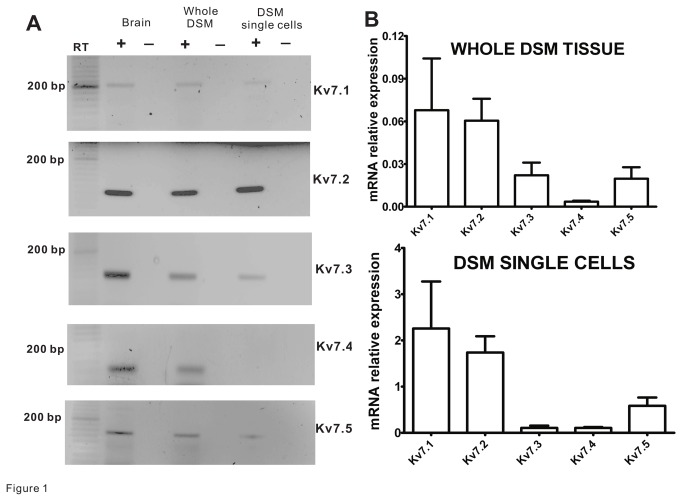
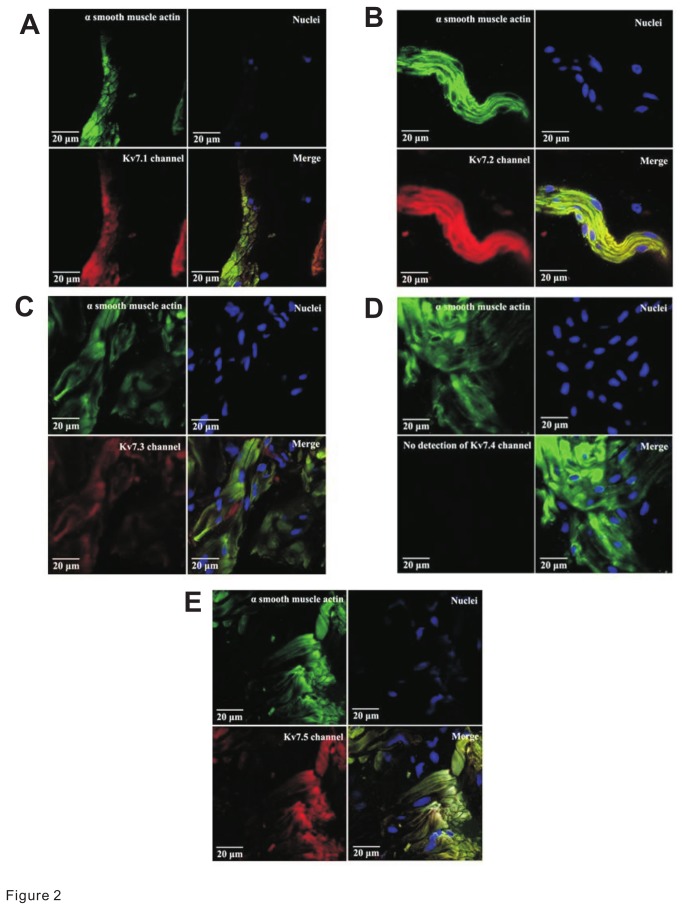
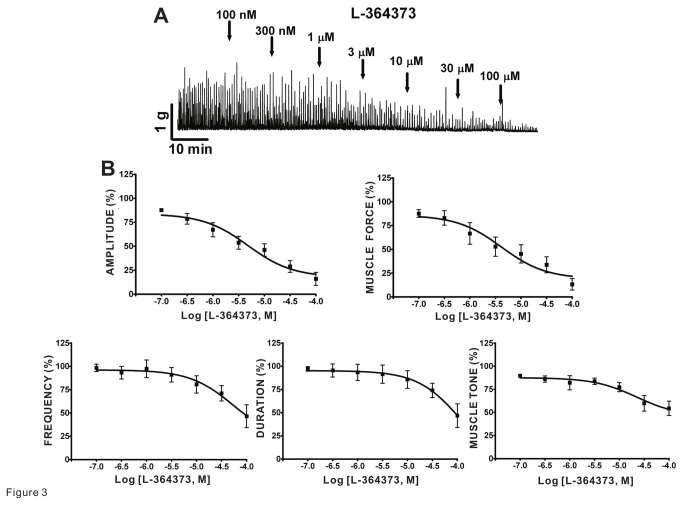
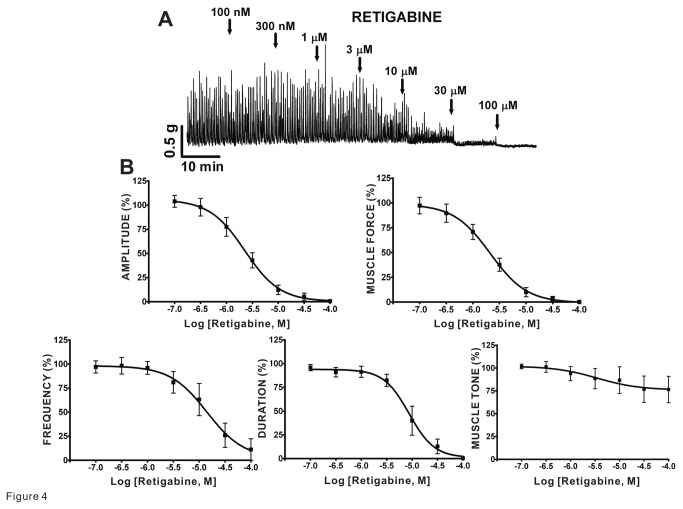
Voltage-gated Kv7 (KCNQ) channels are emerging as essential regulators of smooth muscle excitability and contractility. However, their physiological role in detrusor smooth muscle (DSM) remains to be elucidated. Here, we explored the molecular expression and function of Kv7 channel subtypes in guinea pig DSM by RT-PCR, qRT-PCR, immunohistochemistry, electrophysiology, and isometric tension recordings. In whole DSM tissue, mRNAs for all Kv7 channel subtypes were detected in a rank order: Kv7.1~Kv7.2Kv7.3~Kv7.5Kv7.4. In contrast, freshly-isolated DSM cells showed mRNA expression of: Kv7.1~Kv7.2Kv7.5Kv7.3~Kv7.4. Immunohistochemical confocal microscopy analyses of DSM, conducted by using co-labeling of Kv7 channel subtype-specific antibodies and α-smooth muscle actin, detected protein expression for all Kv7 channel subtypes, except for the Kv7.4, in DSM cells. L-364373 (R-L3), a Kv7.1 channel activator, and retigabine, a Kv7.2-7.5 channel activator, inhibited spontaneous phasic contractions and the 10-Hz electrical field stimulation (EFS)-induced contractions of DSM isolated strips. Linopiridine and XE991, two pan-Kv7 (effective at Kv7.1-Kv7.5 subtypes) channel inhibitors, had opposite effects increasing DSM spontaneous phasic and 10 Hz EFS-induced contractions. EFS-induced DSM contractions generated by a wide range of stimulation frequencies were decreased by L-364373 (10 µM) or retigabine (10 µM), and increased by XE991 (10 µM). Retigabine (10 µM) induced hyperpolarization and inhibited spontaneous action potentials in freshly-isolated DSM cells. In summary, Kv7 channel subtypes are expressed at mRNA and protein levels in guinea pig DSM cells. Their pharmacological modulation can control DSM contractility and excitability; therefore, Kv7 channel subtypes provide potential novel therapeutic targets for urinary bladder dysfunction.


Conflict of interest statement

Competing Interests: The authors have declared that no competing interests exist.

Figures

Figure 1
Figure 1. Kv7 channel subtype mRNA expression in guinea pig DSM whole tissue and single-cells.
A) Gel electrophoresis images illustrate RT-PCR detection of all Kv7 channel subtypes including Kv7.1, Kv7.2, Kv7.3, Kv7.4, and Kv7.5 channel mRNA messages in mucosa-free whole DSM tissue (N=4). At DSM single-cell level, unlike other Kv7 channel subtypes (Kv7.1, Kv7.2, Kv7.3, and Kv7.5), the Kv7.4 channel mRNA message was not detected. Guinea pig brain was used as a positive control. No product was observed in the negative controls (-RT) in which reverse transcriptase was not added to the reaction. B) qRT-PCR analysis shows relatively high expression of Kv7.1, Kv7.2, and Kv7.5 subtypes but low (barely detectible) levels of Kv7.4 channel mRNA in both DSM whole tissue (N=4) and DSM single cells (N=4). Data were normalized to GAPDH using the ΔCt method.
Figure 2
Figure 2. Protein expression of Kv7 channel subtypes in guinea pig DSM.
Confocal images illustrate the staining for Kv7.1 (A), Kv7.2 (B), Kv7.3 (C), Kv7.4 (D), and Kv7.5 (E) channel subtype proteins in mucosa-free whole DSM tissue. Kv7 channel subtype proteins were detected by immunohistochemistry using subtype-specific antibodies. In all panels, α-smooth muscle actin is shown in green; cell nuclei are illustrated in blue; the specific Kv7 channel subtype protein expression is represented by red staining. The merged images of α-smooth muscle actin, nuclei, and the Kv7 channel protein expression are illustrated in the quadrant labeled “Merge”. Images were captured with a Carl Zeiss LSM 700 META confocal microscope (63x objective). Experiments were conducted on DSM tissue samples isolated from 3 different guinea pigs.
Figure 3
Figure 3. Kv7.1 channel activator L-364373 inhibited spontaneous phasic contractions in guinea pig DSM isolated strips.
A) This original DSM tension recording illustrates L-364373 inhibitory effect on spontaneous phasic contractions of DSM isolated strips in a concentration-dependent manner. B) Cumulative concentration-response curves for L-364373 show significant reduction in DSM spontaneous phasic contraction amplitude, muscle force, frequency, duration, and muscle tone (n=7, N=4); see Table 1 for potency and maximum efficacy values. TTX (1 µM) was present throughout the experiments.
Figure 4
Figure 4. Kv7.2-Kv7.5 channel opener retigabine decreased spontaneous phasic contractions in guinea pig DSM isolated strips.
A) This original DSM tension recording illustrates retigabine inhibitory effects on spontaneous phasic contractions of DSM isolated strips in a concentration-dependent manner. B) Cumulative concentration-response curves for retigabine summarize reduction in DSM spontaneous phasic contraction amplitude, muscle force, frequency, and duration (n=7, N=6); see Table 1 for potency and maximum efficacy values. TTX (1 µM) was present throughout the experiments.
Figure 5
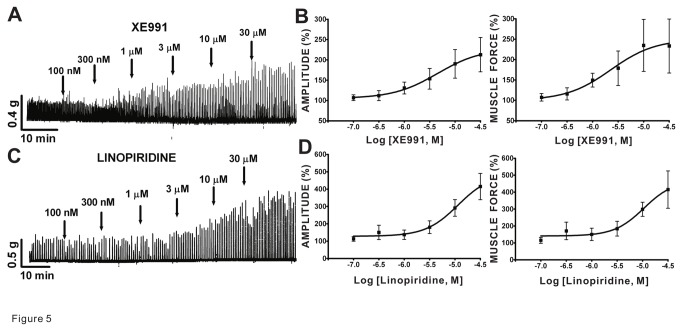
Figure 5. Kv7.1-Kv7.5 inhibitors, XE991 and linopiridine, increased spontaneous phasic contractions in guinea pig DSM isolated strips.
A) This original DSM tension recording illustrates that XE991 enhances spontaneous phasic contractions in isolated DSM strips in a concentration-dependent manner. B) Cumulative concentration-response curves for XE991 show increases in DSM spontaneous phasic contractions amplitude and muscle force (n=8, N=5). C) This original DSM tension recording exemplifies that linopiridine increases DSM spontaneous phasic contractions in a concentration-dependent manner. D) Cumulative concentration-response curves for linopiridine depict increases in DSM spontaneous phasic contractions amplitude and muscle force (n=7, N=5). Table 1 provides a summary of potency and maximum efficacy values. TTX (1 µM) was present throughout the experiments.
Figure 6
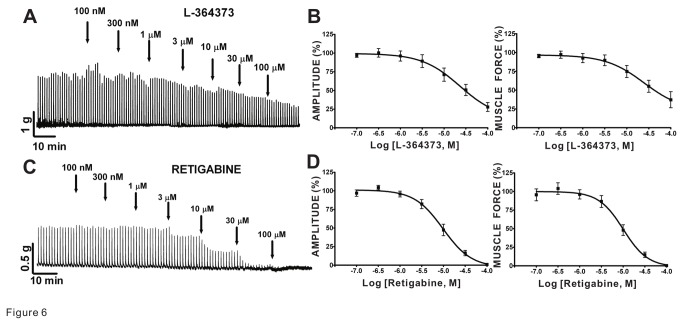
Figure 6. Kv7 channel activators, L-364373 and retigabine, induced inhibition of the 10 Hz EFS-evoked contractions in guinea pig DSM isolated strips.
A) This original DSM tension recording illustrates L-364373 inhibitory effects on DSM 10 Hz EFS-induced contractions. B) Cumulative concentration-response curves for L-364373 summarize inhibitory effects on the amplitude and muscle force of EFS-induced contractions (n=6, N=4). C) This original DSM tension recording depicts an effect of retigabine on contractions induced by EFS (10 Hz). D) Cumulative concentration-response curves for retigabine demonstrate reduction of 10 Hz EFS-induced DSM contraction amplitude and muscle force (n=9, N=8). Table 2 summarizes the potency and maximum efficacy values.
Figure 7
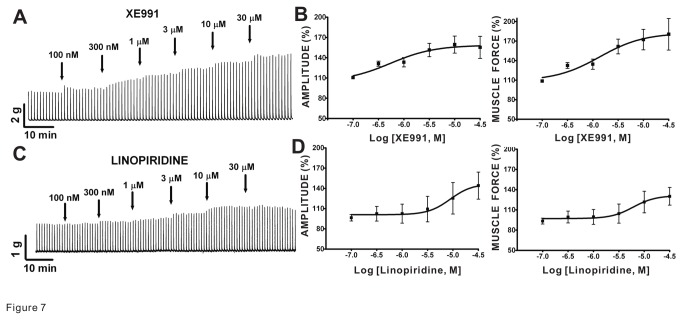
Figure 7. Kv7 inhibitors, XE991 and linopiridine, enhanced the 10 Hz EFS-induced contractions in guinea pig DSM isolated strips.
A) This original DSM tension recording illustrates that XE991 increased 10 Hz EFS-induced contractions. B) Cumulative concentration-response curves for XE991 show potentiation of amplitude and muscle force (n=9, N=7). C) This original DSM tension recording for linopridine (100 nM–30 µM) illustrates an increase in 10 Hz EFS-induced contractions. D) Cumulative concentration-response curves for linopiridine show inhibition of EFS-induced contraction amplitude and muscle force (n=6, N=5); see Table 2 for the potency and maximum efficacy values.
Figure 8
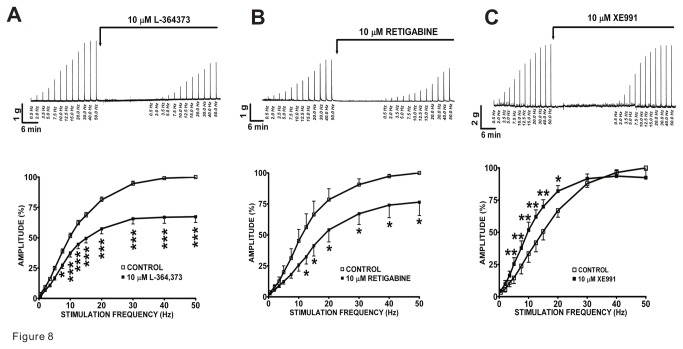
Figure 8. Effect of Kv7 channel modulators on the 0.5–50 Hz EFS-induced contractions in guinea pig DSM isolated strips.
A-B) The original DSM tension recordings and frequency-response curves illustrate the inhibitory effects of L-364373 (n=7, N=4) and retigabine (n=6, N=4) on the 0.5–50 Hz EFS-induced contraction amplitude. C) The original DSM tension recording and frequency-response curves reveal that XE991 enhanced the 0.5-20 Hz EFS-induced contraction amplitude (n=8, N=5). The maximal EFS-induced contraction amplitude at a stimulation frequency of 50 Hz under control conditions was taken to be 100%; *P<0.05, **P<0.01, ***P<0.005 versus control.
Figure 9
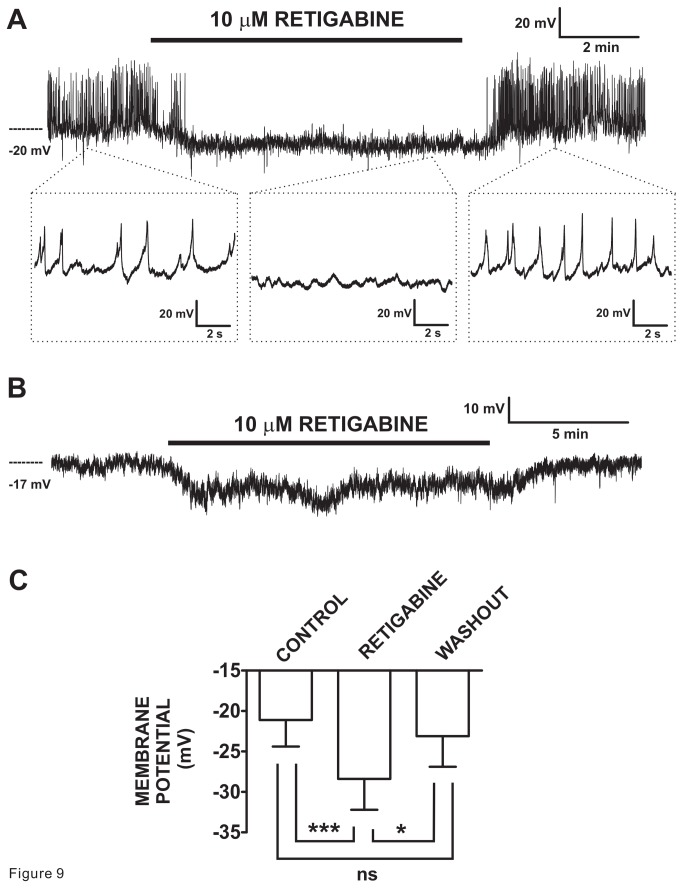
Figure 9. Kv7.2-7.5 channel activator retigabine induced hyperpolarization and inhibition of spontaneous action potentials in freshly-isolated guinea pig DSM cells.
A) The original current-clamp membrane potential recording illustrates spontaneous action potentials exhibited by a DSM cell. Retigabine (10 µM) inhibited these spontaneous action potentials and caused membrane hyperpolarization. Upon washout, the electrical activity fully recovered. The insets in (A) depict the electrical activity on an expanded time scale for the time points indicated allowing for visualization of the action potentials. B) The original membrane potential recording from a DSM cell lacking spontaneous action potentials. Retigabine (10 µM) induced hyperpolarization and upon its washout membrane potential recovered. C) Summary data show statistically significant hyperpolarization of DSM cells by retigabine (10 µM) (n=12, N=11) and the recovery upon its washout (n=8, N=7). The bars depict actual mean membrane potential and SEM values for each condition. The indicated comparisons indicate statistical significance of ***P<0.001 and *<0.05 for the specified conditions, ns = non-significant (P>0.05).

References

    1. Petkov GV (2012) Role of potassium ion channels in detrusor smooth muscle function and dysfunction. Nat Rev Urol 9: 30-40. - PMC - PubMed
    1. Brueggemann LI, Kakad PP, Love RB, Solway J, Dowell ML et al. (2012) Kv7 potassium channels in airway smooth muscle cells: signal transduction intermediates and pharmacological targets for bronchodilator therapy. Am J Physiol Lung Cell Mol Physiol 302: L120-L132. doi:10.1152/ajplung.00194.2011. PubMed: 21964407. - DOI - PMC - PubMed
    1. Zhong XZ, Harhun MI, Olesen SP, Ohya S, Moffatt JD et al. (2010) Participation of KCNQ (Kv7) potassium channels in myogenic control of cerebral arterial diameter. J Physiol 588: 3277-3293. doi:10.1113/jphysiol.2010.192823. PubMed: 20624791. - DOI - PMC - PubMed
    1. McCallum LA, Pierce SL, England SK, Greenwood IA, Tribe RM (2011) The contribution of Kv7 channels to pregnant mouse and human myometrial contractility. J Cell Mol Med 15: 577-586. doi:10.1111/j.1582-4934.2010.01021.x. PubMed: 20132415. - DOI - PMC - PubMed
    1. Ng FL, Davis AJ, Jepps TA, Harhun MI, Yeung SY et al. (2011) Expression and function of the K+ channel KCNQ genes in human arteries. Br J Pharmacol 162: 42-53. doi:10.1111/j.1476-5381.2010.01027.x. PubMed: 20840535. - DOI - PMC - PubMed

Publication types

MeSH terms

LinkOut - more resources