


Contextualising complementary feeding in a broader framework for stunting prevention
- PMID: 24074316
- PMCID: PMC6860787
- DOI: 10.1111/mcn.12088
Contextualising complementary feeding in a broader framework for stunting prevention
Abstract
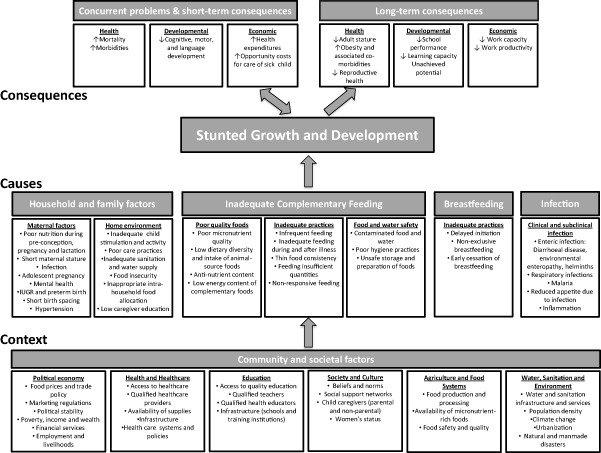
An estimated 165 million children are stunted due to the combined effects of poor nutrition, repeated infection and inadequate psychosocial stimulation. The complementary feeding period, generally corresponding to age 6-24 months, represents an important period of sensitivity to stunting with lifelong, possibly irrevocable consequences. Interventions to improve complementary feeding practices or the nutritional quality of complementary foods must take into consideration the contextual as well as proximal determinants of stunting. This review presents a conceptual framework that highlights the role of complementary feeding within the layers of contextual and causal factors that lead to stunted growth and development and the resulting short- and long-term consequences. Contextual factors are organized into the following groups: political economy; health and health care systems; education; society and culture; agriculture and food systems; and water, sanitation and environment. We argue that these community and societal conditions underlie infant and young child feeding practices, which are a central pillar to healthy growth and development, and can serve to either impede or enable progress. Effectiveness studies with a strong process evaluation component are needed to identify transdisciplinary solutions. Programme and policy interventions aimed at preventing stunting should be informed by careful assessment of these factors at all levels.
Keywords: World Health Organization; complementary feeding; conceptual framework; healthy growth and development; stunting, transdisciplinary approaches.
© 2013 John Wiley & Sons Ltd.
Conflict of interest statement
The authors declare that they have no conflicts of interest.
Figures
References
-
- Aboud F.E. & Akhter S. (2011) A cluster‐randomized evaluation of a responsive stimulation and feeding intervention in Bangladesh. Pediatrics 127, e1191–e1197. - PubMed
-
- Abubakar A., Holding P., Van De Vijver F.J., Newton C. & Van Baar A. (2010) Children at risk for developmental delay can be recognised by stunting, being underweight, ill health, little maternal schooling or high gravidity. Journal of Child Psychology and Psychiatry, and Allied Disciplines 51, 652–659. - PMC - PubMed
-
- Adair L.S. & Guilkey D.K. (1997) Age‐specific determinants of stunting in Filipino children. The Journal of Nutrition 127, 314–320. - PubMed
-
- Adair L.S., Fall C.H.D., Osmond C., Stein A.D., Martorell R., Ramirez‐Zea M. et al, for the COHORTS Group (2013) Associations of linear growth and relative weight gain during early life with adult health and human capital in countries of low and middle income: findings from five birth cohort studies. Lancet published online March 28. Available at: http://dx.doi.org/ 10.1016/S0140-6736(13)60103-8 (Accessed 8 August 2013). - DOI - PMC - PubMed
-
- Affleck W. & Pelto G. (2012) Caregivers’ responses to an intervention to improve young child feeding behaviors in rural Bangladesh: a mixed method study of facilitators and barriers to change. Social Science & Medicine 75 (4), 651–658. - PubMed
Publication types
MeSH terms
LinkOut - more resources
Full Text Sources
Other Literature Sources
Medical
