


Sensitization to food and inhalant allergens in relation to age and wheeze among children with atopic dermatitis
- PMID: 24074334
- PMCID: PMC3801418
- DOI: 10.1111/cea.12169
Sensitization to food and inhalant allergens in relation to age and wheeze among children with atopic dermatitis
Abstract
Background: Atopic dermatitis (AD) is common in children; however, persistence of AD with or without asthma is less common. Longitudinal studies remain limited in their ability to characterize how IgE antibody responses evolve in AD, and their relationship with asthma.
Objective: To use a cross-sectional study design of children with active AD to analyse age-related differences in IgE antibodies and relation to wheeze.
Methods: IgE antibodies to food and inhalant allergens were measured in children with active AD (5 months to 15 years of age, n = 66), with and without history of wheeze.
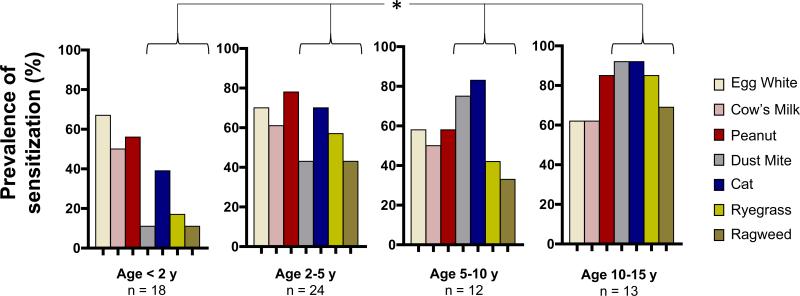
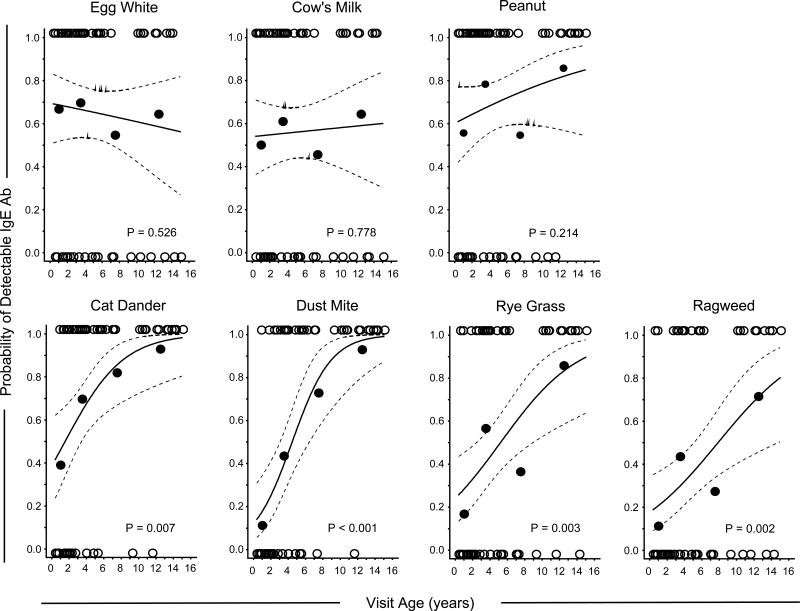
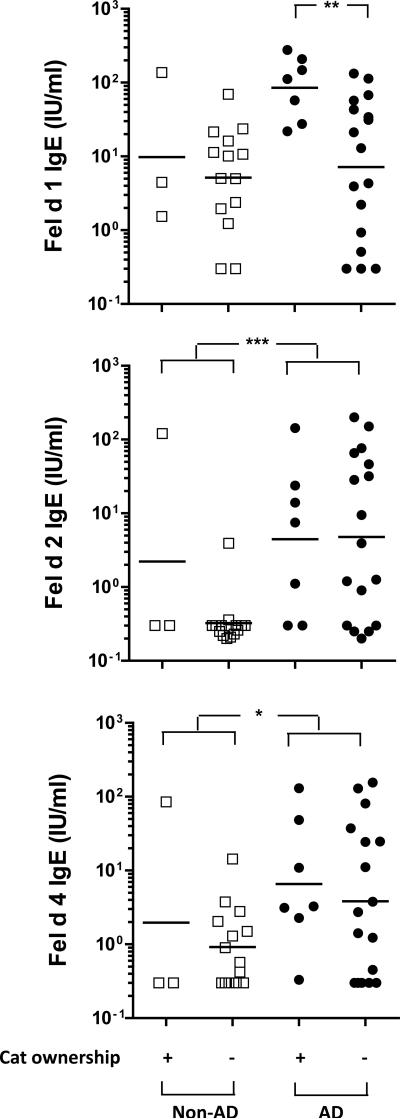
Results: Whereas IgE antibodies to foods persisted at a similar prevalence and titre throughout childhood, IgE antibodies to all aeroallergens rose sharply into adolescence. From birth, the chance of sensitization for any aeroallergen increased for each 12-month increment in age (OR ≥ 1.21, P < 0.01), with the largest effect observed for dust mite (OR = 1.56, P < 0.001). A steeper age-related rise in IgE antibody titre to dust mite, but no other allergen was associated with more severe disease. Despite this, sensitization to cat was more strongly associated with wheeze (OR = 4.5, P < 0.01), and linked to Fel d 1 and Fel d 4, but not Fel d 2. Comparison of cat allergic children with AD to those without, revealed higher IgE levels to Fel d 2 and Fel d 4 (P < 0.05), but not Fel d 1.
Conclusions and clinical relevance: Differences in sensitization to cat and dust mite among young children with AD may aid in identifying those at increased risk for disease progression and development of asthma. Early sensitization to cat and risk for wheeze among children with AD may be linked to an increased risk for sensitization to a broader spectrum of allergen components from early life. Collectively, our findings argue for early intervention strategies designed to mitigate skin inflammation in children with AD.
Keywords: IgE antibodies; aeroallergens; age; asthma; atopic dermatitis; cat; dust mite; food allergy; wheeze.
© 2013 John Wiley & Sons Ltd.
Figures


References
-
- Warner JO. A double-blinded, randomized, placebo-controlled trial of cetirizine in preventing the onset of asthma in children with atopic dermatitis: 18 months’ treatment and 18 months’ posttreatment follow-up. J Allergy Clin Immunol. 2001;108:929–37. - PubMed
-
- Spergel JM, Paller AS. Atopic dermatitis and the atopic march. J Allergy Clin Immunol. 2003;112:S118–27. - PubMed
-
- Boulay ME, Boulet LP. The relationships between atopy, rhinitis and asthma: pathophysiological considerations. Curr Opin Allergy Clin Immunol. 2003;3:51–5. - PubMed
-
- Gustafsson D, Sjoberg O, Foucard T. Development of allergies and asthma in infants and young children with atopic dermatitis--a prospective follow-up to 7 years of age. Allergy. 2000;55:240–5. - PubMed
Publication types
MeSH terms
Substances
Grants and funding
LinkOut - more resources
Full Text Sources
Other Literature Sources
Medical
Miscellaneous
