


Patterns of current use of tobacco products among U.S. high school students for 2000-2012--findings from the National Youth Tobacco Survey
- PMID: 24074604
- PMCID: PMC4534716
- DOI: 10.1016/j.jadohealth.2013.08.003
Patterns of current use of tobacco products among U.S. high school students for 2000-2012--findings from the National Youth Tobacco Survey
Abstract
Purpose: The purpose of this study was to assess patterns and trends of tobacco use among high school students to better understand which products are used individually or concurrently.
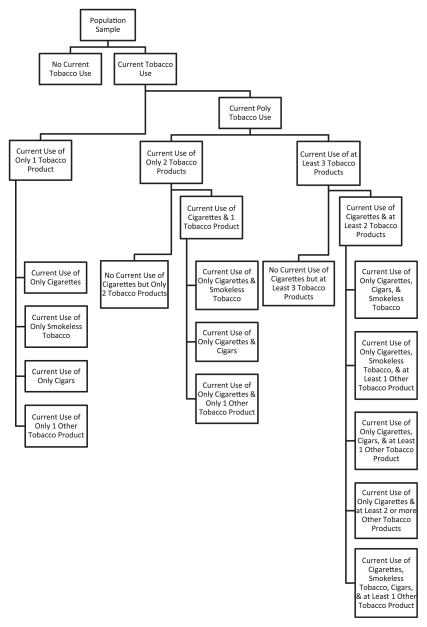
Methods: Data from the National Youth Tobacco Survey from 2000 through 2012 were used to assess patterns and trends of current tobacco use (cigarettes, cigars, smokeless tobacco, and other tobacco products) among U.S. high school students. We assessed use of products individually and concurrently.
Results: During 2000-2012, overall linear declines were observed in current use of any tobacco product from 33.6% to 20.4% (p < .05), current use of only 1 tobacco product, from 18.8% to 10.5% (p < .05), and current poly tobacco use, from 14.7% to 9.9% (p < .05), among high school students. Overall current use of only cigarettes had both a linear decline, from 14.0% to 4.7%, as well as a quadratic trend.
Conclusions: During 2000-2012, the most significant overall decline observed was for students who reported smoking only cigarettes. The results suggest that more data on the use of multiple tobacco products, not just cigarettes, is needed to guide tobacco prevention and control policies and programs.
Keywords: Current tobacco use; High school students; United States.
Published by Elsevier Inc.
Conflict of interest statement
Figures
References
-
- U.S. Department of Health and Human Services. The health consequences of smoking: A report of the Surgeon General. Atlanta, GA: Centers for Disease Control and Prevention; 2004. Available at: http://www.cdc.gov/tobacco/data_statistics/sgr/2004/index.htm.
-
- U.S. Department of Health and Human Services. Preventing tobacco use among youth and young adults: A report of the Surgeon General. Atlanta, GA: Centers for Disease Control and Prevention; 2012. Available at: http://www.cdc.gov/tobacco/data_statistics/sgr/2012/index.htm. - PubMed
-
- Centers for Disease Control and Prevention. Youth Risk Behavior Surveillance - United States, 2011. Morb Mortal Wkly Rep. 2012;61(SS-4) - PubMed
-
- Centers for Disease Control and Prevention. Cigarette use among high school students—United States, 1991–2009. Morb Mortal Wkly Rep. 2010;59:797–801. - PubMed
-
- Substance Abuse and Mental Health Services Administration. Results from the 2010 National Survey on Drug Use and Health: National findings. Rockville, MD: Office of Applied Studies; 2011. NSDUH Series: H-41. HHS publication no. SMA 11-4658. Available at: http://www.oas.samhsa.gov/nsduh/2k10nsduh/2k10Results.pdf.
MeSH terms
Grants and funding
LinkOut - more resources
Full Text Sources
Other Literature Sources
Medical
