


Psychometric properties of the adjective rating scale for withdrawal across treatment groups, gender, and over time
- PMID: 24074852
- PMCID: PMC3870009
- DOI: 10.1016/j.jsat.2013.08.020
Psychometric properties of the adjective rating scale for withdrawal across treatment groups, gender, and over time
Abstract
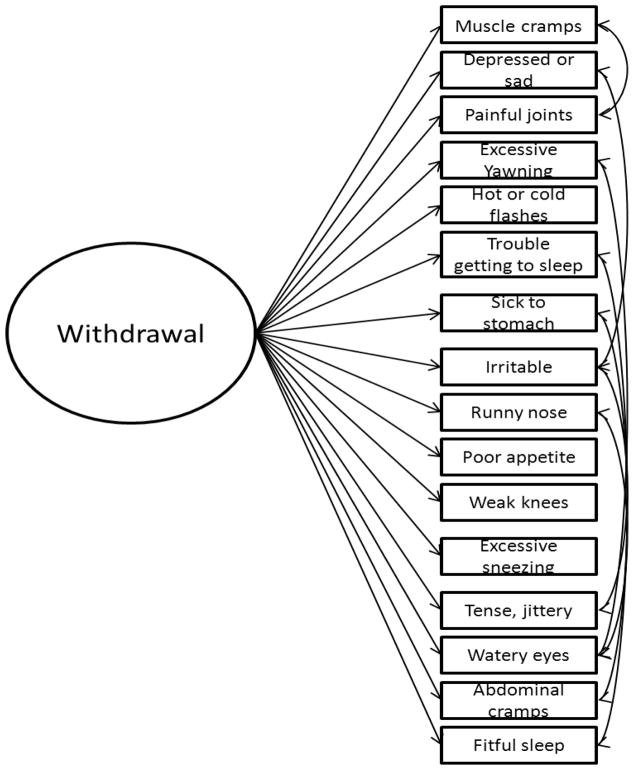
The adjective rating scale for withdrawal (ARSW) is commonly used to assess opiate withdrawal in clinical practice and research. The aims of this study were to examine the factor structure of the ARSW, test measurement invariance across gender and treatment groups, and assess longitudinal measurement invariance across the clinical trial. Secondary data analysis of the National Drug Abuse Treatment Clinical Trials Network 000-3, a randomized clinical trial comparing two tapering strategies, was performed. The ARSW was analyzed at baseline, end of taper and 1-month follow-up (N=515 opioid-dependent individuals). A 1-factor model of the ARSW fit the data and demonstrated acceptable reliability. Measurement invariance was supported across gender and taper groups. Longitudinal measurement invariance was not found across the course of the trial, with baseline assessment contributing to the lack of invariance. If change over time is of interest, change from post-treatment through follow-up may offer the most valid comparison.
Keywords: Measurement invariance; Opiate dependence; Opiate withdrawal; Psychometrics.
© 2013.
Figures
References
-
- Amass L, Kamien JB, Mikulich SK. Efficacy of daily and alternate-day dosing regimens with the combination buprenorphine-naloxone tablet. Drug and Alcohol Dependence. 2000;58:143–152. - PubMed
-
- Barbosa-Leiker C. Factor analysis applied to the metabolic syndrome: A review. In: Berhardt LV, editor. Advances in Medicine and Biology. Vol. 59. Hauppauge, NY: Nova Science Publishers, Inc; (in press)
-
- Barbosa-Leiker C, Wright BR, Burns GL, Parks CD, Strand P. Is the assessment of the metabolic syndrome stable over time? Testing longitudinal measurement invariance of the metabolic syndrome. Annals of Epidemiology. 2011;21:111–117. - PubMed
-
- Bickel WK, Stitzer ML, Bigelow GE, Liebson IA, Jasinski DR, Johnson RE. A clinical trial of buprenorphine: Comparison with methadone in the detoxification of heroin addicts. Clinical Pharmacology & Therapeutics. 1988a;43:72–78. - PubMed
Publication types
MeSH terms
Substances
Grants and funding
LinkOut - more resources
Full Text Sources
Other Literature Sources
Medical
