. 2013 Oct 16;80(2):494-506.
doi: 10.1016/j.neuron.2013.07.049. Epub 2013 Sep 26.

The basal ganglia is necessary for learning spectral, but not temporal, features of birdsong

Affiliations

The basal ganglia is necessary for learning spectral, but not temporal, features of birdsong

Farhan Ali et al. Neuron. .

Abstract

Executing a motor skill requires the brain to control which muscles to activate at what times. How these aspects of control-motor implementation and timing-are acquired, and whether the learning processes underlying them differ, is not well understood. To address this, we used a reinforcement learning paradigm to independently manipulate both spectral and temporal features of birdsong, a complex learned motor sequence, while recording and perturbing activity in underlying circuits. Our results uncovered a striking dissociation in how neural circuits underlie learning in the two domains. The basal ganglia was required for modifying spectral, but not temporal, structure. This functional dissociation extended to the descending motor pathway, where recordings from a premotor cortex analog nucleus reflected changes to temporal, but not spectral, structure. Our results reveal a strategy in which the nervous system employs different and largely independent circuits to learn distinct aspects of a motor skill.


Figures

Figure 1
Figure 1
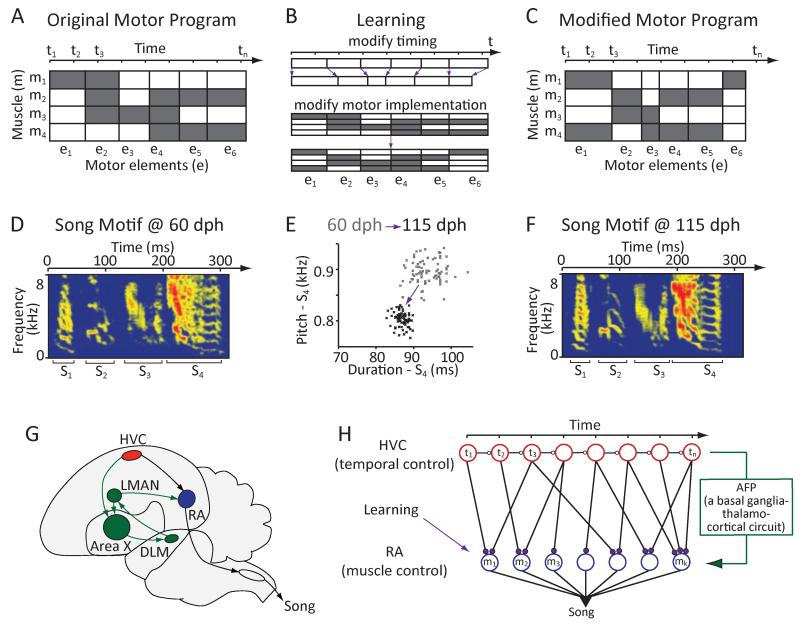
Using songbirds to test whether the nervous system distinguishes learning in the temporal and motor implementation domains. (A-C) Conceptual schematic that parses motor skill learning into separate processes for timing and motor implementation. (A) Muscle activity patterns underlying a hypothetical 6-element motor sequence. Each element is defined by its duration (timing) and the set of recruited muscles (motor implementation). Grey – muscle is ‘active’. (B) Learning can be conceptualized as the process of changing timing (e.g. duration; top) and motor implementation (e.g. which muscles are active; bottom) of the individual motor elements. (C) Modified motor program resulting from changes to both aspects. (D-F) Birdsong learning as an example of the process outlined in A-C. (D) Spectrogram of a juvenile zebra finch song. (E) Learning modifies both temporal and spectral (i.e. motor implementation) aspects of song, as exemplified by changes to the duration and pitch of syllable ‘S4’. Pitch and duration estimates for 80 consecutive renditions of the syllable recorded at 60 (grey) and 115 (black) days post hatch (dph) respectively; pitch calculated from the harmonic stack part of the syllable. (F) Spectrogram of a song from the bird in D at 115 dph. (G) Schematic of the song circuit underlying vocal learning and production. HVC and RA constitute the cortical part of the descending motor pathway. These motor regions are also indirectly connected through the Anterior Forebrain Pathway (AFP), a basal ganglia (Area X) - thalamo (DLM) - cortical (LMAN) circuit. H. Presumed functional organization of the motor pathway in which HVC represents time (t) in the form of a synaptic chain network and RA neurons control specific muscles or muscle groups (m). Learning in the motor pathway is thought to be driven by plasticity in RA, which is facilitated and guided by input from the AFP (Doya and Sejnowski, 1995; Fiete et al., 2004, 2007; Troyer and Doupe, 2000). Adapted from ref. (Fee et al., 2004).
Figure 2
Figure 2
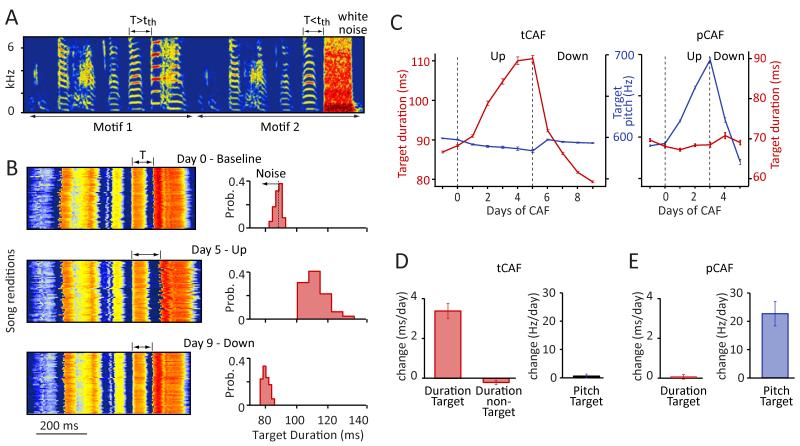
Independent modification of temporal and spectral song features using an aversive reinforcement learning paradigm. (A) Spectrogram of the song for the bird in B and C. The duration of the target segment (T) is measured on-line and aversive white noise presented contingent on its duration being above (to shorten) or below (to lengthen) a threshold (tth) (see Experimental Procedures). (B) Song power (red-high; blue-low) for 50 consecutive motifs aligned on target onset at baseline (top), and after driving the target duration up for 5 days (middle) and down for 4 days (bottom); (right) associated target duration distributions. (C) Learning trajectories for duration (tCAF) and pitch (pCAF) for the target (see panel A). For pCAF the target was the pitch of the syllable. (D-E) Summary statistics for changes in pitch and duration during tCAF (n=24 birds) (D) and pCAF (n=14 birds) (E). Duration values in C,D, and E refer to the targeted syllable for pCAF and the targeted segment (mostly ‘syllable + gap’ as in C) for tCAF. Error bars represent standard error of the mean here and in all subsequent figures.
Figure 3
Figure 3
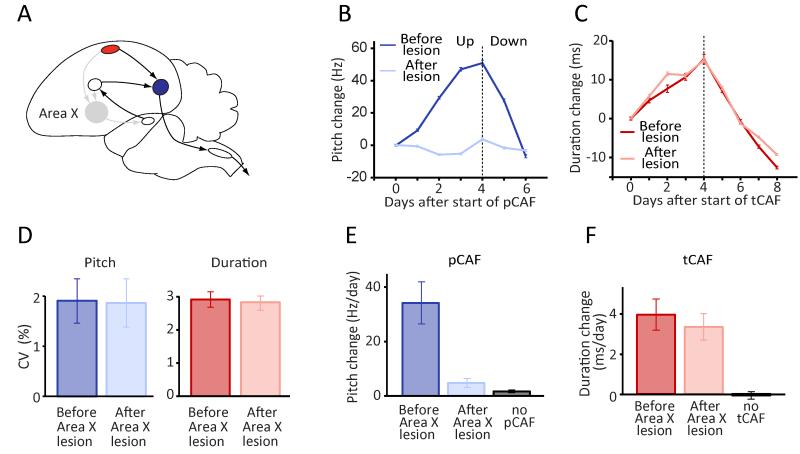
Area X lesions reveal a dissociation in how this basal ganglia structure contributes to adaptive modification of spectral and temporal song features. (A) Schematic of the song circuit following Area X lesions. Grey denotes disrupted pathways/circuits. (B) pCAF-induced changes to the pitch of a targeted syllable in an example bird before (blue) and after (light blue) bilateral Area X lesions. Pitch was driven up (first 4 days), then down (last 2 days). (C) tCAF-induced shifts in the duration of the target interval before (red) and after (light red) Area X lesions in the same bird as in panel B. (D) Variability in pitch and duration before and after Area X lesions. (E-F) Effects of Area X lesions on learning rates in pCAF (n=6 birds) (E) and tCAF (n=7 birds) (F).
Figure 4
Figure 4
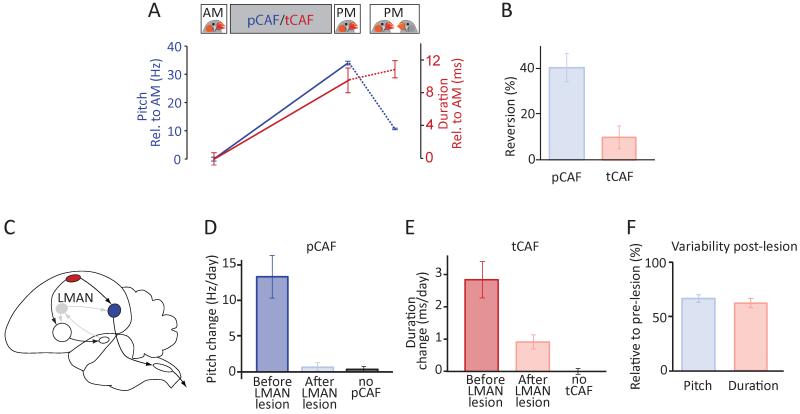
Distinct roles for LMAN in adaptive modification of temporal and spectral structure. (A) Female-directed singing, which reduces LMAN activity, caused a reversion in learned changes to pitch, but not interval duration. Example data from the same bird shows the average pitch and duration of the target before and after a day of pCAF (solid blue line) and tCAF (solid red line) respectively; last data point shows the corresponding values after presentation of a female (dashed lines). (B) Average reversion of the day’s learned changes upon presentation of a female bird (i.e. the directed singing-induced change in pitch or duration relative to the day’s total change; n=11 birds for pCAF, n=5 birds for tCAF). Duration values corrected for global tempo changes observed during directed singing (Stepanek and Doupe, 2010) (see Experimental Procedures). (C) Schematic of the song circuit following LMAN lesions. Grey denotes disrupted pathways/circuits. (D-E) Learning rates in pCAF (n=4 birds) (D) and tCAF (n=8 birds) (E) before and after LMAN lesions. (F) Effects of LMAN lesions on variability in pitch and interval duration.
Figure 5
Figure 5
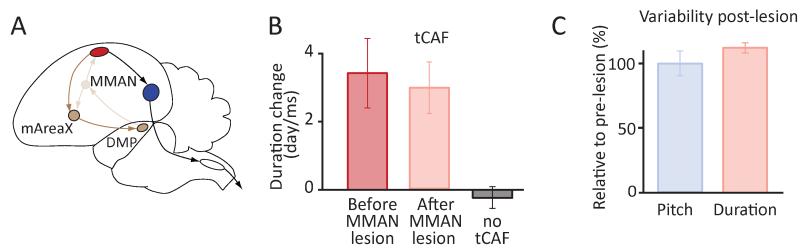
A basal ganglia-thalamo-cortical circuit parallel to the AFP with projections to HVC is not required for learning temporal structure. (A) Schematic outline of the basal ganglia loop originating from and projecting back to HVC (brown). mArea X is a basal ganglia region medial to Area X; DMP is the dorsomedial nucleus of the posterior thalamus; MMAN is the medial magnocellular nucleus of the anterior nidopallium. Faint lines denote pathways/circuit disrupted by lesions to MMAN. (B-C) Effect of MMAN lesions on learning rates in tCAF (B) and spectral and temporal variability of song (C) across 3 birds.
Figure 6
Figure 6
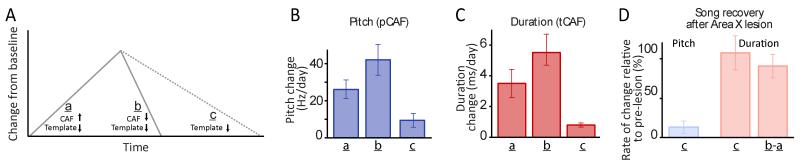
The dissociation in how Area X contributes to learning in the spectral and temporal domains extends to ‘normal’ CAF-free song recovery. (A) Schematic of how CAF and the normal song recovery process (‘template’) may contribute and interact during various forms of learning: a – CAF away from baseline; b – CAF towards baseline; c – spontaneous return to baseline. (B-C). Rate of change in pitch (B) and duration (C) for the scenarios in A. (D) Effect of Area X lesions on the spontaneous return to baseline for pitch and duration (n=3 and 4 birds respectively).
Figure 7
Figure 7
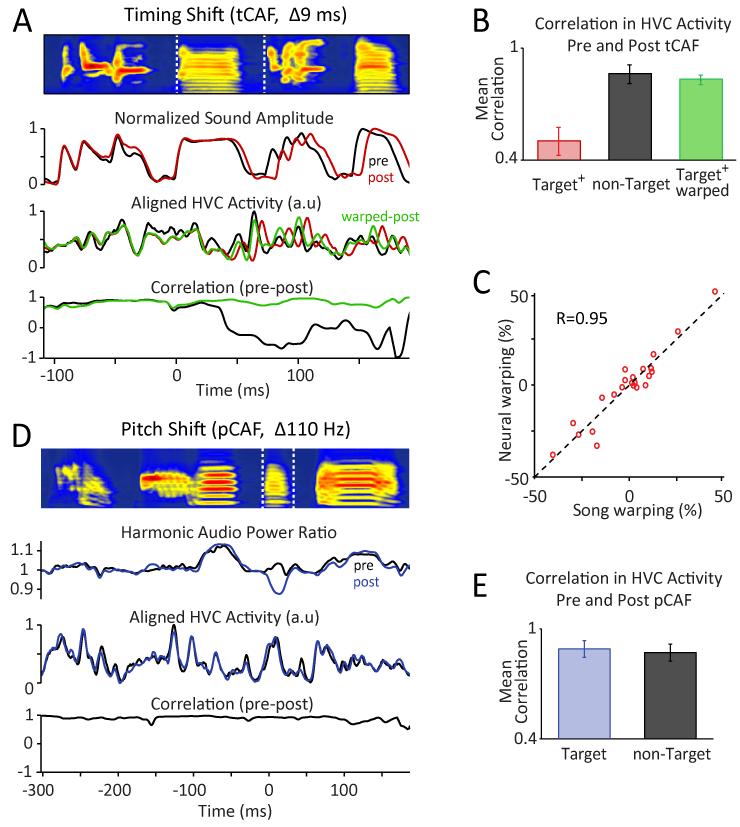
HVC network activity reflects learned changes to temporal, but not spectral structure. (A) Comparing HVC recordings before and after 3 days of tCAF during which the duration of the target segment (bracketed by dashed white lines) increased by 9 ms. Top row: Average song spectrogram prior to tCAF. Second row: Mean audio power envelope (‘Sound Amplitude’) for the song motif before (black) and after (red) tCAF. Third row: Mean neural power (‘HVC Activity’) before and after tCAF. Overlaid (green) is the HVC activity post-CAF time-warped to account for temporal changes in the song (see Experimental Procedures). Bottom row: Local Pearson’s correlation (50 ms sliding window) between the song-aligned neural traces before and after tCAF, using original (black) and warped (green) post-tCAF traces. (B) Summary data for n=13 tCAF experiments in 6 birds, showing mean correlations between HVC activity at the start and end of tCAF for conditions and song segments as indicated (target+ = target + 100 ms). (C) Time-warping the average neural traces recorded in HVC after tCAF to those recorded before tCAF yielded estimates of temporal re-scaling (% stretching/shrinking) in the target intervals that were highly correlated with those derived from the respective sound recordings. Data points correspond to warping estimates for individual song elements (syllables and gaps) making up the target (n=23 song elements from 13 tCAF drives in 6 birds). (D) Comparing HVC recordings before and after a pCAF drive. Top, Third, and Bottom rows: Same as in panel A. Second row: Ratio of power in the frequency bands corresponding to the first 10 harmonics of the target syllable at baseline (pitch = 530 Hz, harmonic bandwidth = 10 Hz) to the total power in bands offset by half-pitch. (E) Similar to panel B, but for n=8 pCAF drives in 4 birds.

References

    1. Andalman AS, Fee MS. A basal ganglia-forebrain circuit in the songbird biases motor output to avoid vocal errors. Proceedings of the National Academy of Sciences. 2009;106:12518–12523. - PMC - PubMed
    1. Appeltants D, Absil P, Balthazart J, Ball GF. Identification of the origin of catecholaminergic inputs to HVc in canaries by retrograde tract tracing combined with tyrosine hydroxylase immunocytochemistry. J. Chem. Neuroanat. 2000;18:117–133. - PubMed
    1. Aronov D, Fee MS. Natural Changes in Brain Temperature Underlie Variations in Song Tempo during a Mating Behavior. PLoS ONE. 2012;7:e47856. - PMC - PubMed
    1. Bottjer SW, Miesner EA, Arnold AP. Forebrain lesions disrupt development but not maintenance of song in passerine birds. Science. 1984;224:901–903. - PubMed
    1. Botvinick MM, Niv Y, Barto AC. Hierarchically organized behavior and its neural foundations: A reinforcement learning perspective. Cognition. 2009;113:262–280. - PMC - PubMed

Publication types

LinkOut - more resources