


Outcome and prognostic factors for patients who relapse after allogeneic hematopoietic stem cell transplantation
- PMID: 24076323
- PMCID: PMC3848699
- DOI: 10.1016/j.bbmt.2013.09.011
Outcome and prognostic factors for patients who relapse after allogeneic hematopoietic stem cell transplantation
Abstract
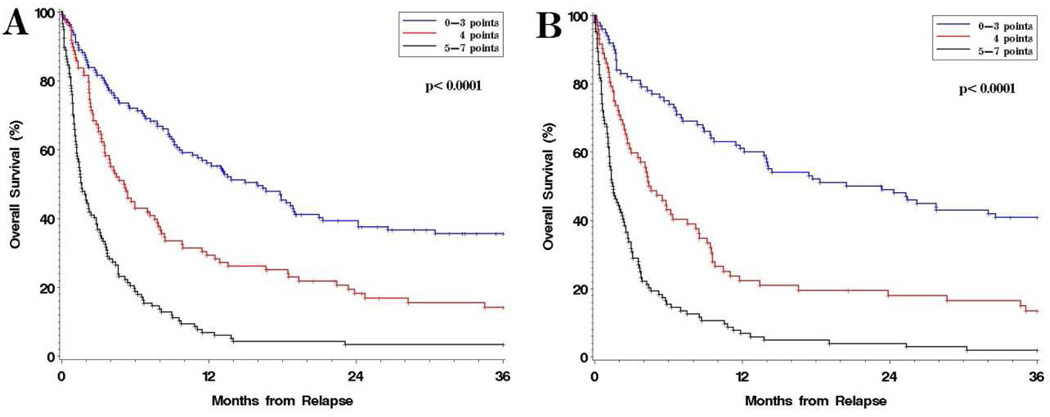
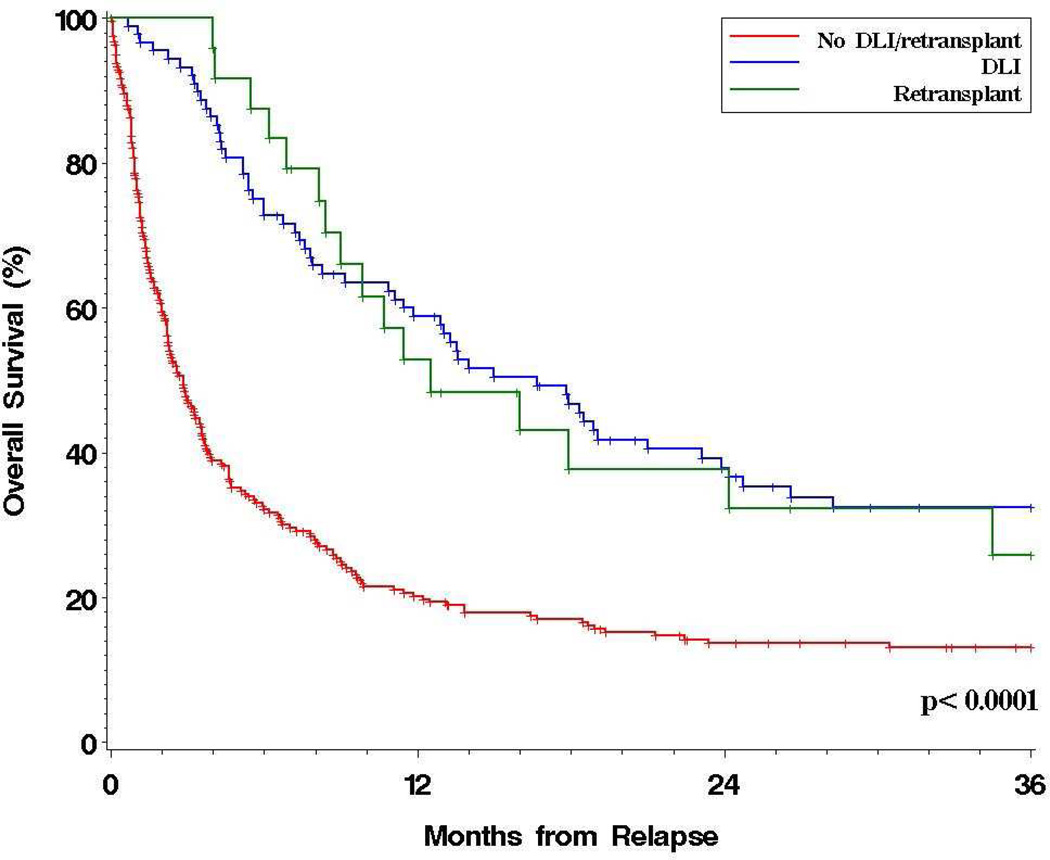
Disease relapse remains a major obstacle to the success of allogeneic hematopoietic stem cell transplantation (HSCT), yet little is known about the relevant prognostic factors after relapse. We studied 1080 patients transplanted between 2004 and 2008, among whom 351 relapsed. The 3-year postrelapse overall survival (prOS) rate was 19%. Risk factors for mortality after relapse included shorter time to relapse, higher disease risk index at HSCT, myeloablative conditioning, high pretransplantation comorbidity index, and graft-versus-host disease (GVHD) occurring before relapse. Important prognostic factors did not vary by disease type. Based on this, we could stratify patients into 3 groups, with 3-year prOS rates of 36%, 14%, and 3% (P < .0001). This score was validated in an historical cohort of 276 patients. Postrelapse donor lymphocyte infusion or repeat HSCT was associated with improved prOS, as was the development of GVHD after relapse. These differences remained significant in models that accounted for other prognostic factors and in landmark analyses of patients who survived at least 2 months from relapse. The results of this study may aid with prognostication and management of patients who relapse after HSCT and motivate the design of clinical trials aimed at relapse prevention or treatment in higher-risk patients.
Keywords: Allogeneic hematopoietic stem cell transplantation; Donor lymphocyte infusion; Prognostic factors; Relapse.
Copyright © 2013 American Society for Blood and Marrow Transplantation. Published by Elsevier Inc. All rights reserved.
Conflict of interest statement
The authors have no conflicts of interest to disclose.
Figures
References
-
- Alyea EP, DeAngelo DJ, Moldrem J, et al. NCI First International Workshop on The Biology, Prevention and Treatment of Relapse after Allogeneic Hematopoietic Cell Transplantation: report from the committee on prevention of relapse following allogeneic cell transplantation for hematologic malignancies. Biol Blood Marrow Transplant. 2010;16:1037–1069. - PMC - PubMed
-
- Bishop MR, Alyea EP, 3rd, Cairo MS, et al. National Cancer Institute's First International Workshop on the Biology, Prevention, and Treatment of Relapse after Allogeneic Hematopoietic Stem Cell Transplantation: summary and recommendations from the organizing committee. Biol Blood Marrow Transplant. 2011;17:443–454. - PMC - PubMed
-
- Cairo MS, Jordan CT, Maley CC, et al. NCI first International Workshop on the biology, prevention, and treatment of relapse after allogeneic hematopoietic stem cell transplantation: report from the committee on the biological considerations of hematological relapse following allogeneic stem cell transplantation unrelated to graft-versus-tumor effects: state of the science. Biol Blood Marrow Transplant. 2010;16:709–728. - PMC - PubMed
-
- Kroger N, Bacher U, Bader P, et al. NCI First International Workshop on the Biology, Prevention, and Treatment of Relapse after Allogeneic Hematopoietic Stem Cell Transplantation: report from the Committee on Disease-Specific Methods and Strategies for Monitoring Relapse following Allogeneic Stem Cell Transplantation. Part I: Methods, acute leukemias, and myelodysplastic syndromes. Biol Blood Marrow Transplant. 2010;16:1187–1211. - PMC - PubMed
-
- Miller JS, Warren EH, van den Brink MR, et al. NCI First International Workshop on The Biology, Prevention, and Treatment of Relapse After Allogeneic Hematopoietic Stem Cell Transplantation: Report from the Committee on the Biology Underlying Recurrence of Malignant Disease following Allogeneic HSCT: Graft-versus-Tumor/Leukemia Reaction. Biol Blood Marrow Transplant. 2010;16:565–586. - PMC - PubMed
Publication types
MeSH terms
Grants and funding
LinkOut - more resources
Full Text Sources
Other Literature Sources
Miscellaneous
