


Cervical squamocolumnar junction-specific markers define distinct, clinically relevant subsets of low-grade squamous intraepithelial lesions
- PMID: 24076771
- PMCID: PMC3905241
- DOI: 10.1097/PAS.0b013e3182989ee2
Cervical squamocolumnar junction-specific markers define distinct, clinically relevant subsets of low-grade squamous intraepithelial lesions
Abstract
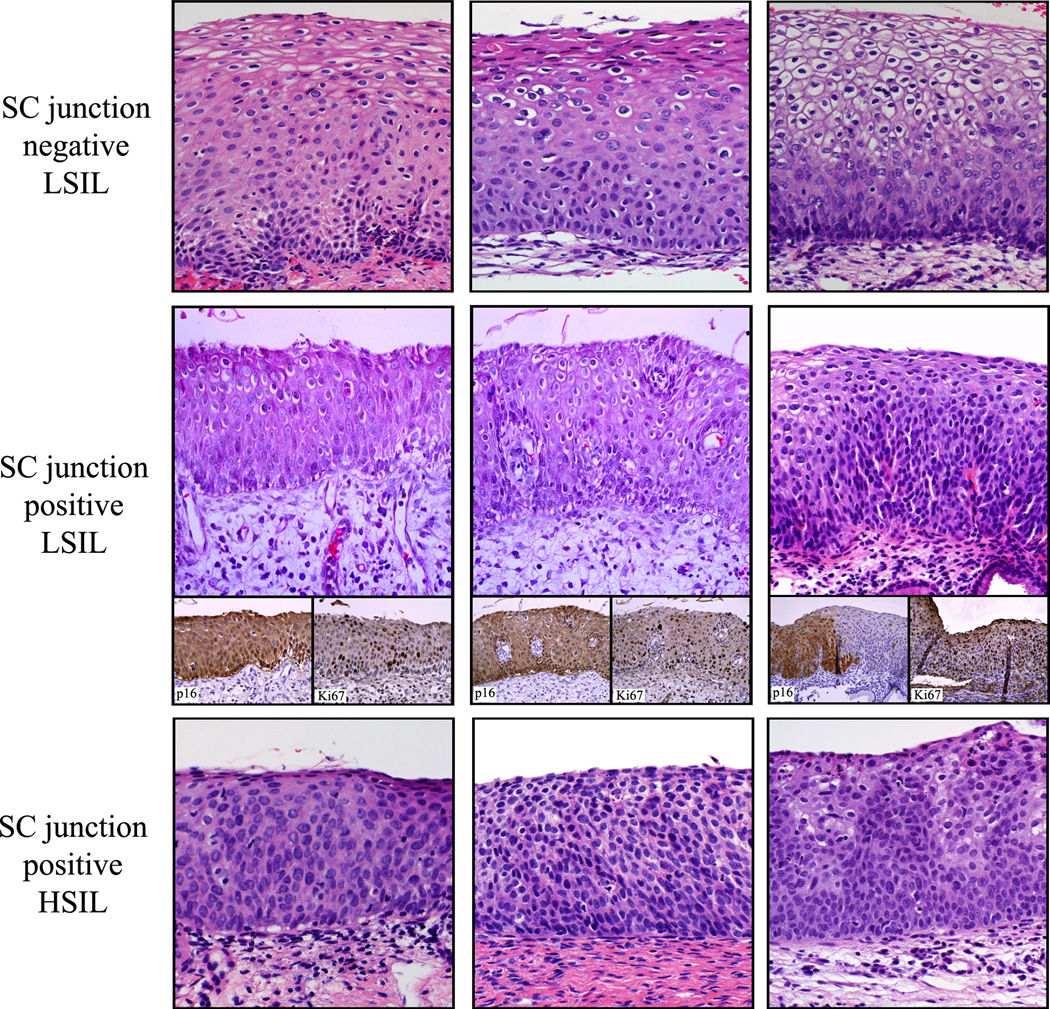
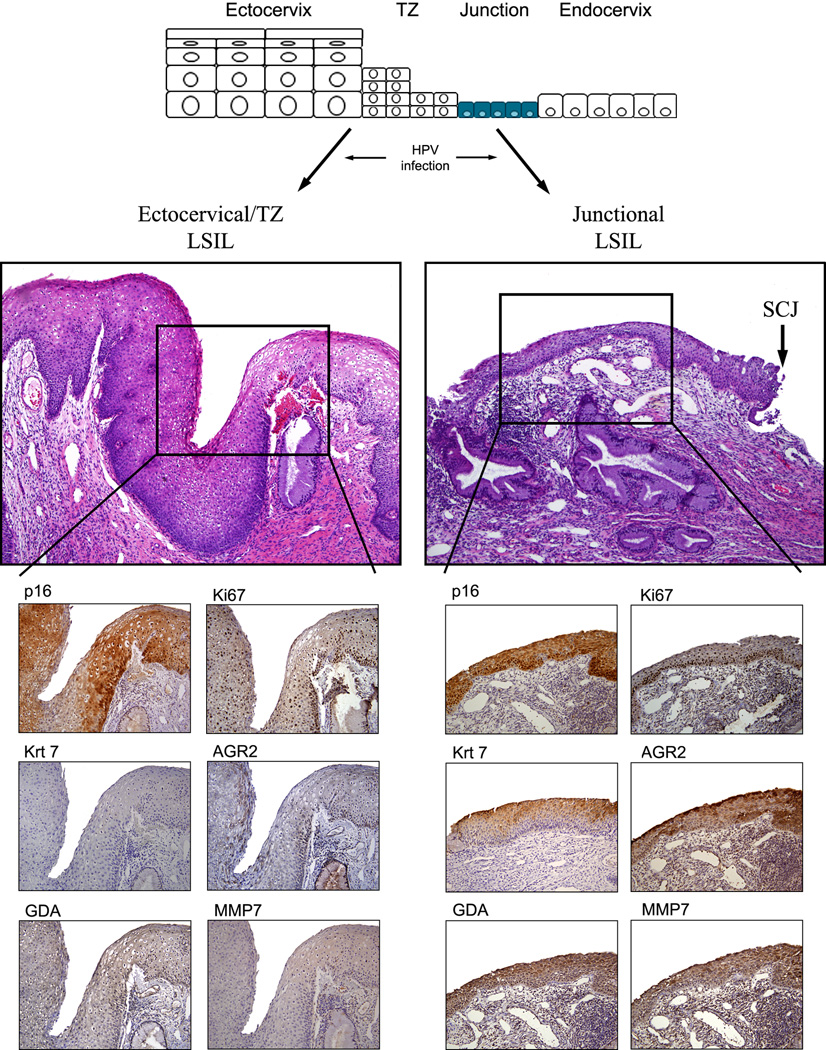
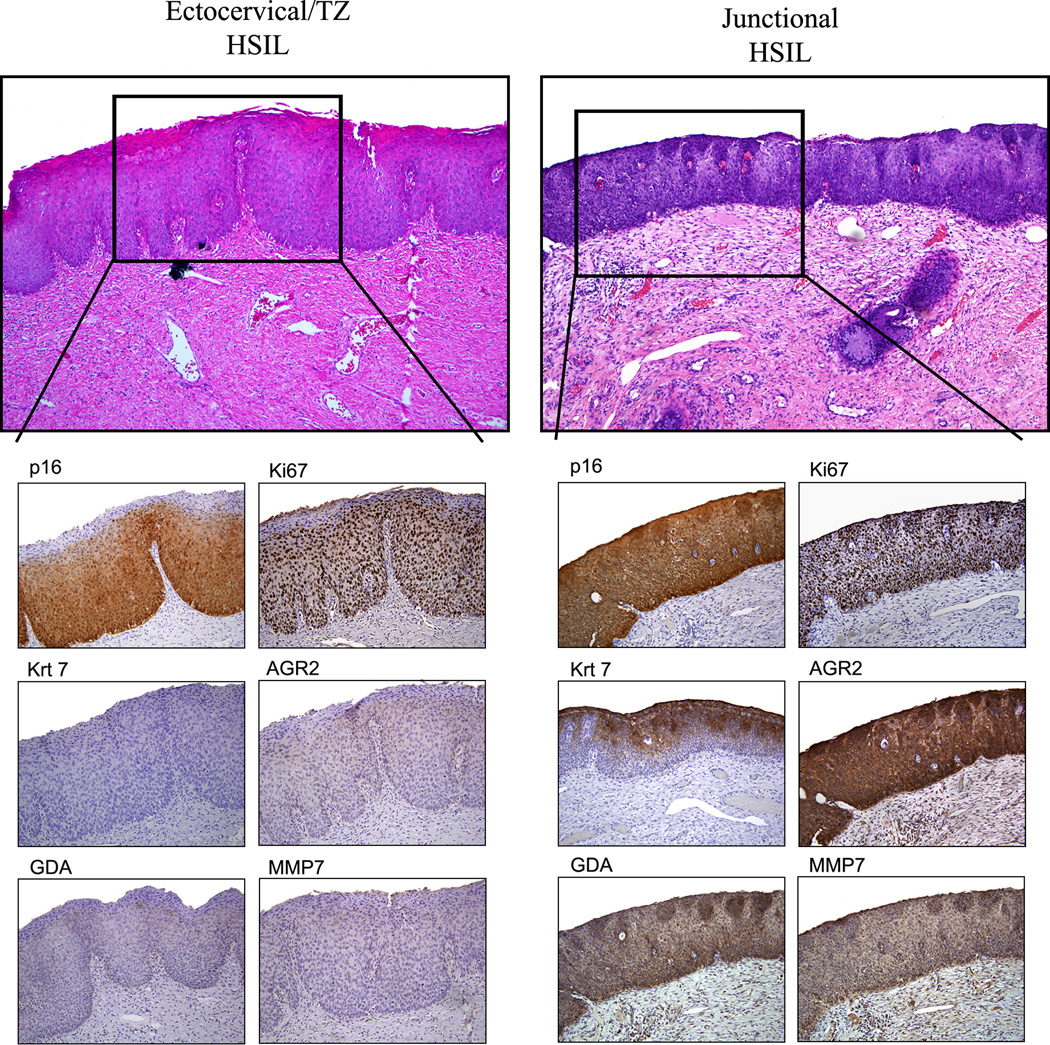
Low-grade cervical squamous abnormalities (low-grade squamous intraepithelial lesions [LSIL, CIN1]) can be confused with or followed by high-grade (HSIL, CIN2/3) lesions, expending considerable resources. Recently, a cell of origin for cervical neoplasia was proposed in the squamocolumnar junction (SCJ); HSILs are almost always SCJ, but LSILs include SCJ and SCJ subsets. Abnormal cervical biopsies from 214 patients were classified by 2 experienced pathologists (panel) as LSIL or HSIL using published criteria. SILs were scored SCJ and SCJ using SCJ-specific antibodies (keratin7, AGR2, MMP7, and GDA). Assessments of interobserver agreement, p16 staining pattern, proliferative index, and outcome were compared. The original diagnostician agreed with the panel diagnosis of HSIL and SCJ LSIL in all cases (100%). However, for SCJ LSIL, panelists disagreed with each other by 15% and with the original diagnostician by 46.2%. Comparing SCJ and SCJ LSILs, 60.2% and 94.9% were p16 positive, 23% and 74.4% showed strong (full-thickness) p16 staining, and 0/54 (0%) and 8/33 (24.2%) with follow-up had an HSIL outcome, respectively. Some SCJ LSILs are more likely to both generate diagnostic disagreement and be associated with HSIL. Conversely, SCJ LSILs generate little observer disagreement and, when followed, have a very low risk of HSIL outcome. Thus, SCJ biomarkers in conjunction with histology may segregate LSILs with very low risk of HSIL outcome and conceivably could be used as a management tool to reduce excess allocation of resources to the follow-up of these lesions.
Conflict of interest statement
The authors declare no conflict of interest.
Figures
References
-
- Crum CP, Ikenberg H, Richart RM, et al. Human papillomavirus type 16 and early cervical neoplasia. N Engl J Med. 1984;310:880–883. - PubMed
-
- De Villiers EM, Fauquet C, Broker TR, et al. Classification of papillomaviruses. Virology. 2004;324:17–27. - PubMed
-
- Koutsky LA, Ault KA, Wheeler CM, et al. A controlled trial of a human papillomavirus type 16 vaccine. N Engl J Med. 2002;347:1645–1651. - PubMed
-
- Bansal N, Wright JD, Cohen CJ, et al. Natural history of established low grade cervical intraepithelial (CIN 1) lesions. Anticancer Res. 2008;28:1763–1766. - PubMed
Publication types
MeSH terms
Substances
Grants and funding
LinkOut - more resources
Full Text Sources
Other Literature Sources
Medical
Miscellaneous
