


Contact investigation for active tuberculosis among child contacts in Uganda
- PMID: 24077055
- PMCID: PMC3840405
- DOI: 10.1093/cid/cit645
Contact investigation for active tuberculosis among child contacts in Uganda
Abstract
Background: Tuberculosis is a large source of morbidity and mortality among children. However, limited studies characterize childhood tuberculosis disease, and contact investigation is rarely implemented in high-burden settings. In one of the largest pediatric tuberculosis contact investigation studies in a resource-limited setting, we assessed the yield of contact tracing on childhood tuberculosis and indicators for disease progression in Uganda.
Methods: Child contacts aged <15 years in Kampala, Uganda, were enrolled from July 2002 to June 2009 and evaluated for tuberculosis disease via clinical, radiographic, and laboratory methods for up to 24 months.
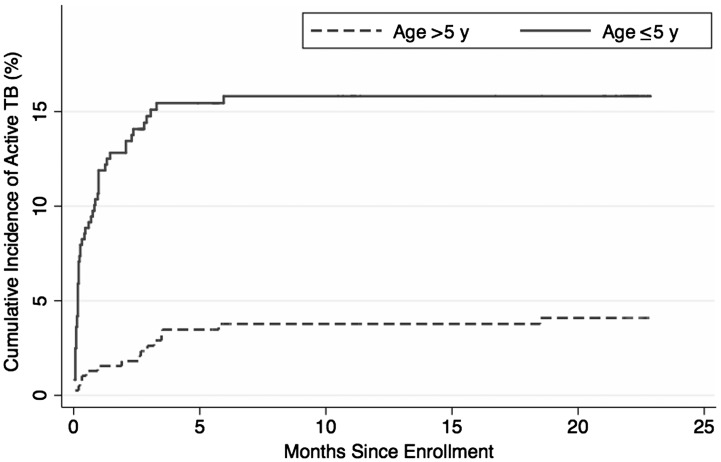
Results: Seven hundred sixty-one child contacts were included in the analysis. Prevalence of tuberculosis in our child population was 10%, of which 71% were culture-confirmed positive. There were no cases of disseminated tuberculosis, and 483 of 490 children (99%) started on isoniazid preventative therapy did not develop disease. Multivariable testing suggested risk factors including human immunodeficiency virus (HIV) status (odds ratio [OR], 7.90; P < .001), and baseline positive tuberculin skin test (OR, 2.21; P = .03); BCG vaccination was particularly protective, especially among children aged ≤5 years (OR, 0.23; P < .001). Adult index characteristics such as sex, HIV status, and extent or severity of disease were not associated with childhood disease.
Conclusions: Contact tracing for children in high-burden settings is able to identify a large percentage of culture-confirmed positive tuberculosis cases before dissemination of disease, while suggesting factors for disease progression to identify who may benefit from targeted screening.
Keywords: child; contact tracing; pediatric; risk factors; tuberculosis.
Figures
Comment in
-
Editorial commentary: more evidence to support screening of child contacts of tuberculosis cases: if not now, then when?Clin Infect Dis. 2013 Dec;57(12):1693-4. doi: 10.1093/cid/cit647. Epub 2013 Sep 27. Clin Infect Dis. 2013. PMID: 24077056 No abstract available.
References
-
- World Health Organization. Geneva, Switzerland: WHO; 2012. Global tuberculosis report 2012.
-
- Harries AD, Hargreaves NJ, Graham SM, et al. Childhood tuberculosis in Malawi: nationwide case-finding and treatment outcomes. Int J Tuberc Lung Dis. 2002;6:424–31. - PubMed
-
- Peter D, Maher D, Qazi SA. A research agenda for childhood tuberculosis: improving the management of childhood tuberculosis within national tuberculosis programmes: research priorities based on a literature review. Geneva, Switzerland: World Health Organization; 2007.
-
- Stop TB Partnership Childhood TB Subgroup, World Health Organization. Guidance for national tuberculosis programmes on the management of tuberculosis in children. Chapter 1: introduction and diagnosis of tuberculosis in children. Int J Tuberc Lung Dis. 2006;10:1091–7. - PubMed
Publication types
MeSH terms
Grants and funding
LinkOut - more resources
Full Text Sources
Other Literature Sources
Medical
