


Proteomic markers of DNA repair and PI3K pathway activation predict response to the PARP inhibitor BMN 673 in small cell lung cancer
- PMID: 24077350
- PMCID: PMC3882158
- DOI: 10.1158/1078-0432.CCR-13-1975
Proteomic markers of DNA repair and PI3K pathway activation predict response to the PARP inhibitor BMN 673 in small cell lung cancer
Abstract
Purpose: Small cell lung carcinoma (SCLC) is an aggressive malignancy affecting nearly 30,000 people annually in the United States. We have previously identified elevated PARP1 levels in SCLC and demonstrated in vitro sensitivity to the PARP inhibitors AZD 2281 and AG014699. Here, we evaluate activity of a novel, potent PARP inhibitor, BMN 673, and identify markers of response as a basis for developing predictive markers for clinical application.
Experimental design: Inhibition of SCLC proliferation by BMN 673 was assayed in vitro and effects on tumor growth were measured in SCLC xenograft models. Protein expression and pathway activation was assessed by reverse phase protein array and western blot analysis. PARP inhibition was confirmed using a PAR ELISA.
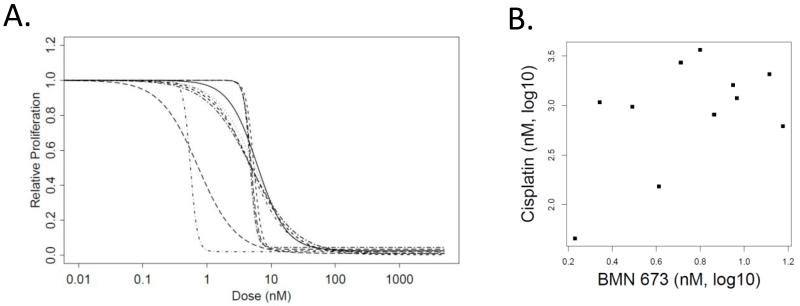
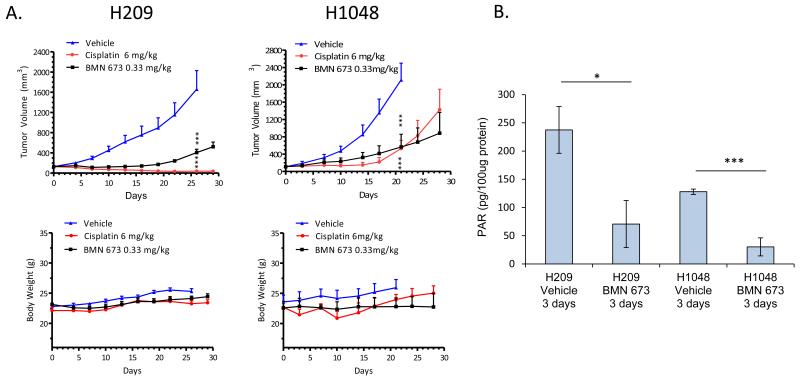
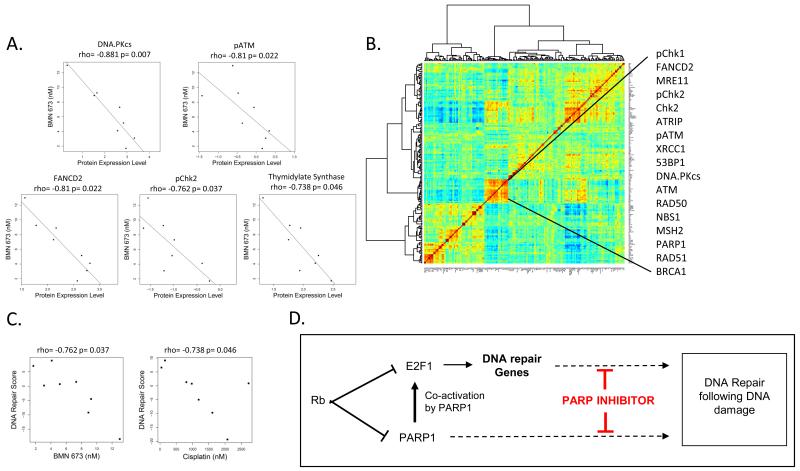
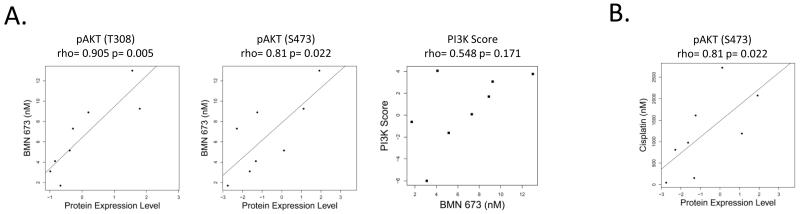
Results: We demonstrate striking, single agent activity of BMN 673 in SCLC cell lines and xenografts, with single agent BMN 673 exhibiting in vivo activity similar to cisplatin. Sensitivity to BMN 673 was associated with elevated baseline expression levels of several DNA repair proteins, whereas greater drug resistance was observed in SCLC models with baseline activation of the PI3K/mTOR pathway. Furthermore, we developed and confirmed these data with a novel "DNA repair score" consisting of a group of 17 DNA repair proteins.
Conclusions: Elevated expression of multiple DNA repair proteins, as well as a corresponding "DNA repair protein score," predict response to BMN 673 in in vitro SCLC models. These observations complement recent work in which PI3K inhibition sensitizes breast cancer models to PARP inhibition, suggesting cooperation between DNA repair and PI3K pathways.
©2013 AACR.
Figures
Comment in
-
Proteomic markers of DNA repair and PI3K pathway activation predict response to the PARP inhibitor BMN 673 in small cell lung cancer--response.Clin Cancer Res. 2014 Apr 15;20(8):2237. doi: 10.1158/1078-0432.CCR-13-3391. Epub 2014 Mar 31. Clin Cancer Res. 2014. PMID: 24687924 Free PMC article. No abstract available.
-
Proteomic markers of DNA repair and PI3K pathway activation predict response to the PARP inhibitor BMN 673 in small cell lung cancer--letter.Clin Cancer Res. 2014 Apr 15;20(8):2236. doi: 10.1158/1078-0432.CCR-13-2679. Epub 2014 Mar 31. Clin Cancer Res. 2014. PMID: 24687925 No abstract available.
References
-
- Herrmann LL, Zabramski JM. Nonaneurysmal subarachnoid hemorrhage: a review of clinical course and outcome in two hemorrhage patterns. J Neurosci Nurs. 2007;39:135–42. - PubMed
-
- Govindan R, Page N, Morgensztern D, Read W, Tierney R, Vlahiotis A, et al. Changing epidemiology of small-cell lung cancer in the United States over the last 30 years: analysis of the surveillance, epidemiologic, and end results database. Journal of clinical oncology: official journal of the American Society of Clinical Oncology. 2006;24:4539–44. - PubMed
-
- Tibes R, Qiu Y, Lu Y, Hennessy B, Andreeff M, Mills GB, et al. Reverse phase protein array: validation of a novel proteomic technology and utility for analysis of primary leukemia specimens and hematopoietic stem cells. Molecular cancer therapeutics. 2006;5:2512–21. - PubMed
Publication types
MeSH terms
Substances
Grants and funding
LinkOut - more resources
Full Text Sources
Other Literature Sources
Medical
Miscellaneous
