Review
. 2013 Sep 27;54(9):6390-400.
doi: 10.1167/iovs.13-12547.

The corneal epithelial basement membrane: structure, function, and disease

Affiliations
Review

The corneal epithelial basement membrane: structure, function, and disease

André A M Torricelli et al. Invest Ophthalmol Vis Sci. .

Abstract

The corneal epithelial basement membrane (BM) is positioned between basal epithelial cells and the stroma. This highly specialized extracellular matrix functions not only to anchor epithelial cells to the stroma and provide scaffolding during embryonic development but also during migration, differentiation, and maintenance of the differentiated epithelial phenotype. Basement membranes are composed of a diverse assemblage of extracellular molecules, some of which are likely specific to the tissue where they function; but in general they are composed of four primary components--collagens, laminins, heparan sulfate proteoglycans, and nidogens--in addition to other components such as thrombospondin-1, matrilin-2, and matrilin-4 and even fibronectin in some BM. Many studies have focused on characterizing BM due to their potential roles in normal tissue function and disease, and these structures have been well characterized in many tissues. Comparatively few studies, however, have focused on the function of the epithelial BM in corneal physiology. Since the normal corneal stroma is avascular and has relatively low keratocyte density, it is expected that the corneal BM would be different from the BM in other tissues. One function that appears critical in homeostasis and wound healing is the barrier function to penetration of cytokines from the epithelium to stroma (such as transforming growth factor β-1), and possibly from stroma to epithelium (such as keratinocyte growth factor). The corneal epithelial BM is also involved in many inherited and acquired corneal diseases. This review examines this structure in detail and discusses the importance of corneal epithelial BM in homeostasis, wound healing, and disease.

Keywords: basement membrane; corneal epithelium; myofibroblasts; wound healing.


Figures
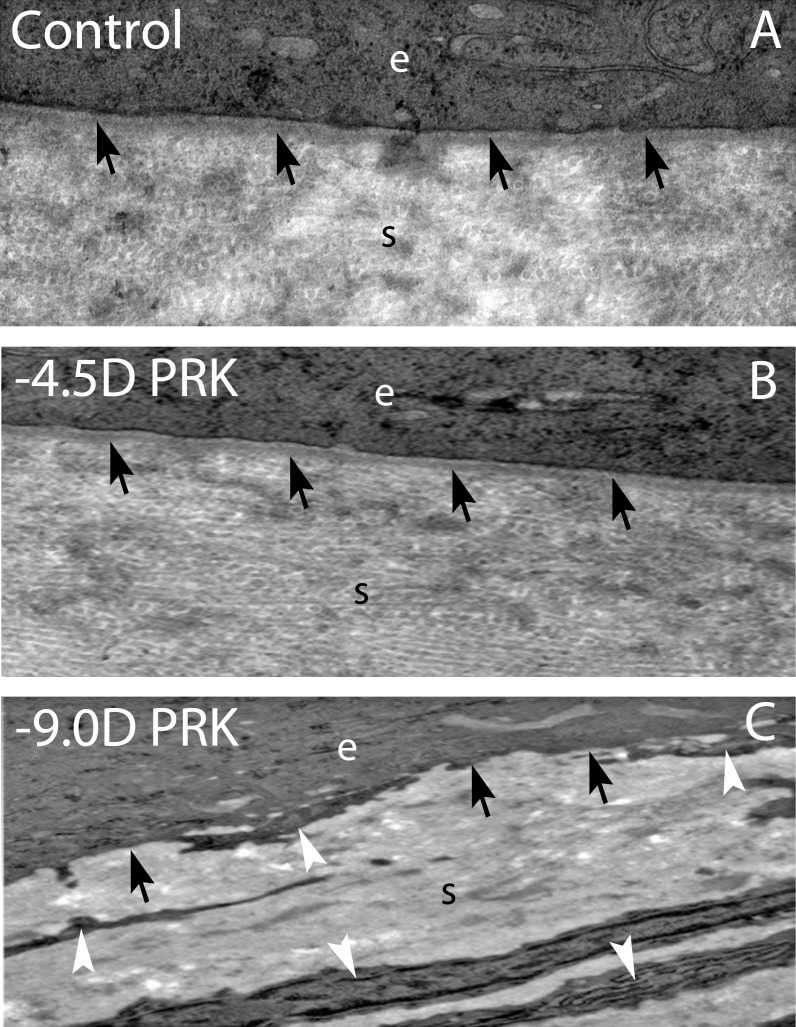
Figure 1.
Figure 1.
Transmission electron microscopy of the central corneal epithelial basement membrane of rabbits after photorefractive keratectomy and in controls. (A) A control corneal section showing a sharp epithelial basement membrane that includes the lamina densa (arrows) and lamina lucida (the less dense band between lamina densa and basal epithelial cells) present between the epithelium (e) and the stroma (s). (B) A −4.5-diopter (D) PRK cornea that healed without haze at 1 month after surgery showing a regenerated epithelial basement membrane (arrows) similar to the control cornea in (A). The extracellular matrix in the stroma (s) also demonstrates a similar structural pattern compared to the control cornea. (C) A −9.0-D PRK cornea that healed with dense subepithelial haze at 1 month after PRK. A large number of myofibroblasts (arrowheads) with large amounts of rough endoplasmic reticulum are surrounded by disorganized extracellular matrix in the stroma (s) beneath the epithelium (e). There is no evidence of a lamina densa-like or lamina lucida-like structure between the epithelium and the stroma. Magnification for all: ×30,000.
Figure 2.
Figure 2.
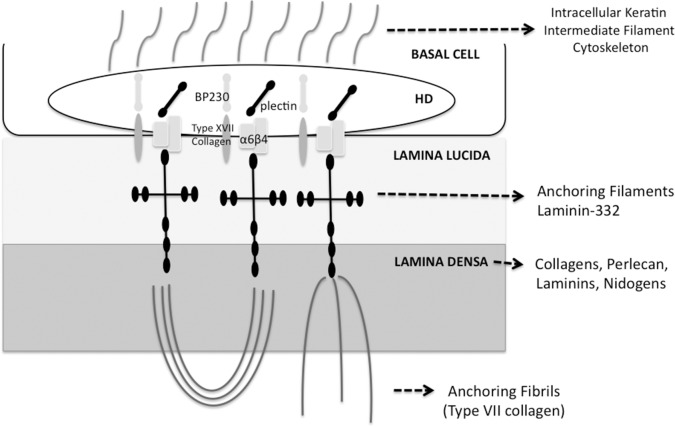
Schematic diagram of the basement membrane, overlying basal cell, and underlying stroma in the cornea interconnected by the hemidesmosome-anchoring filament complex. It is important to note that other component molecules are present in corneal epithelial basement membrane that are not included in this simplified diagram. HD, hemidesmosome; BP230, bullous pemphigoid antigen 230.
Figure 3.
Figure 3.
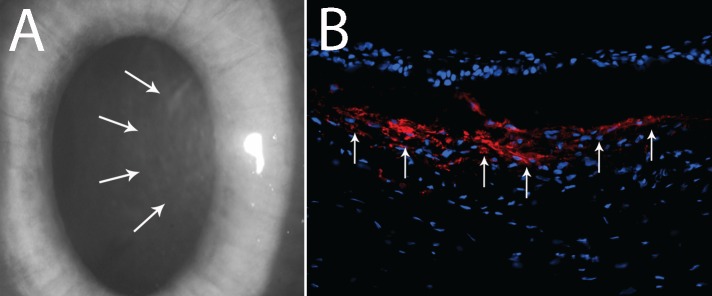
Corneal haze and myofibroblasts. (A) Slit-lamp photo of rabbit cornea at 1 month after −9.0-D PRK corneal ablation surgery. Note the dense subepithelial haze (arrows). Magnification: ×20. (B) Immunocytochemistry for alpha-smooth actin (αSMA)+ myofibroblast cells (red) shows a high density of αSMA+ myofibroblasts (arrows) in the subepithelial stroma at 1 month after −9.0-D PRK. Magnification: ×400.
Figure 4.
Figure 4.
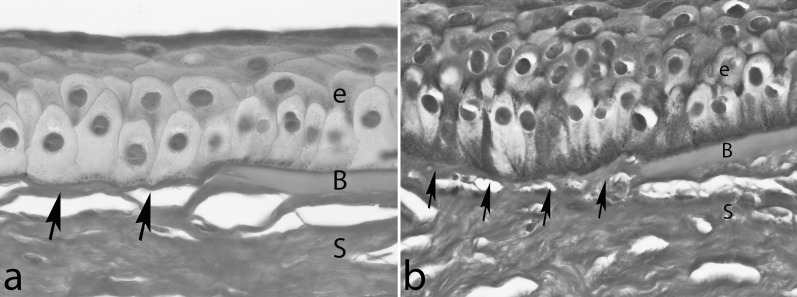
Histopathologic analysis of corneal sections of two patients (a, b) with keratoconus stained with periodic acid Schiff (PAS). Note the breaks or attenuations (arrows) in Bowman's layer (B). Ultrastructural transmission electron microscopy studies have demonstrated that the epithelial basement membrane is abnormally thin or missing in areas of the central cornea in most keratoconus corneas removed at the time of corneal transplantation. Epithelial (e) thickness tends to be highly variable in keratoconus, often within one cornea of a single patient. In the area shown in (b), there is hyperplasia and hypertrophy of epithelial cells (e), while in (a), the epithelium (e) is relatively normal in thickness. In other areas (not shown), the epithelium can be very thin. S, stroma. Magnification: ×630.

References

    1. Kruegel J, Miosge N. Basement membrane components are key players in specialized extracellular matrices. Cell Mol Life Sci. 2010; 67: 2879–2895 - PMC - PubMed
    1. Timpl R, Brown JC. Supramolecular assembly of basement membranes. Bioessays. 1996; 18: 123–132 - PubMed
    1. Merker HJ. Morphology of the basement membrane. Microsc Res Tech. 1994; 28: 95–124 - PubMed
    1. Tuori A, Uusitalo H, Burgeson RE, Terttunen J, Virtanen I. The immunohistochemical composition of the human corneal basement membrane. Cornea. 1996; 15: 286–294 - PubMed
    1. Hynes RO. The extracellular matrix: not just pretty fibrils. Science. 2009; 326: 1216–1219 - PMC - PubMed

Publication types