. 2012 Nov;1(4):301-314.
doi: 10.2174/2211556011201040301.

Gene Expression Under the Influence: Transcriptional Profiling of Ethanol in the Brain

Affiliations

Gene Expression Under the Influence: Transcriptional Profiling of Ethanol in the Brain

Candice Contet. Curr Psychopharmacol. 2012 Nov.

Abstract

Sensitivity to ethanol intoxication, propensity to drink ethanol and vulnerability to develop alcoholism are all influenced by genetic factors. Conversely, exposure to ethanol or subsequent withdrawal produce gene expression changes, which, in combination with environmental variables, may participate in the emergence of compulsive drinking and relapse. The present review offers an integrated perspective on brain gene expression profiling in rodent models of predisposition to differential ethanol sensitivity or consumption, in rats and mice subjected to acute or chronic ethanol exposure, as well as in human alcoholics. The functional categories over-represented among differentially expressed genes suggest that the transcriptional effects of chronic ethanol consumption contribute to the neuroplasticity and neurotoxicity characteristic of alcoholism. Importantly, ethanol produces distinct transcriptional changes within the different brain regions involved in intoxication, reinforcement and addiction. Special emphasis is put on recent profiling studies that have provided some insights into the molecular mechanisms potentially mediating genome-wide regulation of gene expression by ethanol. In particular, current evidence for a role of transcription factors, chromatin remodeling and microRNAs in coordinating the expression of large sets of genes in animals predisposed to excessive ethanol drinking or exposed to protracted abstinence, as well as in human alcoholics, is presented. Finally, studies that have compared ethanol with other drugs of abuse have highlighted common gene expression patterns that may play a central role in drug addiction. The availability of novel technologies and a focus on mechanistic approaches are shaping the future of ethanol transcriptomics.

Keywords: Ethanol; RNA-seq; alcohol; brain; gene expression; microarray; profiling; transcriptome.


Conflict of interest statement

CONFLICT OF INTEREST

The author declares no conflict of interest.

Figures
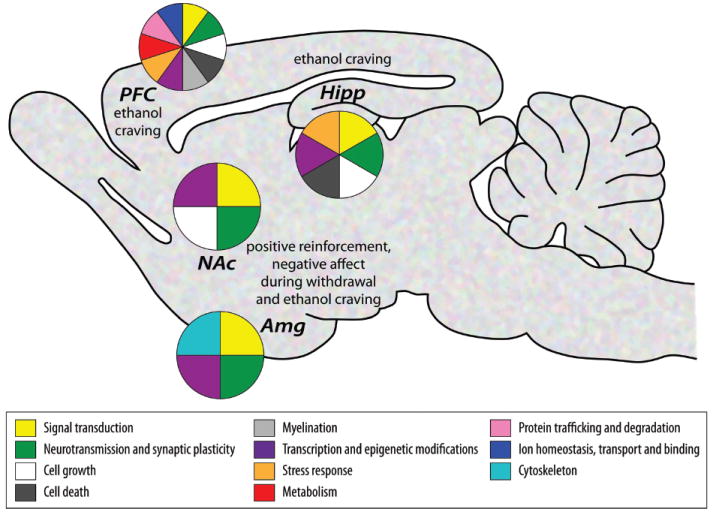
Fig. (1)
Fig. (1)
Brain scheme illustrating the regional specificity of functional categories that are enriched among genes differentially expressed in rodent predisposition models, rodent models of ethanol exposure and human alcoholics. Functional categories that were identified by at least two independent studies analyzing the same brain region are reported by a color-coded pie section. While “signal transduction”, “neurotransmission and synaptic plasticity” and “transcription and epigenetic modifications” emerged across all mesocorticolimbic structures, the other categories were selectively altered in individual regions. A vast majority of gene profiling studies performed in human alcoholics used postmortem prefrontal cortex (PFC) tissue and, as a result, most of the data generated in the nucleus accumbens (NAc), amygdala (Amg) and hippocampus (Hipp) arise from rodent models (see Table 1 for details). The role played by these four brain regions in the different stages of alcoholism are also highlighted. Amygdala was analyzed as a whole in some studies, while others have differentiated the central nucleus (implicated in acute reinforcement, emotional dysfunction in dependent subjects and stress-induced reinstatement) and the basolateral nucleus (implicated in cue conditioning, and, as such, in ethanol craving and relapse). Likewise, the nucleus accumbens is partitioned into a shell (contributing to the positive reinforcing effects of ethanol as well as to the negative emotional states associated with withdrawal), which was selectively sampled in some studies, and a core (involved in conditioned reinforcement). Note that other relevant brain regions (such as the ventral tegmental area, dorsal striatum or cerebellum) have been analyzed by a limited number of studies, which did not allow for the representation of convergent findings on this scheme.
Fig. (2)
Fig. (2)
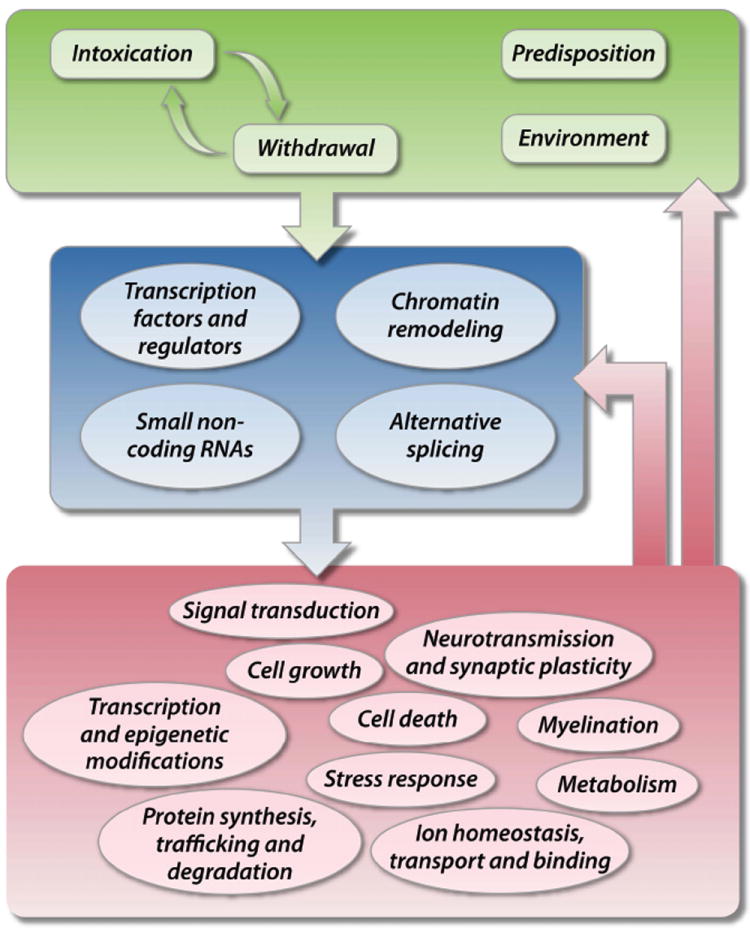
Schematic summary of molecular mechanisms hypothesized to drive the genome-wide regulation of gene expression in alcoholism. The green halo regroups potential causative factors for transcriptional changes in relation to alcoholism. Single nucleotide polymorphisms may influence the expression level of a given gene and the activity of its protein product, and thereby predispose an individual to increased vulnerability to or protection against alcoholism [2]. On the other hand, environmental variables, such as stressful life events or comorbid diseases, may also impact gene expression and thereby interact with the effects of ethanol [2]. The blue halo identifies molecular mechanisms that could mediate the global co-regulation of gene expression across the genome. Recent microarray and RNA-seq studies have pinpointed a potential role for transcription factors [37-40], epigenetic modifications [29, 35, 41, 42] and miRNAs [33, 34, 43] in the coordinated regulation of gene sets. In addition, RNA-seq is starting to uncover that alcoholism can affect the relative expression of different splice variants of a given gene [89]. The red halo highlights the functional categories that are enriched among genes differentially expressed in the brain of rodent predisposition models, rodent models of ethanol exposure and human alcoholics (see Table 2 for details). Changes in the expression level of genes encoding proteins involved in mRNA and small non-coding RNA processing, DNA methylation, histone acetylation and methylation can in turn contribute to accentuate, dampen or reorient the effects of the mechanisms identified in the blue halo. Moreover, changes in brain structure, connectivity and function resulting from the altered expression of genes involved in myelination, neurotransmission, signal transduction etc. are hypothesized to ultimately produce the behavioral impairments characteristic of alcoholism.

References

    1. Koob GF. Alcoholism: allostasis and beyond. Alcohol Clin Exp Res. 2003;27(2):232–43. - PubMed
    1. Ducci F, Goldman D. Genetic approaches to addiction: genes and alcohol. Addiction. 2008;103(9):1414–28. - PMC - PubMed
    1. Spanagel R. Alcoholism: a systems approach from molecular physiology to addictive behavior. Physiol Rev. 2009;89(2):649–705. - PubMed
    1. Gonye GE, Chakravarthula P, Schwaber JS, Vadigepalli R. From promoter analysis to transcriptional regulatory network prediction using PAINT. Methods Mol Biol. 2007;408:49–68. - PubMed
    1. Nugent R, Meila M. An overview of clustering applied to molecular biology. Methods Mol Biol. 2010;620:369–404. - PubMed

LinkOut - more resources