


Adapting evidence-based interventions using a common theory, practices, and principles
- PMID: 24079747
- PMCID: PMC3954876
- DOI: 10.1080/15374416.2013.836453
Adapting evidence-based interventions using a common theory, practices, and principles
Abstract
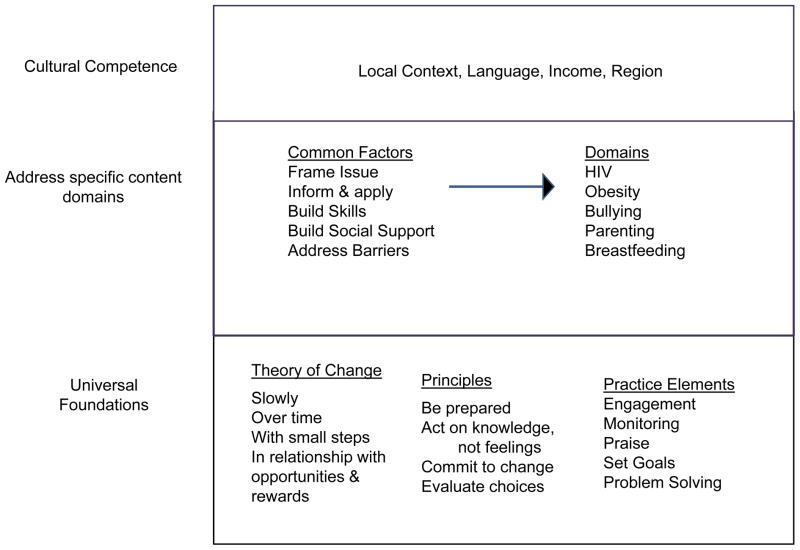
Hundreds of validated evidence-based intervention programs (EBIP) aim to improve families' well-being; however, most are not broadly adopted. As an alternative diffusion strategy, we created wellness centers to reach families' everyday lives with a prevention framework. At two wellness centers, one in a middle-class neighborhood and one in a low-income neighborhood, popular local activity leaders (instructors of martial arts, yoga, sports, music, dancing, Zumba), and motivated parents were trained to be Family Mentors. Trainings focused on a framework that taught synthesized, foundational prevention science theory, practice elements, and principles, applied to specific content areas (parenting, social skills, and obesity). Family Mentors were then allowed to adapt scripts and activities based on their cultural experiences but were closely monitored and supervised over time. The framework was implemented in a range of activities (summer camps, coaching) aimed at improving social, emotional, and behavioral outcomes. Successes and challenges are discussed for (a) engaging parents and communities; (b) identifying and training Family Mentors to promote children and families' well-being; and (c) gathering data for supervision, outcome evaluation, and continuous quality improvement. To broadly diffuse prevention to families, far more experimentation is needed with alternative and engaging implementation strategies that are enhanced with knowledge harvested from researchers' past 30 years of experience creating EBIP. One strategy is to train local parents and popular activity leaders in applying robust prevention science theory, common practice elements, and principles of EBIP. More systematic evaluation of such innovations is needed.
Conflict of interest statement
No authors have any competing interests. All authors have completed the Unified Competing Interest form and declare: no support from any organization for the submitted work, no financial relationships with any organizations that might have an interest in the submitted work in the previous three years, no other relationships or activities that could appear to have influenced the submitted work.
The Corresponding Author has the right to grant on behalf of all authors and does grant on behalf of all authors, a worldwide license to the Publishers and its licensees in perpetuity, in all forms, formats and media (whether known now or created in the future), to i) publish, reproduce, distribute, display and store the Contribution, ii) translate the Contribution into other languages, create adaptations, reprints, include within collections and create summaries, extracts and/or abstracts of the Contribution, iii) create any other derivative work(s) based on the Contribution, iv) to exploit all subsidiary rights in the Contribution, v) the inclusion of electronic links from the Contribution to third party material where-ever it may be located; and, vi) license any third party to do any or all of the above.
Figures
References
-
- Anderson S, Ray P. The cultural creatives: How 50 million people are changing the world. Three Rivers Press; New York, NY: 2000.
-
- Berggren GG. The nutrition demonstration foyer: A model for combating malnutrition in Haiti. Hoviprep monostraph series #2. International Food & Nutrition Program, MIT; 1984.
-
- Botvin GJ, Tortu S. Preventing Adolescent Substance Abuse Through Life Skills Training. In: Price R, Cowen E, Lorion R, Ramos-McKay J, editors. Fourteen ounces of prevention: A casebook for practitioners. vi. Washington, DC, US: American Psychological Association; 1988. pp. 98–110.pp. 191 - DOI
-
- Chan M. Address to the eleventh global forum for health research: fostering new models of science development and collaboration. Current Opinion in HIV/AIDS. 2007;3(4):477–80.
Publication types
MeSH terms
Grants and funding
LinkOut - more resources
Full Text Sources
Other Literature Sources
Research Materials
Miscellaneous
