Review
. 2014:9:287-314.
doi: 10.1146/annurev-pathol-012513-104715. Epub 2013 Sep 25.

MicroRNAs in cancer

Affiliations
Review

MicroRNAs in cancer

Gianpiero Di Leva et al. Annu Rev Pathol. 2014.

Abstract

MicroRNAs (miRNAs) are small noncoding RNAs that typically inhibit the translation and stability of messenger RNAs (mRNAs), controlling genes involved in cellular processes such as inflammation, cell-cycle regulation, stress response, differentiation, apoptosis, and migration. Thus, miRNAs have been implicated in the regulation of virtually all signaling circuits within a cell, and their dysregulation has been shown to play an essential role in the development and progression of cancer. Here, after a brief description of miRNA genomics, biogenesis, and function, we discuss the effects of miRNA dysregulation in the cellular pathways that lead to the progressive conversion of normal cells into cancer cells and the potential to develop new molecular miRNA-targeted therapies.


Figures
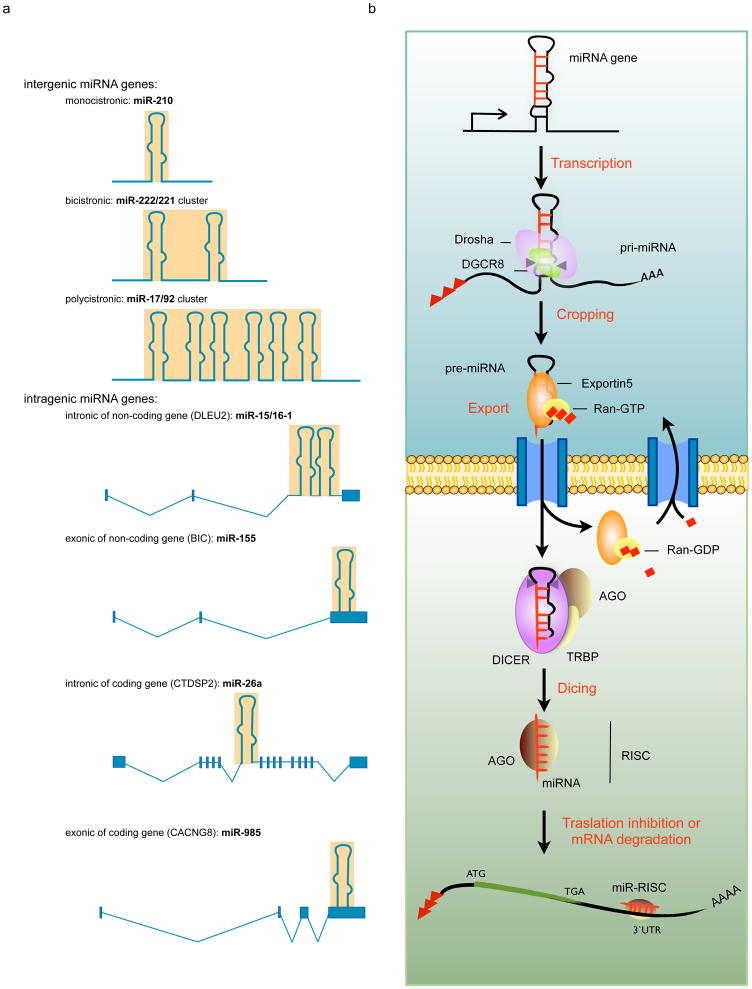
Figure 1
Figure 1. miRNAs genomics, biogenesis and function
a) miRNAs can be divided in two main classes based on their genomic organization: intergenic, they are independent transcription unit; intragenic, located inside another gene and transcribed in the same orientation of the host gene. Intergenic miRNA gene can be single-, bi- or poly-cistronic. Intragenic miRNAs are generally located in the introns of the host genes but in a relative small percentage they are located in exons. The host genes can be coding or non-coding genes. The blue boxes represent the exon of the host genes and the hairpin-structures symbolize the miRNA sequence location. b) miRNA biogenesis is a multistep process that can be divided in transcription, nuclear cropping, export to cytoplasm and cytoplasmic dicing. MiRNA genes are generally transcribed in long capped and polyadenilated RNA transcripts (pri-miRNA) by RNA polymerase II (pol-II) and subjected to a first processing operated by the nuclear enzyme of the RNase III family, DROSHA. The resulting hairpin-loop RNAs (pre-mRNAs) are recognized by the Exportin 5 (XPO5) /RanGTP transporter and exported to the cytoplasm where a second enzyme of the RNase III family, Dicer, catalyses the second processing step (dicing) to produce miRNA duplexes. Dicer, TRBP, and Argonaute proteins (AGO) mediate the processing of pre-miRNA and the assembly of the RISC (RNA-induced silencing complex) in humans. One strand of the duplex remains on the Ago protein as the mature miRNA, whereas the other strand is degraded. Ago is thought to be associated with Dicer in the dicing step as well as in the RISC assembly step.
Figure 2
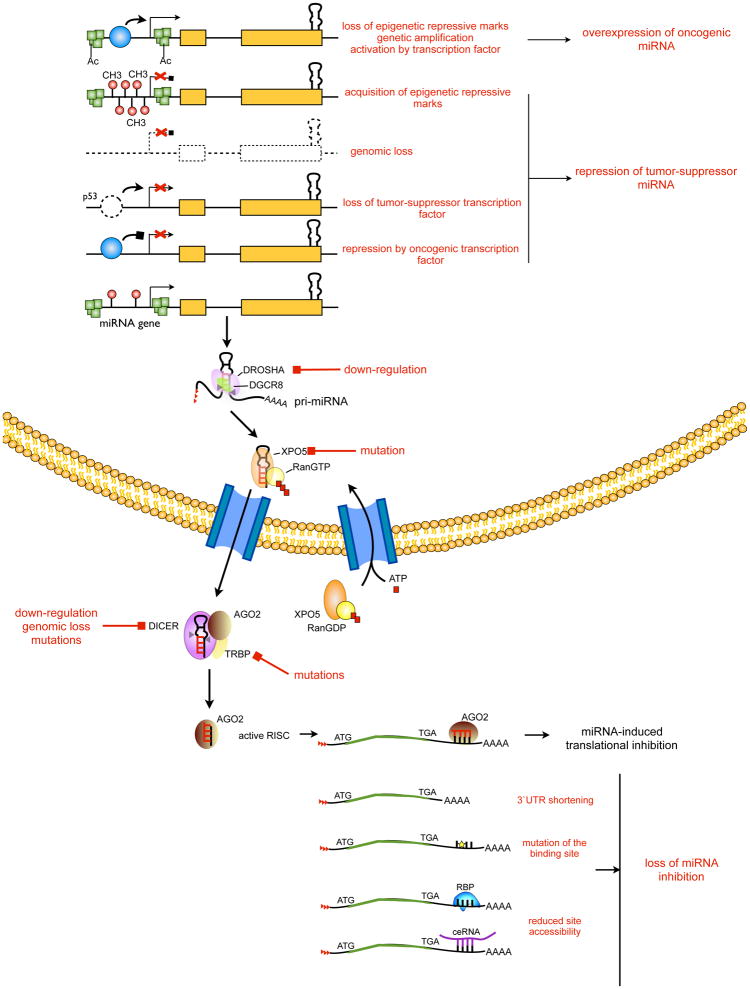
Figure 2. miRNAs dysregulation in cancer
The canonical miRNA biogenesis pathway and miR-RISC activity are schematically represented. In red, steps commonly deregulated in cancer are reported and visually associated to the miRNA dysregulation identified in cancer. RNA binding protein abbreviated as RBP. ceRNAs represented in blue. CH3, methylation; Ac, acetylation.

References

    1. Lee RC, Feinbaum RL, Ambros V. The C. elegans heterochronic gene lin-4 encodes small RNAs with antisense complementarity to lin-14. Cell. 1993;75:843–54. - PubMed
    1. Reinhart BJ, Slack FJ, Basson M, Pasquinelli AE, Bettinger JC, et al. The 21-nucleotide let-7 RNA regulates developmental timing in Caenorhabditis elegans. Nature. 2000;403:901–06. - PubMed
    1. Lagos-Quintana M, Rauhut R, Lendeckel W, Tuschl T. Identification of novel genes coding for small expressed RNAs. Science. 2001;294:853–58. - PubMed
    1. Lau NC, Lim LP, Weinstein EG, Bartel DP. An abundant class of tiny RNAs with probable regulatory roles in Caenorhabditis elegans. Science. 2001;294:858–62. - PubMed
    1. Lee RC, Ambros V. An extensive class of small RNAs in Caenorhabditis elegans. Science. 2001;294:862–64. - PubMed

Publication types