


Chinese My Trauma Recovery, a Web-based intervention for traumatized persons in two parallel samples: randomized controlled trial
- PMID: 24080137
- PMCID: PMC3815433
- DOI: 10.2196/jmir.2690
Chinese My Trauma Recovery, a Web-based intervention for traumatized persons in two parallel samples: randomized controlled trial
Abstract
Background: Guided self-help interventions for PTSD (post-traumatic stress disorder) are a promising tool for the dissemination of contemporary psychological treatment.
Objective: This study investigated the efficacy of the Chinese version of the My Trauma Recovery (CMTR) website.
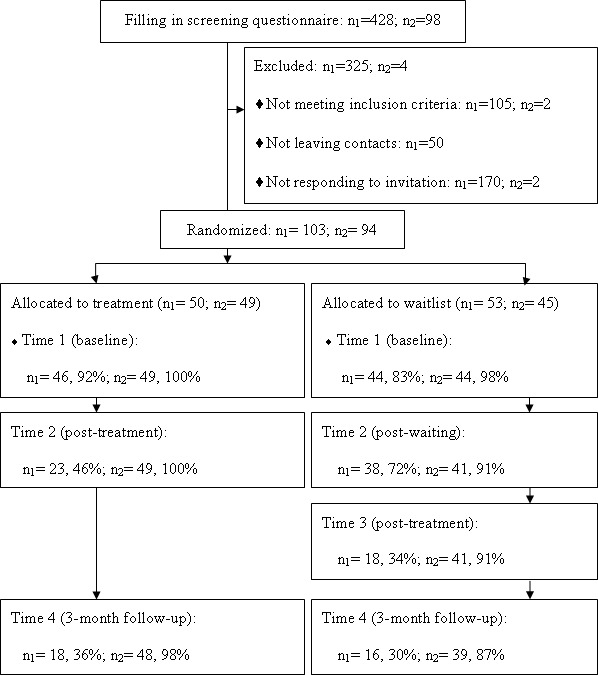
Methods: In an urban context, 90 survivors of different trauma types were recruited via Internet advertisements and allocated to a randomized controlled trial (RCT) with a waiting list control condition. In addition, in a rural context, 93 survivors mainly of the 2008 Sichuan earthquake were recruited in-person for a parallel RCT in which the website intervention was conducted in a counseling center and guided by volunteers. Assessment was completed online on a professional Chinese survey website. The primary outcome measure was the Post-traumatic Diagnostic Scale (PDS); secondary outcome measures were Symptom Checklist 90-Depression (SCL-D), Trauma Coping Self-Efficacy Scale (CSE), Post-traumatic Cognitive Changes (PCC), and Social Functioning Impairment (SFI) questionnaires adopted from the My Trauma Recovery website.
Results: For the urban sample, findings indicated a significant group×time interaction in post-traumatic symptom severity (F₁,₈₈=7.65, P=.007). CMTR reduced post-traumatic symptoms significantly with high effect size after one month of treatment (F₁,₄₅=15.13, Cohen's d=0.81, P<.001) and the reduction was sustained over a 3-month follow-up (F₁,₄₅=17.29, Cohen's d=0.87, P<.001). In the rural sample, the group×time interaction was also significant in post-traumatic symptom severity (F₁,₉₁=5.35, P=.02). Post-traumatic symptoms decreased significantly after treatment (F₁,₄₈=43.97, Cohen's d=1.34, P<.001) and during the follow-up period (F₁,₄₈=24.22, Cohen's d=0.99, P<.001). Additional outcome measures (post-traumatic cognitive changes, depression) indicated a range of positive effects, in particular in the urban sample (group×time interactions: F₁,₈₈=5.32-8.37, all Ps<.03), contributing to the positive evidence for self-help interventions. Differences in the effects in the two RCTs are exploratorily explained by sociodemographic, motivational, and setting feature differences between the two samples.
Conclusions: These findings give support for the short-term efficacy of CMTR in the two Chinese populations and contribute to the literature that self-help Web-based programs can be used to provide mental health help for traumatized persons.
Trial registration: Australia New Zealand Clinical Trials Registry (ANZCTR): ACTRN12611000951954; https://www.anzctr.org.au/Trial/Registration/TrialReview.aspx?ACTRN=12611000951954 (Archived by WebCite at http://www.webcitation.org/6G7WyNODk).
Keywords: Web-based; randomized controlled trial; self-help; stress disorders; traumatic.
Conflict of interest statement
Conflicts of Interest: None declared.
Figures

References
-
- Meyer B, Berger T, Caspar F, Beevers CG, Andersson G, Weiss M. Effectiveness of a novel integrative online treatment for depression (Deprexis): randomized controlled trial. J Med Internet Res. 2009;11(2):e15. doi: 10.2196/jmir.1151. http://www.jmir.org/2009/2/e15/ - DOI - PMC - PubMed
-
- Powell J, Hamborg T, Stallard N, Burls A, McSorley J, Bennett K, Griffiths KM, Christensen H. Effectiveness of a web-based cognitive-behavioral tool to improve mental well-being in the general population: randomized controlled trial. J Med Internet Res. 2013;15(1):e2. doi: 10.2196/jmir.2240. http://www.jmir.org/2012/1/e2/ - DOI - PMC - PubMed
-
- Ritterband LM, Gonder-Frederick LA, Cox DJ, Clifton AD, West RW, Borowitz SM. Internet interventions: In review, in use, and into the future. Professional Psychology: Research and Practice. 2003;34(5):527–534. doi: 10.1037/0735-7028.34.5.527. - DOI
Publication types
MeSH terms
LinkOut - more resources
Full Text Sources
Other Literature Sources
Medical
Research Materials
Miscellaneous
