


Prospective cohort study comparing intravenous busulfan to total body irradiation in hematopoietic cell transplantation
- PMID: 24081656
- PMCID: PMC3854109
- DOI: 10.1182/blood-2013-08-519009
Prospective cohort study comparing intravenous busulfan to total body irradiation in hematopoietic cell transplantation
Abstract
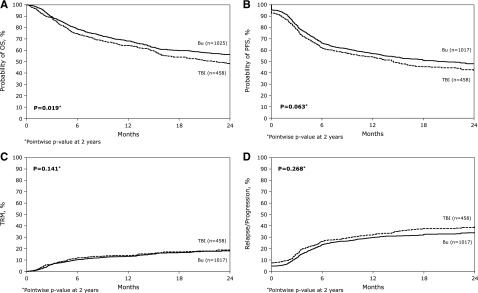
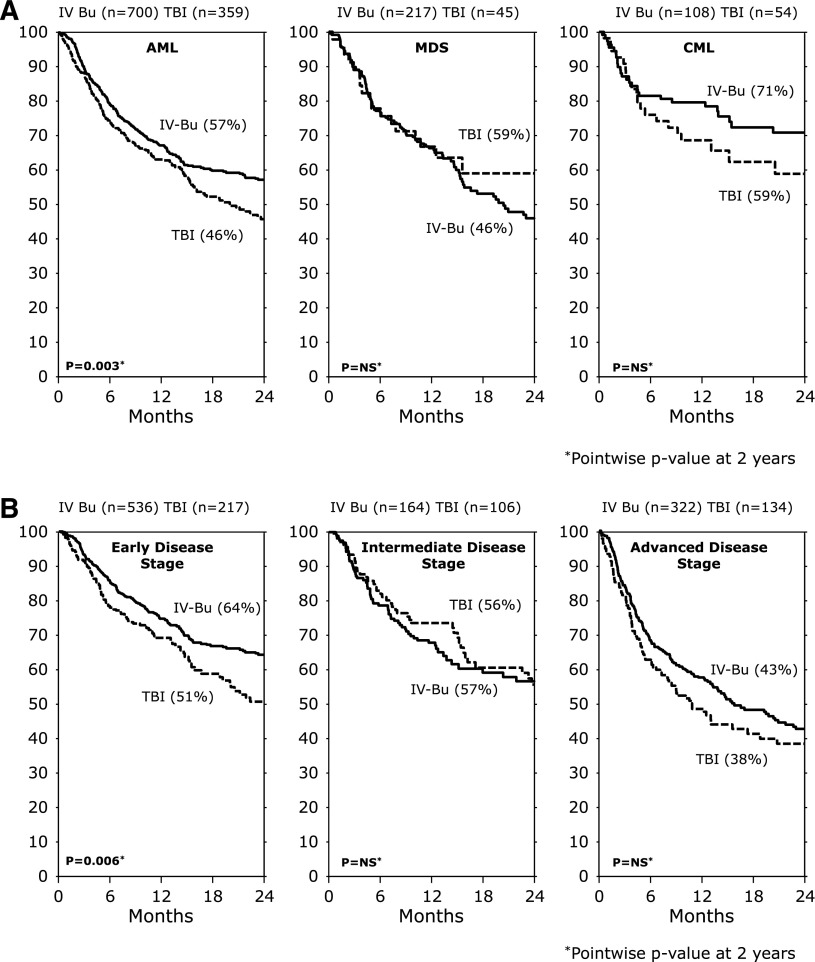
We conducted a prospective cohort study testing the noninferiority of survival of ablative intravenous busulfan (IV-BU) vs ablative total body irradiation (TBI)-based regimens in myeloid malignancies. A total of 1483 patients undergoing transplantation for myeloid malignancies (IV-BU, N = 1025; TBI, N = 458) were enrolled. Cohorts were similar with respect to age, gender, race, performance score, disease, and disease stage at transplantation. Most patients had acute myeloid leukemia (68% IV-BU, 78% TBI). Grafts were primarily peripheral blood (77%) from HLA-matched siblings (40%) or well-matched unrelated donors (48%). Two-year probabilities of survival (95% confidence interval [CI]), were 56% (95% CI, 53%-60%) and 48% (95% CI, 43%-54%, P = .019) for IV-BU (relative risk, 0.82; 95% CI, 0.68-0.98, P = .03) and TBI, respectively. Corresponding incidences of transplant-related mortality (TRM) were 18% (95% CI, 16%-21%) and 19% (95% CI, 15%-23%, P = .75) and disease progression were 34% (95% CI, 31%-37%) and 39% (95% CI, 34%-44%, P = .08). The incidence of hepatic veno-occlusive disease (VOD) was 5% for IV-BU and 1% with TBI (P < .001). There were no differences in progression-free survival and graft-versus-host disease. Compared with TBI, IV-BU resulted in superior survival with no increased risk for relapse or TRM. These results support the use of myeloablative IV-BU vs TBI-based conditioning regimens for treatment of myeloid malignancies.
Figures
Comment in
-
Busulfan or TBI: answer to an age-old question.Blood. 2013 Dec 5;122(24):3856-7. doi: 10.1182/blood-2013-10-530006. Blood. 2013. PMID: 24311716
References
-
- Thomas ED, Buckner CD, Clift RA, et al. Marrow transplantation for acute nonlymphoblastic leukemia in first remission. N Engl J Med. 1979;301(11):597–599. - PubMed
-
- Tutschka PJ, Copelan EA, Kapoor N. Replacing total body irradiation with busulfan as conditioning of patients with leukemia for allogeneic marrow transplantation. Transplant Proc. 1989;21(1 Pt 3):2952–2954. - PubMed
-
- Blaise D, Maraninchi D, Archimbaud E, et al. Allogeneic bone marrow transplantation for acute myeloid leukemia in first remission: a randomized trial of a busulfan-Cytoxan versus Cytoxan-total body irradiation as preparative regimen: a report from the Group d’Etudes de la Greffe de Moelle Osseuse. Blood. 1992;79(10):2578–2582. - PubMed
-
- Ringdén O, Ruutu T, Remberger M, et al. A randomized trial comparing busulfan with total body irradiation as conditioning in allogeneic marrow transplant recipients with leukemia: a report from the Nordic Bone Marrow Transplantation Group. Blood. 1994;83(9):2723–2730. - PubMed
-
- Clift RA, Buckner CD, Thomas ED, et al. Marrow transplantation for chronic myeloid leukemia: a randomized study comparing cyclophosphamide and total body irradiation with busulfan and cyclophosphamide. Blood. 1994;84(6):2036–2043. - PubMed
Publication types
MeSH terms
Substances
Grants and funding
LinkOut - more resources
Full Text Sources
Other Literature Sources
Research Materials
