


Cemented versus uncemented hemiarthroplasty for displaced femoral neck fractures: 5-year followup of a randomized trial
- PMID: 24081667
- PMCID: PMC3940758
- DOI: 10.1007/s11999-013-3308-9
Cemented versus uncemented hemiarthroplasty for displaced femoral neck fractures: 5-year followup of a randomized trial
Abstract
Background: Displaced femoral neck fractures usually are treated with hemiarthroplasty. However, the degree to which the design of the implant used (cemented or uncemented) affects the outcome is not known and may be therapeutically important.
Questions/purposes: In this randomized controlled trial, we sought to compare cemented with cementless fixation in bipolar hemiarthroplasties at 5 years in terms of (1) Harris hip scores; (2) femoral fractures; (3) overall health outcomes using the Barthel Index and EQ-5D scores; and (4) complications, reoperations, and mortality since our earlier report on this cohort at 1-year followup.
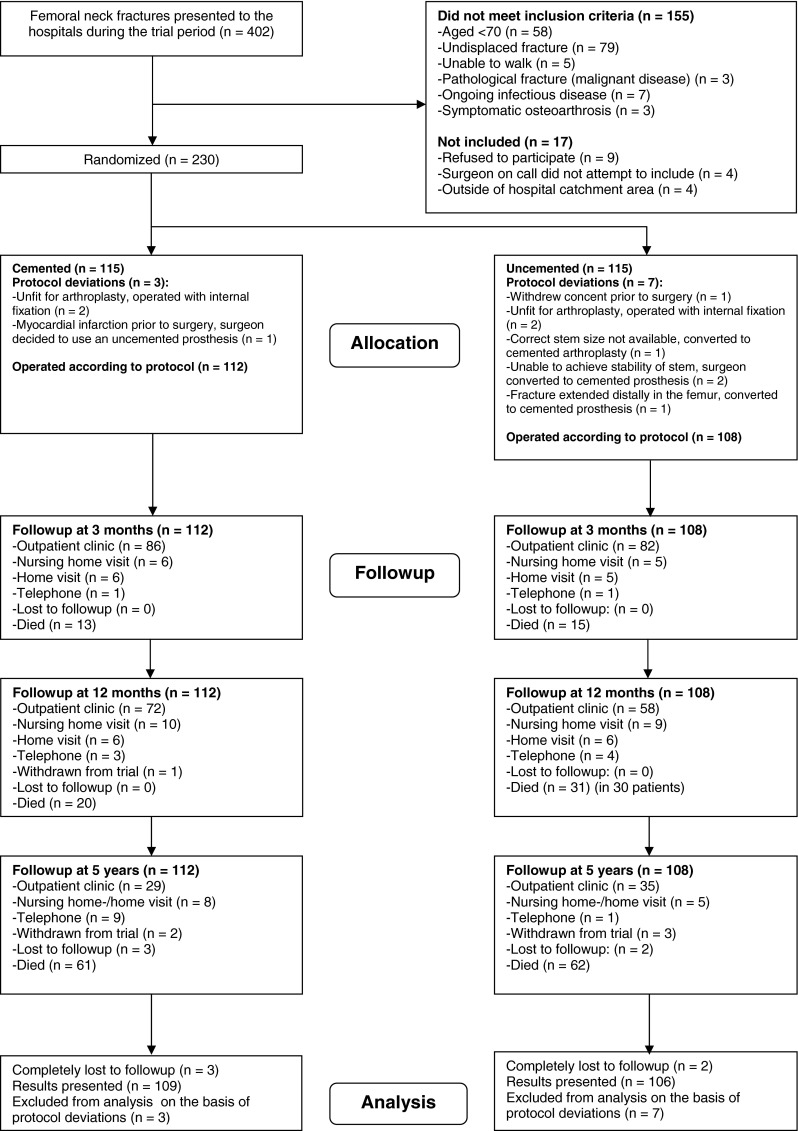
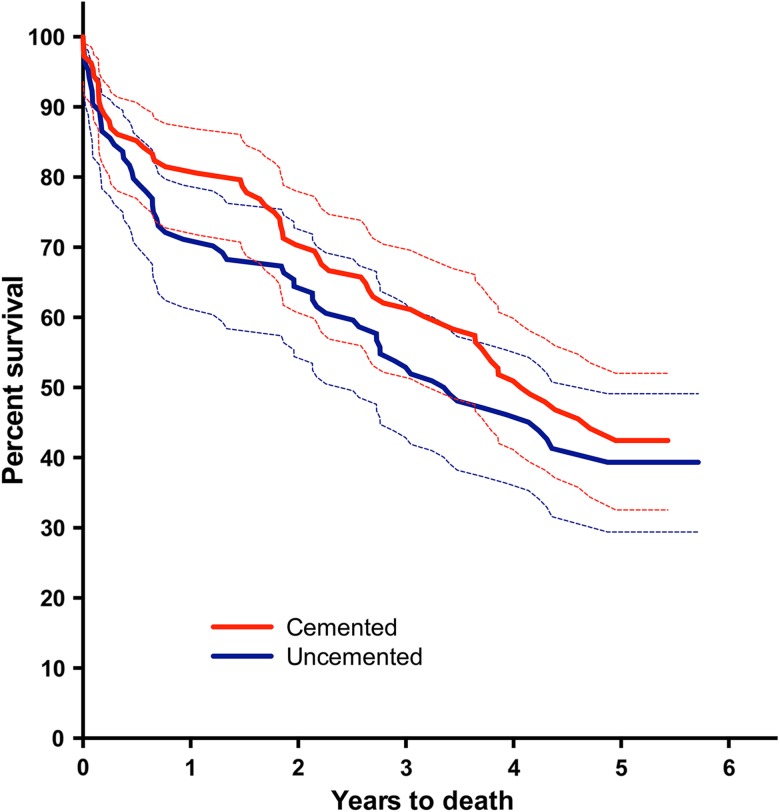
Methods: We present followup at a median of 5 years after surgery (range, 56-65 months) from a randomized trial comparing a cemented hemiarthroplasty (112 hips) with an uncemented, hydroxyapatite-coated hemiarthroplasty (108 hips), both with a bipolar head. Results were previously reported at 1-year followup. Harris hip scores, Barthel Index, and EQ-5D scores were assessed by one research nurse and one orthopaedic surgeon. Complications and reoperations were determined by chart review and radiographs examined by three orthopaedic surgeons. Sixty patients (56%) had died in the cemented group and 63 (60%) in the uncemented group. Respectively, three and two patients (2.7% and 1.9%) were completely lost to followup.
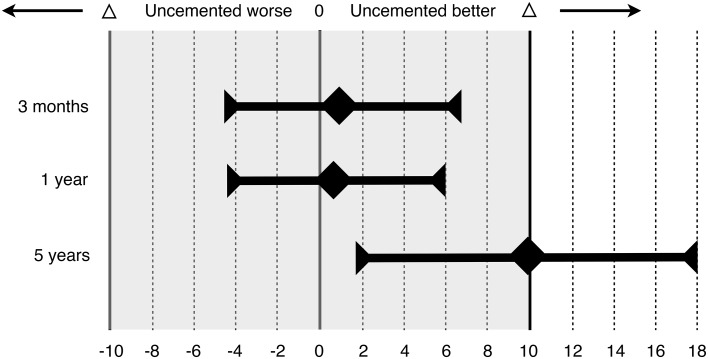
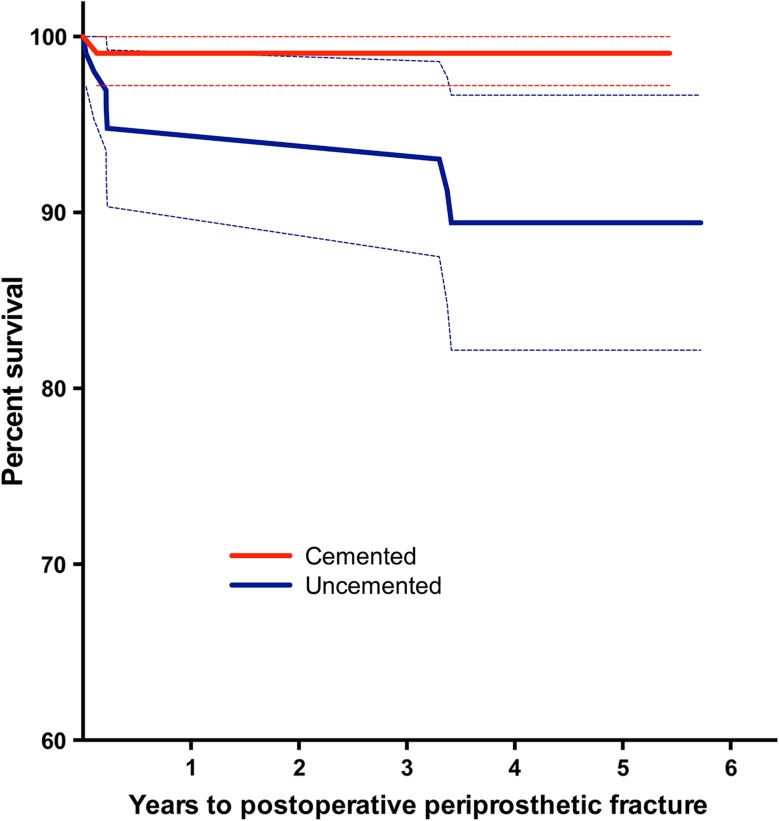
Results: Harris hip scores at 5 years were higher in the uncemented group than in the cemented group (86.2 versus 76.3; mean difference 9.9; 95% confidence interval [CI], 1.9-17.9). The prevalence of postoperative periprosthetic femoral fractures was 7.4% in the uncemented group and 0.9% in the cemented group (hazard ratio [HR], 9.3; 95% CI, 1.16-74.5). Barthel Index and EQ-5D scores were not different between the groups. Between 1 and 5 years, we found no additional infections or dislocations. The mortality rate was not different between the groups (HR, 1.2; 95% CI, 0.82-1.7).
Conclusions: Both arthroplasties may be used with good medium-term results after displaced femoral neck fractures. The uncemented hemiarthroplasty may result in higher hip scores but appears to carry an unacceptably high risk of later femoral fractures.
Level of evidence: Level I, therapeutic study. See the Guidelines for Authors for a complete description of levels of evidence.
Figures
References
-
- Bhandari M, Devereaux PJ, Tornetta P, 3rd, Swiontkowski MF, Berry DJ, Haidukewych G, Schemitsch EH, Hanson BP, Koval K, Dirschl D, Leece P, Keel M, Petrisor B, Heetveld M, Guyatt GH. Operative management of displaced femoral neck fractures in elderly patients. An international survey. J Bone Joint Surg Am. 2005;87:2122–2130. doi: 10.2106/JBJS.E.00535. - DOI - PubMed
-
- EuroQol_Group. EuroQol—a new facility for the measurement of health-related quality of life. Health Policy. 1990;16:199–208. - PubMed
Publication types
MeSH terms
Substances
LinkOut - more resources
Full Text Sources
Other Literature Sources
Medical
Research Materials
