


Snatch-farrowed, porcine-colostrum-deprived (SF-pCD) pigs as a model for swine infectious disease research
- PMID: 24082397
- PMCID: PMC3605934
Snatch-farrowed, porcine-colostrum-deprived (SF-pCD) pigs as a model for swine infectious disease research
Abstract
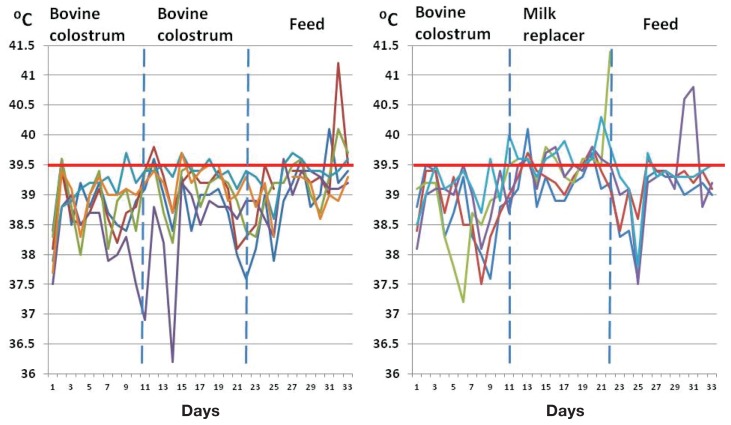
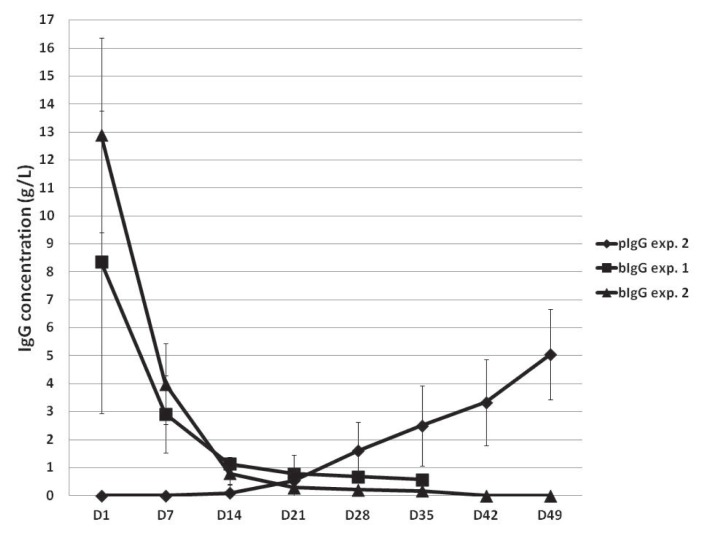
The current study tested the benefit of commercially available spray-dried bovine colostrum (The Saskatoon Colostrum Company, Saskatoon, Saskatchewan) in raising snatch-farrowed, porcine-colostrum-deprived (SF-pCD) pigs. In experiment 1, 12 SF-pCD pigs received a liquid diet composed mainly of bovine colostrum from birth to day 10; 6 remained on the same liquid diet (COL), and the other 6 were fed a diet composed mainly of milk replacer (RPL) until weaning. In experiment 2, 12 SF-pCD pigs were fed mainly bovine colostrum before weaning; after weaning, 6 were fed a starter diet containing 20% (w/w) bovine colostrum powder (STARTER-COL), and the other 6 were fed a starter diet without any bovine colostrum (STARTER-CTRL) until termination (day 42 or day 49). In experiment 1 the COL pigs had significantly fewer fever-days than did the RPL pigs. In experiment 2 diarrhea, typhlocolitis, and pancreatic degeneration developed in 4 of the STARTER-COL pigs after weaning. In both experiments all the pigs fed mainly bovine colostrum before weaning survived until termination. All pigs tested free of swine influenza virus H1N1 and H3N2, Porcine reproductive and respiratory syndrome virus, and Porcine parvovirus. In experiment 2 all the pigs tested free of Porcine circovirus type 2 (PCV2), but some in both groups tested positive for Torque teno virus genogroups 1 and 2. In conclusion, with the use of snatch-farrowing and bovine colostrum, pigs can be raised in the absence of porcine maternal antibodies with 100% survival and freedom from most porcine pathogens of biologic relevance. This model is potentially suitable for animal disease research.
La présente étude visait à tester l’avantage du colostrum bovin déshydraté disponible commercialement pour élever des porcs captés à la misebas et privés de colostrum porcin (SF-pCD). Dans l’expérience 1, 12 porcs SF-pCD ont reçu une diète liquide composée principalement de colostrum bovin de la naissance au jour 10; 6 sont demeurés sur la même diète liquide (COL), et les 6 autres étaient nourris avec une diète composée principalement de substitut de lait (RPL) jusqu’au sevrage. Dans l’expérience 2, 12 porcs SF-pCD étaient nourris principalement avec du colostrum bovin avant le sevrage; après le sevrage, 6 étaient nourris avec une diète de début contenant 20 % (poids/poids) de poudre de colostrum bovin (STARTER-COL), et les 6 autres étaient nourris avec une diète de début mais sans le colostrum bovin (STARTER-CTRL) jusqu’à la fin de l’expérience (jour 42 ou jour 49). Dans l’expérience 1, les porcs COL avaient significativement moins de jours avec fièvre que les porcs RPL. Dans l’expérience 2, de la diarrhée, une typhlocolite et une dégénération du pancréas s’est développée chez 4 des porcs STARTER-COL après le sevrage. Dans les 2 expériences tous les porcs nourris principalement avec du colostrum bovin avant le sevrage ont survécu jusqu’à la fin de l’expérimentation. Tous les porcs se sont avérés négatifs pour les virus H1N1 et H3N2 de l’influenza porcin, le virus du syndrome reproducteur et respiratoire porcin, et le parvovirus porcin. Dans l’expérience 2, tous les porcs ont testé négatif pour le circovirus porcin de type 2 (PCV2), mais quelques-uns dans les 2 groupes ont testé positif pour le virus Torque teno des génogroupes 1 et 2. En conclusion, avec l’utilisation de la mise-bas avec captation et de colostrum bovin, les porcs peuvent être élevés en absence d’anticorps maternels porcins avec un taux de survie de 100 % et l’absence des principaux agents pathogènes porcins d’importance biologique. Ce modèle est potentiellement approprié pour la recherche sur les maladies animales.(Traduit par Docteur Serge Messier).
Figures
References
-
- Struve R. A source of CDCD swine for research. Proc Am Assoc Swine Vet Conf. 1999;117
-
- Sangild PT, Holtug K, Diernaes L, Schmidt M, Skadhauge E. Birth and prematurity influence intestinal function in the new-born pig. Comp Biochem Physiol A Physiol. 1997;118:359–361. - PubMed
-
- Fowden AL, Li J, Forhead AJ. Glucocorticoids and the preparation for life after birth: Are there long-term consequences of the life insurance? Proc Nutr Soc. 1998;57:113–122. - PubMed
-
- Butler JE, Weber P, Sinkora M, et al. Antibody repertoire development in fetal and neonatal piglets. VIII. Colonization is required for newborn piglets to make serum antibodies to T-dependent and type 2 T-independent antigens. J Immunol. 2002;169:6822–6830. - PubMed
Publication types
MeSH terms
Substances
LinkOut - more resources
Full Text Sources
Other Literature Sources