


Female gender remains an independent risk factor for poor outcome after acute nontraumatic intracerebral hemorrhage
- PMID: 24083025
- PMCID: PMC3777128
- DOI: 10.1155/2013/219097
Female gender remains an independent risk factor for poor outcome after acute nontraumatic intracerebral hemorrhage
Abstract
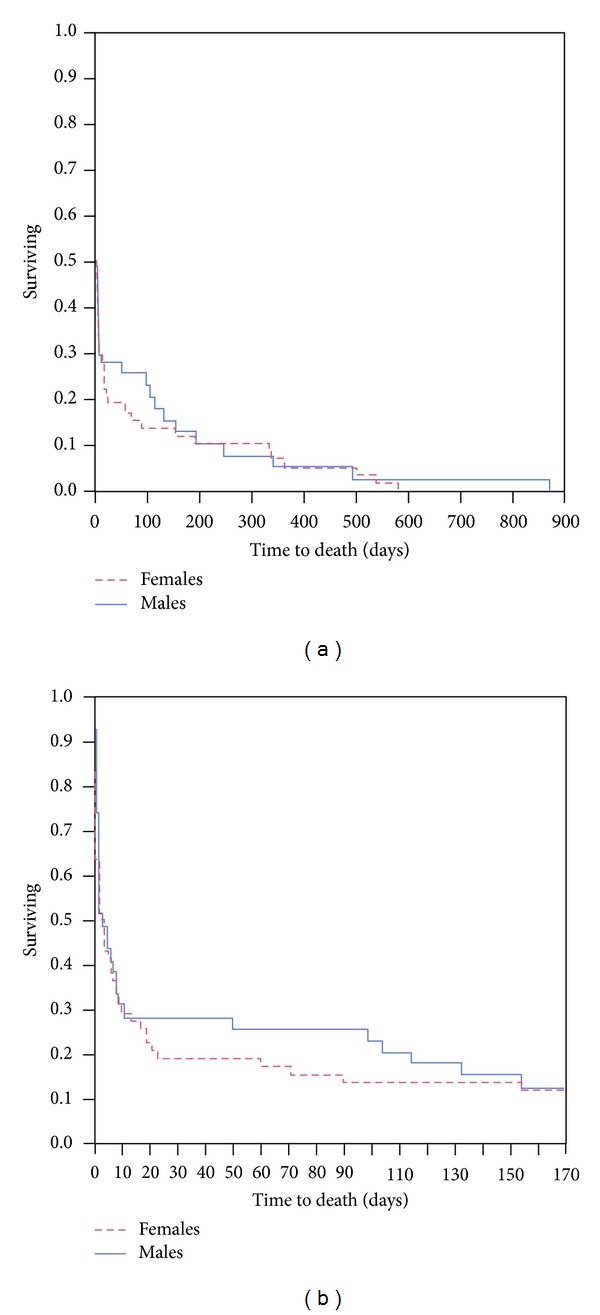
Objective. To study whether gender influences outcome after intracerebral hemorrhage (ICH). Methods. Cohort study of 245 consecutive adults presenting to the emergency department with spontaneous ICH from January 2006 to December 2008. Patients with subarachnoid hemorrhage, extradural hemorrhage, and recurrence of hemorrhage were excluded. Results. There were no differences noted between genders in stroke severity (NIHSS) at presentation, ICH volume, or intraventricular extension (IVE) of hemorrhage. Despite this, females had 1.94 times higher odds of having a bad outcome (modified Rankin score (mRs) ≥3) as compared to males (95% CI 1.12 to 3.3) and 1.84 times higher odds of early mortality (95% CI 1.02-3.33). analyzing known variables influencing mortality in ICH, the authors found that females did have higher serum glucose levels on arrival (P = 0.0096) and 4.2 times higher odds for a cerebellar involvement than males (95% CI 1.63-10.75). After adjusting for age, NIHSS, glucose levels, hemorrhage volume, and IVE, female gender remained an independent predictor of early mortality (P = 0.0127). Conclusions. Female gender may be an independent predictor of early mortality in ICH patients, even after adjustment for stroke severity, hemorrhage volume, IVE, serum glucose levels, and age.
Figures
References
-
- Rosamond WD, Folsom AR, Chambless LE, et al. Stroke incidence and survival among middle-aged adults: 9-year follow- up of the atherosclerosis Risk in Communities (ARIC) cohort. Stroke. 1999;30(4):736–743. - PubMed
-
- Towfighi A, Saver JL, Engelhardt R, Ovbiagele B. A midlife stroke surge among women in the United States. Neurology. 2007;69(20):1898–1904. - PubMed
-
- Murphy SL, Xu J, Kochanek KD. National Vital Statistics Reports. Division of Vital Statistics Centers for Disease Control and Prevention; 2013. Deaths: final data for 2010. http://www.cdc.gov/nchs/data/nvsr/nvsr61/nvsr61_04.pdf. - PubMed
-
- Appelros P, Stegmayr B, Terent A. Sex differences in stroke epidemiology: a systematic review. Stroke. 2009;40(4):1082–1090. - PubMed
-
- Di Carlo A, Lamassa M, Baldereschi M, et al. Sex differences in the clinical presentation, resource use, and 3-month outcome of acute stroke in Europe: data from a multicenter multinational hospital-based registry. Stroke. 2003;34(5):1114–1119. - PubMed
LinkOut - more resources
Full Text Sources
Other Literature Sources
Research Materials
