


Stroke prevention in atrial fibrillation in older adults: existing knowledge gaps and areas for innovation: a summary of an American Federation for Aging research seminar
- PMID: 24083473
- PMCID: PMC3801265
- DOI: 10.1111/jgs.12456
Stroke prevention in atrial fibrillation in older adults: existing knowledge gaps and areas for innovation: a summary of an American Federation for Aging research seminar
Abstract
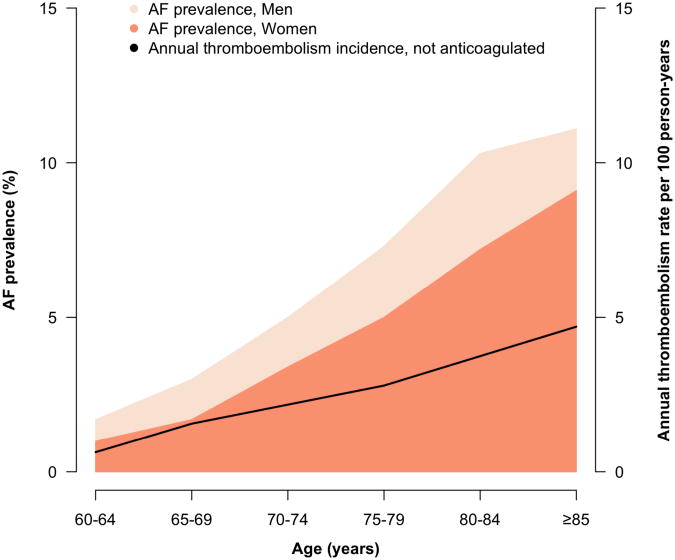
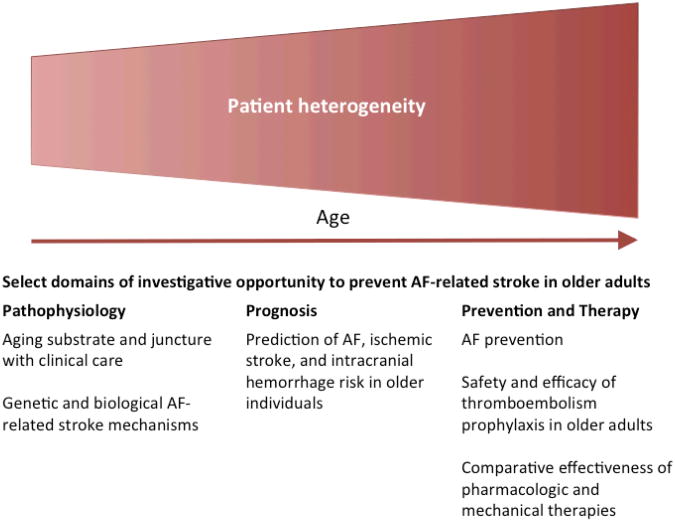
Atrial fibrillation (AF) is a common and morbid cardiac arrhythmia that increases in prevalence with advancing age. The risk of ischemic stroke, a primary and disabling hazard of AF, also increases with advancing age. The aging of the population is anticipated to contribute to a rising burden of AF-related morbidity and economic costs, given the close association between the arrhythmia and aging. Recent biological, diagnostic, and therapeutic developments raise hope that AF-related stroke can be largely prevented, yet despite advances in stroke prevention for individuals with AF, numerous scientific and clinical knowledge gaps remain, particularly as these developments are applied to older adults. Given the public health importance of AF-related stroke in elderly adults, a group of clinician-investigators convened on April 5, 2012, to identify promising areas for investigation that may ultimately reduce stroke-related morbidity. This article summarizes the meeting discussion and emphasizes innovative topic areas that may ultimately facilitate the application of novel preventive, diagnostic, and therapeutic insights into the management of older adults with AF. The opinions of those that participated in the meeting limit this report, which may not represent all of the questions that other experts in this field might raise.
Keywords: atrial fibrillation; elderly; prevention; stroke.
© 2013, Copyright the Authors Journal compilation © 2013, The American Geriatrics Society.
Conflict of interest statement
Figures
References
-
- Go AS, Hylek EM, Phillips KA, et al. Prevalence of diagnosed atrial fibrillation in adults: National implications for rhythm management and stroke prevention: the AnTicoagulation and Risk Factors in Atrial Fibrillation (ATRIA) Study. JAMA. 2001;285:2370–2375. - PubMed
-
- Wolf PA, Abbott RD, Kannel WB. Atrial fibrillation as an independent risk factor for stroke: the Framingham Study. Stroke. 1991;22:983–988. - PubMed
-
- Lamassa M, Di Carlo A, Pracucci G, et al. Characteristics, outcome, and care of stroke associated with atrial fibrillation in Europe: Data from a multicenter multinational hospital-based registry (The European Community Stroke Project) Stroke. 2001;32:392–398. - PubMed
-
- Kim MH, Johnston SS, Chu BC, et al. Estimation of total incremental health care costs in patients with atrial fibrillation in the United States. Circ Cardiovasc Qual Outcomes. 2011;4:313–320. - PubMed
Publication types
MeSH terms
Substances
Grants and funding
- R01 AG026484/AG/NIA NIH HHS/United States
- 1K23HL114724/HL/NHLBI NIH HHS/United States
- R01 HL092577/HL/NHLBI NIH HHS/United States
- T32 NS048005/NS/NINDS NIH HHS/United States
- 5R01AG026484-08/AG/NIA NIH HHS/United States
- P50 NS051343/NS/NINDS NIH HHS/United States
- R01 HL102214/HL/NHLBI NIH HHS/United States
- 5P50NS051343-08/NS/NINDS NIH HHS/United States
- RC2 HL101589/HL/NHLBI NIH HHS/United States
- T32NS048005-08/NS/NINDS NIH HHS/United States
- 1R01HL102214/HL/NHLBI NIH HHS/United States
- 1R01HL092577/HL/NHLBI NIH HHS/United States
LinkOut - more resources
Full Text Sources
Other Literature Sources
Medical
Miscellaneous
