. 2013 Oct 1:13:217.
doi: 10.1186/1471-2180-13-217.

Selective photoinactivation of Candida albicans in the non-vertebrate host infection model Galleria mellonella

Affiliations

Selective photoinactivation of Candida albicans in the non-vertebrate host infection model Galleria mellonella

José Chibebe Junior et al. BMC Microbiol. .

Abstract

Background: Candida spp. are recognized as a primary agent of severe fungal infection in immunocompromised patients, and are the fourth most common cause of bloodstream infections. Our study explores treatment with photodynamic therapy (PDT) as an innovative antimicrobial technology that employs a nontoxic dye, termed a photosensitizer (PS), followed by irradiation with harmless visible light. After photoactivation, the PS produces either singlet oxygen or other reactive oxygen species (ROS) that primarily react with the pathogen cell wall, promoting permeabilization of the membrane and cell death. The emergence of antifungal-resistant Candida strains has motivated the study of antimicrobial PDT (aPDT) as an alternative treatment of these infections. We employed the invertebrate wax moth Galleria mellonella as an in vivo model to study the effects of aPDT against C. albicans infection. The effects of aPDT combined with conventional antifungal drugs were also evaluated in G. mellonella.

Results: We verified that methylene blue-mediated aPDT prolonged the survival of C. albicans infected G. mellonella larvae. The fungal burden of G. mellonella hemolymph was reduced after aPDT in infected larvae. A fluconazole-resistant C. albicans strain was used to test the combination of aPDT and fluconazole. Administration of fluconazole either before or after exposing the larvae to aPDT significantly prolonged the survival of the larvae compared to either treatment alone.

Conclusions: G. mellonella is a useful in vivo model to evaluate aPDT as a treatment regimen for Candida infections. The data suggests that combined aPDT and antifungal therapy could be an alternative approach to antifungal-resistant Candida strains.


Figures
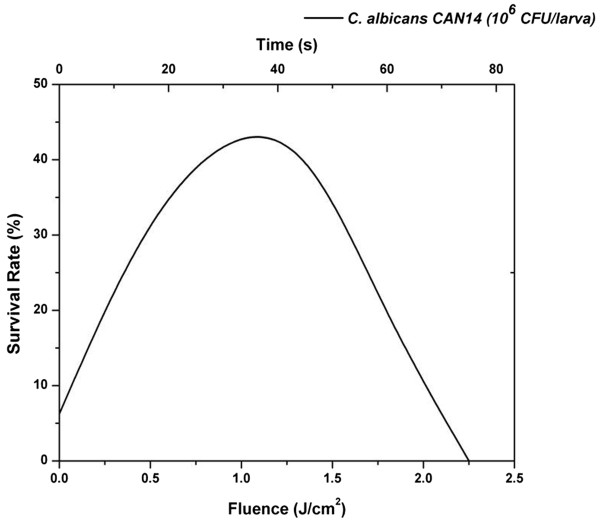
Figure 1
Figure 1
Dose–response 24 h after aPDT in G. mellonella infected by C. albicans Can14. Larvae were infected with 1x10⁶ CFU/larva of C. albicans Can14. The best survival rate was found when the fluence of 0.9 J/cm2 was applied.
Figure 2
Figure 2
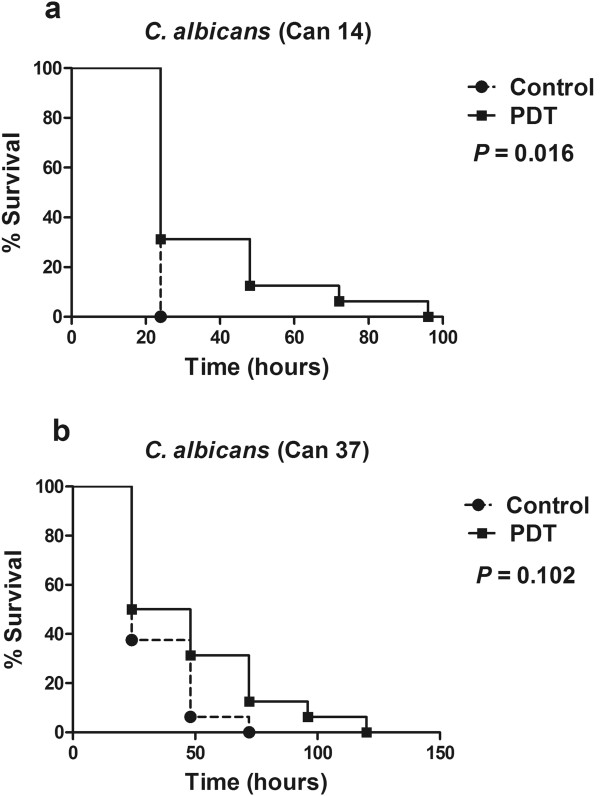
Killing of G. mellonella by C. albicans exposed to antimicrobial PDT. In the aPDT group, the larvae received the PS injection 90 min after the infection with C. albicans. In order to allow a good dispersion of the PS into the insect body, we waited at least 30 additional min after the PS injection prior to the light irradiation. A control group received PS without light exposure. Larvae were maintained at 37°C. a)C. albicans Can14 wild-type strain SC5314, b)C. albicans Can37 clinical isolate from oropharyngeal candidiasis and fluconazole resistant.
Figure 3
Figure 3
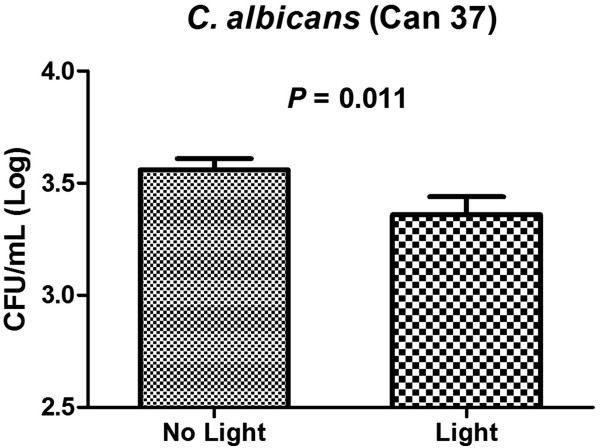
Number of fungal cells in G. mellonella hemolymph immediately post exposed to antimicrobial PDT treatment. Larvae were infected with 1.41x10⁶ CFU/larva of C. albicans Can37 and were maintained at 37°C. After 90 min post-infection, the PS was injected. We waited an additional 30 min prior to light irradiation. After light irradiation, the bacterial burden was measured immediately. Fungal burden was quantified from pools of three larvae hemolymph. aPDT exposed groups resulted in a significant fungal burden reduction when compared to the control group that was not exposed to light. Bars and error bars represent, respectively, the mean and standard deviation of three pooled larvae per group.
Figure 4
Figure 4
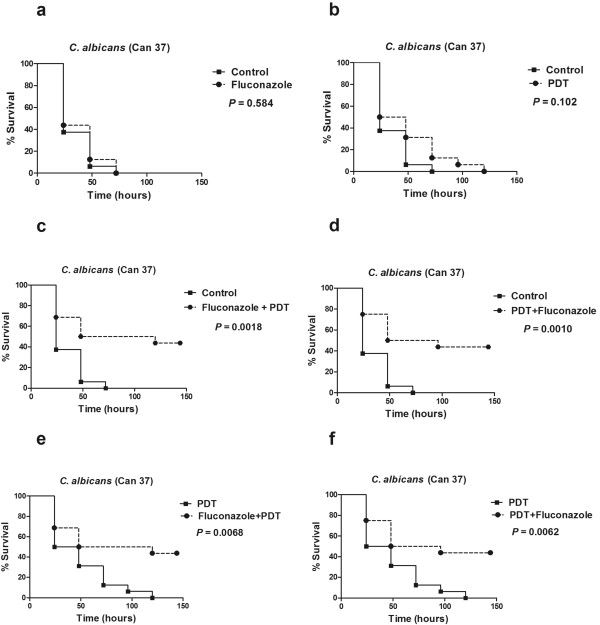
Killing of G. mellonella larvae after infection by C. albicans Can37 fluconazole resistant. The larvae received an injection of 1.4x10⁶CFU/larva and were maintained at 37°C. a) administration of fluconazole (14 mg/kg) or PBS (Control), b) antimicrobial PDT or only MB (Control), c) administration of fluconazole followed by aPDT in a combined therapy or PBS (Control), d) administration of aPDT followed by fluconazole in a combined therapy or PBS (Control), e) administration of aPDT or fluconazole + PDT, f) administration of aPDT or fluconazole + PDT. There was no significant difference on larvae survival when treatment was done only by injecting of fluconazole (P = 0.584) or aPDT alone (P = 0.102). The combined treatment by application of aPDT followed or before fluconazole injection resulted in significantly lower death rates when compared to a control groups (P = 0.0010 to aPDT followed by fluconazole, and P = 0.0018 when aPDT was applied after fluconazole injection). A significant difference in survival was observed for combined treatment compared to aPDT alone (P = 0.0062 for aPDT followed by fluconazole, and P = 0.0068 when aPDT was applied after fluconazole injection).

References

    1. Chabrier-Rosello Y, Giesselman BR, De Jesus-Andino FJ, Foster TH, Mitra S, Haidaris CG. Inhibition of electron transport chain assembly and function promotes photodynamic killing of Candida. J Photochem Photobiol B. 2010;13:117–125. doi: 10.1016/j.jphotobiol.2010.03.005. - DOI - PMC - PubMed
    1. Thein ZM, Seneviratne CJ, Samaranayake YH, Samaranayake LP. Community lifestyle of Candida in mixed biofilms: a mini review. Mycoses. 2009;13:467–475. doi: 10.1111/j.1439-0507.2009.01719.x. - DOI - PubMed
    1. Junqueira JC, Fuchs BB, Muhammed M, Coleman JJ, Suleiman JM, Vilela SF, Costa AC, Rasteiro VM, Jorge AO, Mylonakis E. Oral Candida albicans isolates from HIV-positive individuals have similar in vitro biofilm-forming ability and pathogenicity as invasive Candida isolates. BMC Microbiol. 2011;13:247. doi: 10.1186/1471-2180-11-247. - DOI - PMC - PubMed
    1. Cowen LE, Singh SD, Kohler JR, Collins C, Zaas AK, Schell WA, Aziz H, Mylonakis E, Perfect JR, Whitesell L. et al. Harnessing Hsp90 function as a powerful, broadly effective therapeutic strategy for fungal infectious disease. Proc Natl Acad Sci USA. 2009;13:2818–2823. doi: 10.1073/pnas.0813394106. - DOI - PMC - PubMed
    1. Douglas LJ. Candida biofilms and their role in infection. Trends Microbiol. 2003;13:30–36. doi: 10.1016/S0966-842X(02)00002-1. - DOI - PubMed

Publication types

MeSH terms

LinkOut - more resources