


Newborn length predicts early infant linear growth retardation and disproportionately high weight gain in a low-income population
- PMID: 24083893
- PMCID: PMC3859373
- DOI: 10.1016/j.earlhumdev.2013.09.008
Newborn length predicts early infant linear growth retardation and disproportionately high weight gain in a low-income population
Abstract
Background: Stunting is prevalent by the age of 6 months in the indigenous population of the Western Highlands of Guatemala.
Aim: The objective of this study was to determine the time course and predictors of linear growth failure and weight-for-age in early infancy.
Study design and subjects: One hundred and forty eight term newborns had measurements of length and weight in their homes, repeated at 3 and 6 months. Maternal measurements were also obtained.
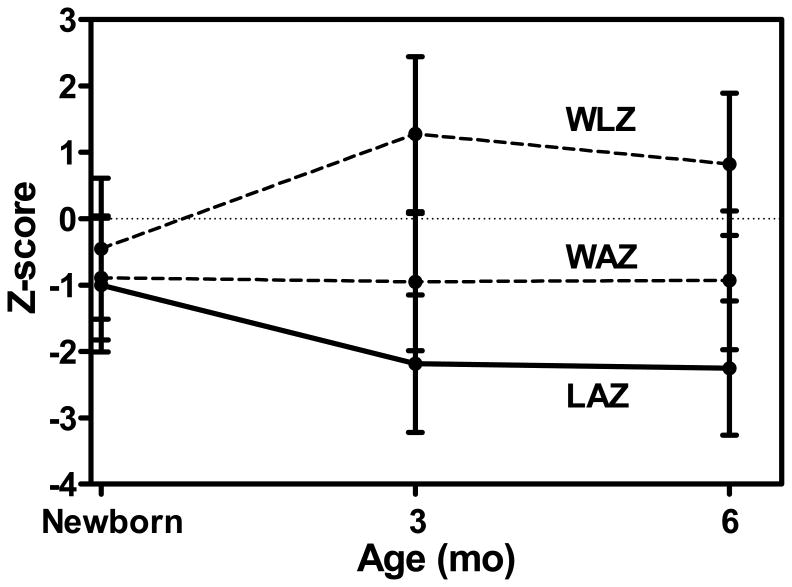
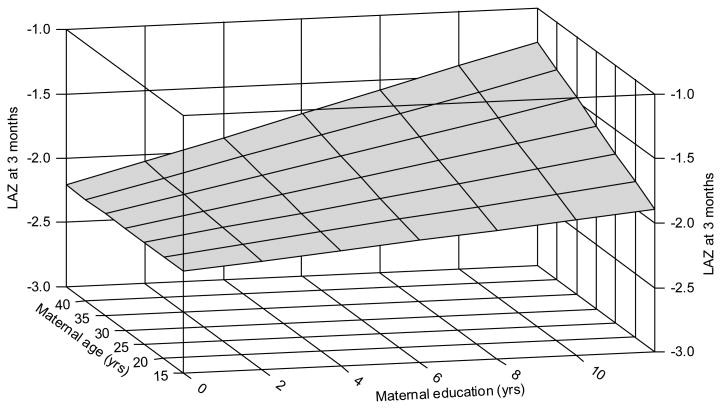
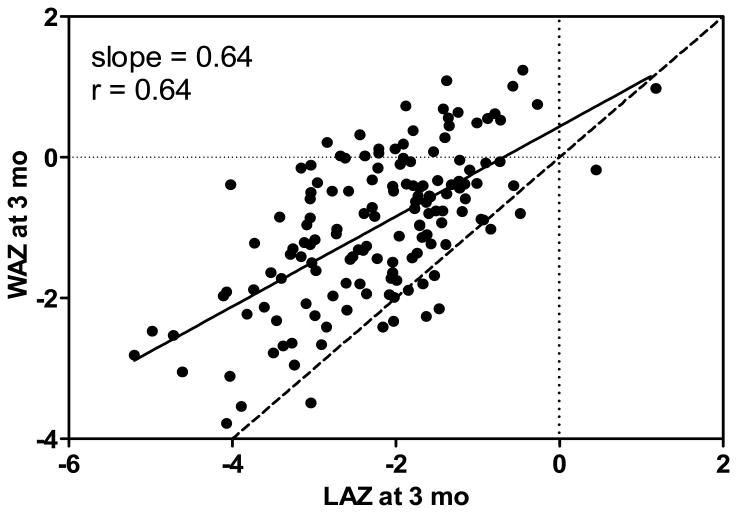
Results: Mean ± SD length-for-age Z-score (LAZ) declined from newborn -1.0 ± 1.01 to -2.20 ± 1.05 and -2.26 ± 1.01 at 3 and 6 months respectively. Stunting rates for newborn, 3 and 6 months were 47%, 53% and 56% respectively. A multiple regression model (R(2) = 0.64) demonstrated that the major predictor of LAZ at 3 months was newborn LAZ with the other predictors being newborn weight-for-age Z-score (WAZ), gender and maternal education∗maternal age interaction. Because WAZ remained essentially constant and LAZ declined during the same period, weight-for-length Z-score (WLZ) increased from -0.44 to +1.28 from birth to 3 months. The more severe the linear growth failure, the greater WAZ was in proportion to the LAZ.
Conclusion: The primary conclusion is that impaired fetal linear growth is the major predictor of early infant linear growth failure indicating that prevention needs to start with maternal interventions.
Keywords: AIC; Akaike Information Criterion; Birth weight; IFS; IUGR; Infant growth; LAZ; LMP; Linear growth; Predictors of infant growth; SES; VIF; WAZ; WLZ; intra-uterine growth retardation; iron folate supplement; last menstrual period; length-for-age Z-score; socio-economic status; variance inflation factor; weight-for-age Z-score; weight-for-length Z-score.
© 2013.
Conflict of interest statement
Figures
References
-
- Caulfield LE, de Onis M, Blossner M, Black RE. Undernutrition as an underlying cause of child deaths associated with diarrhea, pneumonia, malaria, and measles. Am J Clin Nutr. 2004;80(1):193–8. - PubMed
-
- Black RE, Morris SS, Bryce J. Where and why are 10 million children dying every year? Lancet. 2003;361(9376):2226–34. - PubMed
-
- Bhutta ZA, Ahmed T, Black RE, Cousens S, Dewey K, Giugliani E, et al. What works? Interventions for maternal and child undernutrition and survival. Lancet. 2008;371(9610):417–40. - PubMed
-
- Victora CG, de Onis M, Hallal PC, Blossner M, Shrimpton R. Worldwide timing of growth faltering: revisiting implications for interventions. Pediatrics. 2010;125(3):e473–80. - PubMed
-
- Black RE, Allen LH, Bhutta ZA, Caulfield LE, de Onis M, Ezzati M, et al. Maternal and child undernutrition: global and regional exposures and health consequences. Lancet. 2008;371(9608):243–60. - PubMed
Publication types
MeSH terms
Grants and funding
LinkOut - more resources
Full Text Sources
Other Literature Sources
Medical
