


Review
doi: 10.1172/JCI67714.
Epub 2013 Oct 1.
Emerging concepts in immunity to hepatitis C virus infection
- PMID: 24084744
- PMCID: PMC3784533
- DOI: 10.1172/JCI67714
Item in Clipboard
Review
Emerging concepts in immunity to hepatitis C virus infection
J Clin Invest.
2013 Oct.
Abstract
Since the discovery of hepatitis C virus (HCV) by molecular cloning almost a quarter of a century ago, unprecedented at the time because the virus had never been grown in cell culture or detected serologically, there have been impressive strides in many facets of our understanding of the natural history of the disease, the viral life cycle, the pathogenesis, and antiviral therapy. It is apparent that the virus has developed multiple strategies to evade immune surveillance and eradication. This Review covers what we currently understand of the temporal and spatial immunological changes within the human innate and adaptive host immune responses that ultimately determine the outcomes of HCV infection.
Figures
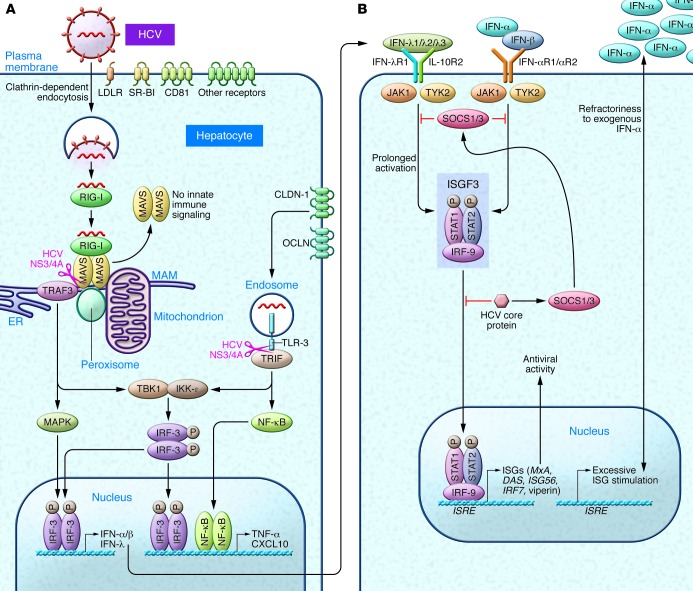
(A) LDL receptors (LDLRs) on the basolateral hepatocyte surface, SR-BI, CD81, and tight-junction proteins CLDN-1 (claudin-1) and OCLN (occludin) are essential for HCV uptake (9). Intracellular HCV recognition occurs through dsRNA sensors such as RIG-I and TLR-3. MAMs function as the central scaffold that coordinates MAVS-dependent signaling of the RIG-I pathway between mitochondria and peroxisomes (21). MAVS interacts with the essential adapter protein TRAF3 to further recruit downstream kinases; activation of the kinases IKK-ε and TANK-binding kinase 1 (TBK1), which phosphorylate the transcription factors IRF-3 and IRF-7 (19), and binding to NF-κB lead to the induction of antiviral and immunomodulatory genes, including types I and III IFNs, as well as chemokines and proinflammatory cytokines that function in parallel with IFNs to mediate the response to HCV (147). (B) Binding of type I IFNs to the IFN-α/β receptors (IFN-αR1 and -2) and type III IFNs (IFN-λ) to the heterodimeric IL-28Ra/IL-10Rβ receptor (24) results in activation of the JAK/STAT pathway, conferring stable association with IRF-9. The resulting IFN-stimulated gene factor 3 (ISGF3) transcription factor complex localizes to the hepatocyte nucleus, where it binds to the ISREs within the promoter/enhancer region of hundreds of ISGs (147). Autocrine and paracrine signaling in neighboring cells results in anti-HCV amplification loops (including IRF-7, which binds to IFN promoters). HCV core protein subverts immunity by the induction of suppressors of cytokine signaling (SOCS1/SOCS3) and by impairing the binding of ISGF3 to nuclear IFN ISREs (19). See text for details.
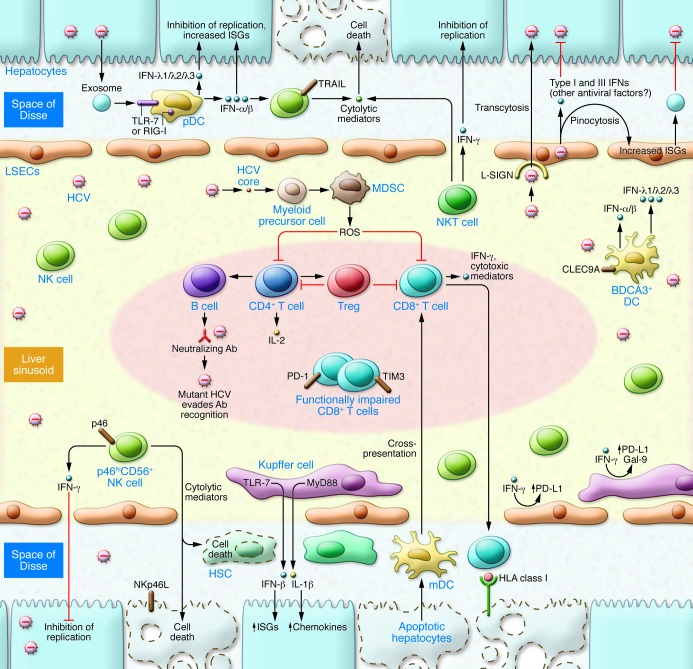
Viral RNA is transferred to pDCs, triggering robust production of IFNs that inhibit HCV replication in hepatocytes. pDCs produce more type I (IFN-α and IFN-β) IFNs, whereas BDCA3+ DCs produce more type III IFNs with HCV infection and do not require direct cell-to-cell contact. NK and NKT cells comprise a large proportion of intrahepatic lymphocytes, mediating antiviral functions through a combination of IFN type II (IFN-γ) production and cytolytic function. IFNα-induced TRAIL is associated with the control of HCV (78, 82). Hepatic accumulation of NKp46hi NK cells is associated with lower viral replication and attenuated fibrosis (78). KCs phagocytose HCV, leading to the induction of innate immune (IFN-β) as well as inflammatory (IL-1β) responses. HCV core protein inhibits type I IFN responses (89) and also drives proinflammatory responses, augmenting processes that result in liver fibrosis (87). IFN-γ induces KC upregulation of Gal-9 and PD-L1, inhibitory ligands that promote T cell dysfunction. LSECs can pinocytose viral particles and produce a broad array of IFNs. Multispecific and polyfunctional CD4+ T (Th) cells provide “help” for clonal expansion of B cells and CTLs required for spontaneous viral control. Early expression of CD127, IL-2 production, development of neutralizing Abs, and HCV-specific CTL cells contribute to immune response (148, 149). PD-1 and TIM3 demarcate functionally impaired CTLs. Moreover, CD33+ myeloid–derived suppressor cells (150) and FOXP3+ Tregs (10, 151) attenuate T cell responses and immune-mediated liver injury.
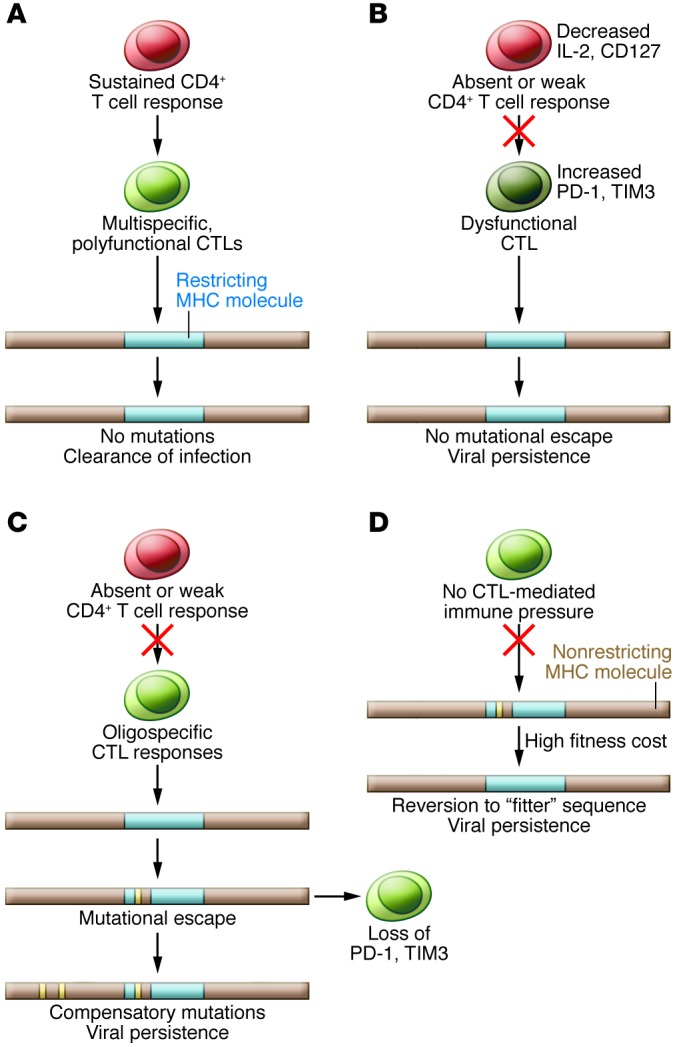
(A) A sustained CD4+ T cell response with multispecific CTLs may constrain the development of viral escape mutations, leading to viral clearance during acute infection. (B) If CTL responses are weak (manifested by high PD-1 and TIM3 expression) with impaired CD4 help and priming, escape mutations likely will not develop. High viral levels and intact HCV epitopes are associated with increased levels of inhibitory receptors. (C) Failure of the CD4+ T cell response in the presence of a narrow but vigorous CTL response favors the development of escape mutations. Additional compensatory mutations may be required for replicative fitness (–122). Viral amino acid substitution is associated with decreased inhibitory receptor expression on CTLs, perhaps accounting for their robust proliferation to wild-type, nonmutated virus (115). (D) Without a restricting HLA allele and immune selective pressure, reversion to the wild-type sequence likely occurs because of the high fitness cost associated with an escape mutation. (Adapted with permission from The Journal of Experimental Medicine [ref. 118].)
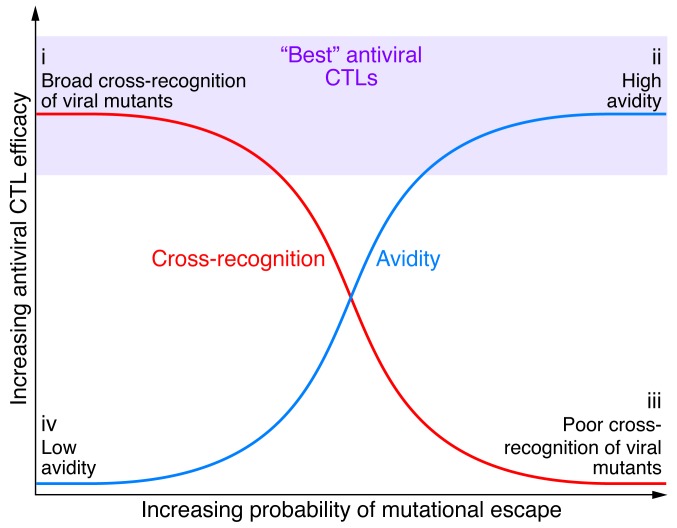
(i) CTLs with low functional avidity rarely select for escape variants, particularly with broad cross-recognition of mutant virus. HCV-specific CTLs that respond effectively to low concentrations of peptide have greater potency than those requiring high peptide concentrations. (ii) CTL responses rapidly selecting for HCV escape variants require a low concentration of peptide for stimulation (high avidity), (iii) but if coupled with poor cross-recognition, they are associated with decreased antiviral efficacy and potentially impaired recognition of variant peptides as they emerge (note that there is the least amount of supportive data in this poor cross-recognition paradigm). (iv) CTLs with low functional avidity rarely select for escape variants. The most effective CTL specificities express both functional attributes (in light purple) during the earliest stages of infection and predate the resolution of viremia. Taken together, the data suggest that strong immunity will eradicate HCV infection, weak immunity will drive few mutations, and intermediate immunity will select for escape but allow for persistence, resulting in a broader viral quasispecies.
References
Publication types
MeSH terms
Grants and funding
- K24 AI083742/AI/NIAID NIH HHS/United States
- R01 HD075549/HD/NICHD NIH HHS/United States
- R01 DK071560/DK/NIDDK NIH HHS/United States
- R01DK071560/DK/NIDDK NIH HHS/United States
- R21 AI103361/AI/NIAID NIH HHS/United States
- R01DK60590/DK/NIDDK NIH HHS/United States
- R01HD075549/HD/NICHD NIH HHS/United States
- U19 AI066328/AI/NIAID NIH HHS/United States
- R21AI103361/AI/NIAID NIH HHS/United States
- U19 AI1066328/AI/NIAID NIH HHS/United States
- R01 DK060590/DK/NIDDK NIH HHS/United States
- R56AI100991/AI/NIAID NIH HHS/United States
- R56 AI100991/AI/NIAID NIH HHS/United States
- K24AI083742/AI/NIAID NIH HHS/United States
LinkOut - more resources
Full Text Sources
Other Literature Sources
Medical
