. 2013 Nov 14;122(20):3440-9.
doi: 10.1182/blood-2012-12-473538. Epub 2013 Oct 1.

Exome sequencing reveals a thrombopoietin ligand mutation in a Micronesian family with autosomal recessive aplastic anemia

Affiliations

Exome sequencing reveals a thrombopoietin ligand mutation in a Micronesian family with autosomal recessive aplastic anemia

Majed J Dasouki et al. Blood. .

Abstract

We recently identified 2 siblings afflicted with idiopathic, autosomal recessive aplastic anemia. Whole-exome sequencing identified a novel homozygous missense mutation in thrombopoietin (THPO, c.112C>T) in both affected siblings. This mutation encodes an arginine to cysteine substitution at residue 38 or residue 17 excluding the 21-amino acid signal peptide of THPO receptor binding domain (RBD). THPO has 4 conserved cysteines in its RBD that form 2 disulfide bonds. Our in silico modeling predicts that introduction of a fifth cysteine may disrupt normal disulfide bonding to cause poor receptor binding. In functional assays, the mutant-THPO-containing media shows two- to threefold reduced ability to sustain UT7-TPO cells, which require THPO for proliferation. Both parents and a sibling with heterozygous R17C change have reduced platelet counts, whereas a sibling with wild-type sequence has normal platelet count. Thus, the R17C partial loss-of-function allele results in aplastic anemia in the homozygous state and mild thrombocytopenia in the heterozygous state in our family. Together with the recent identification of THPO receptor (MPL) mutations and the effects of THPO agonists in aplastic anemia, our results have clinical implications in the diagnosis and treatment of patients with aplastic anemia and highlight a role for the THPO-MPL pathway in hematopoiesis in vivo.


Figures
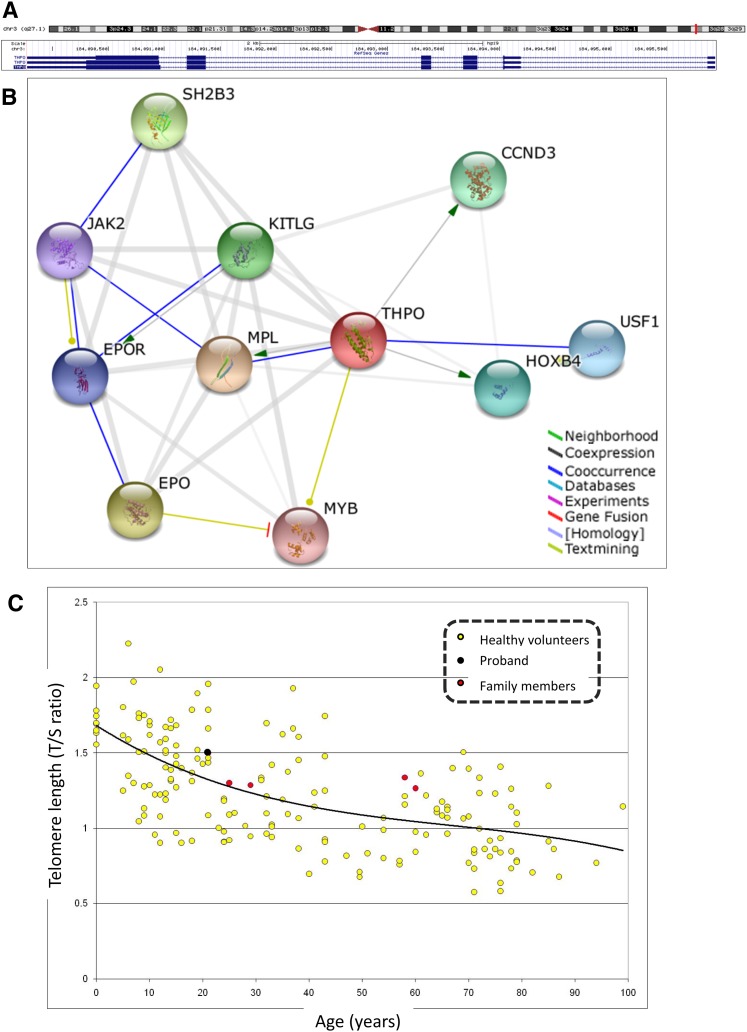
Figure 1
Figure 1
Structure and function of human THPO gene (NM_000460) and telomere length analysis. (A) THPO isoform 1 precursor (chr3q27.1:184 089,773-184 095,9326 160) is extensively alternatively spliced with multiple isoforms (http://genome.ucsc.edu/). Note that THPO is transcribed on the reverse strand. (B) Predicted functional partners of THPO gene (http://string-db.org/). Modes of interaction are shown in different colors with stronger associations represented by thicker lines. Combined score in parentheses. CCND3, cyclin D3 (0.939); EPO, erythropoietin (0.954); EPOR, erythropoietin receptor (0.899); HOXB4, homeobox B4 (0.932); JAK2, Janus kinase 2 (0.895); KITLG, KIT ligand (0.944); MPL, myeloproliferative leukemia virus oncogene (0.999); MYB, v-myb myeloblastosis viral oncogene homolog (avian) (0.892); SH2B3, SH2B adaptor protein 3 (0.944); USF1, upstream transcription factor 1 (0.931). (C) Telomere length in peripheral blood leukocytes is normal in proband and family. Telomere length was determined in the affected proband (black circle) and asymptomatic family members (red circles) by qPCR method and compared with healthy volunteers (yellow circles). No statistical difference was observed in telomere length of the proband or any other family member and control individuals.
Figure 2
Figure 2
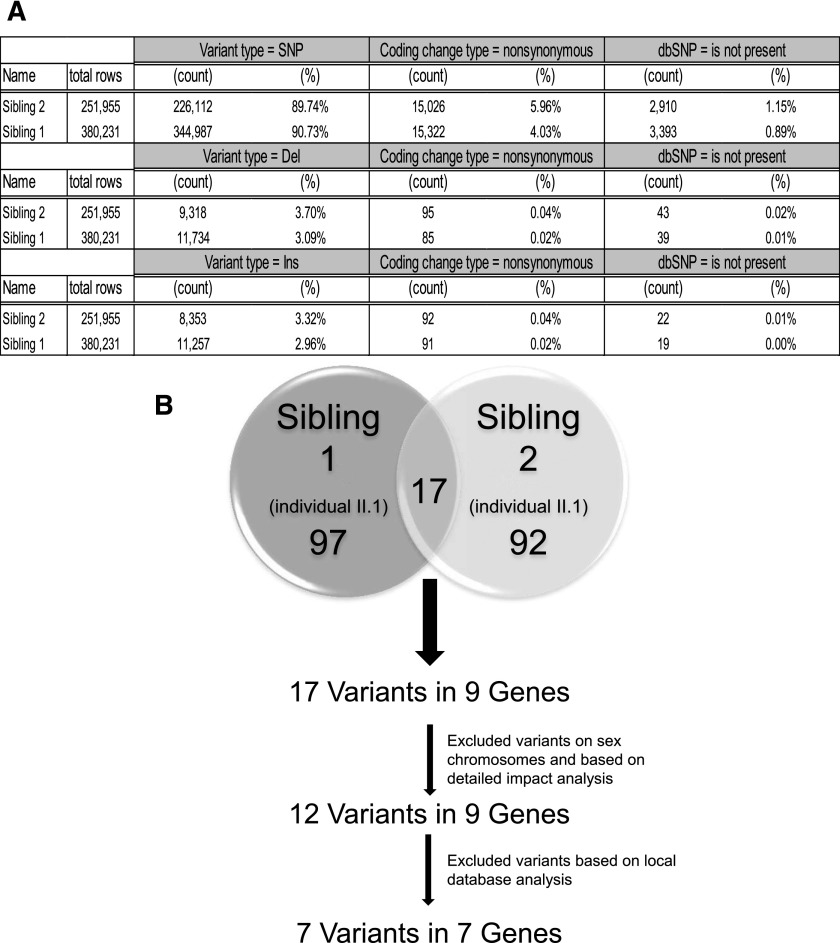
Bioinformatic analysis of exome sequence data to identify candidate homozygous variants. Exome sequence analysis was done in both affected siblings, and the resulting novel, nonsynonymous, homozygous variants were filtered using DNAnexus platform. Only 17 novel nonsynonymous homozygous SNPs were shared between the 2 affected siblings. Using additional filters, novel SNPs were limited to 7.
Figure 3
Figure 3
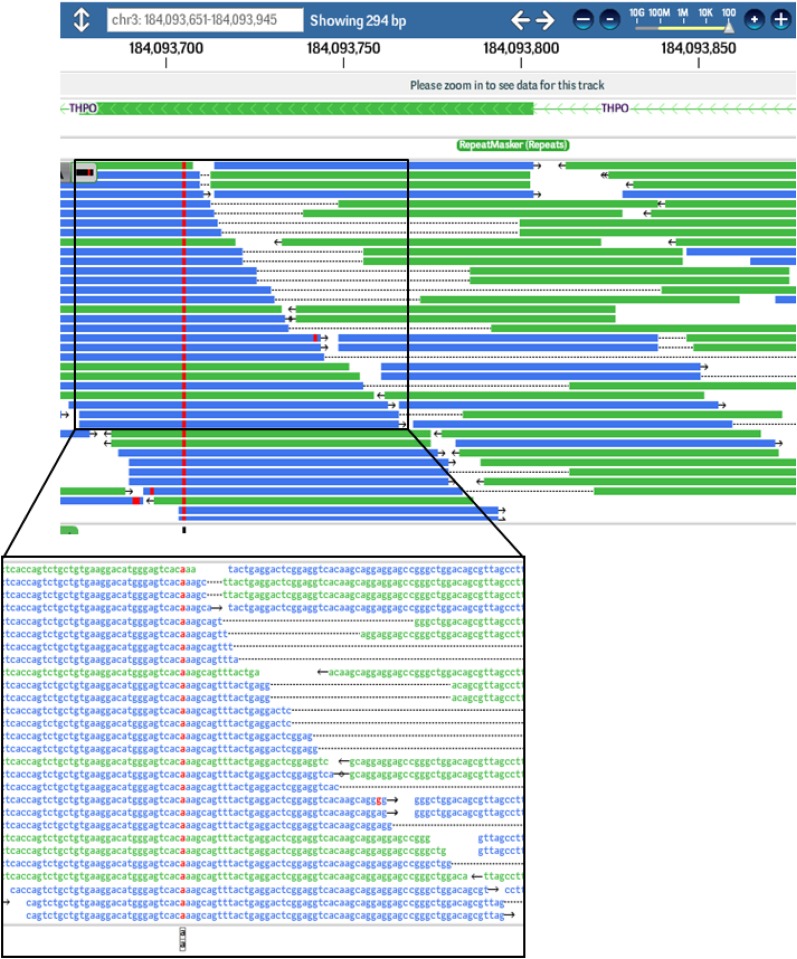
A novel homozygous THPO variant (c.CTG>TGT;p.Arg17Cys) was identified in both siblings affected with aplastic anemia. Screen shot of exome sequence reads (left) and DNA sequence abnormality shown on the reverse strand (red) as visualized by DNAnexus software.
Figure 4
Figure 4
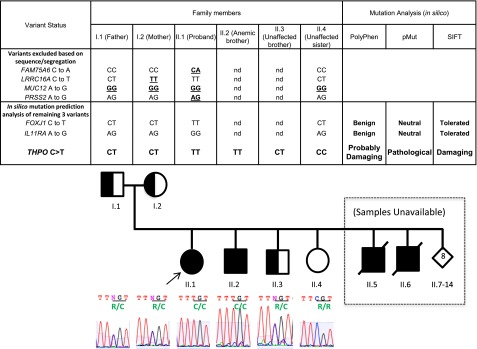
Genetic segregation analysis and in silico mutation prediction analyses of SNP variants identified by exome sequencing. Only the homozygous THPO variant (c.CGT>TGT;p.Arg17C) segregated with the aplastic anemia phenotype in the proband (II.1) and her asymptomatic affected brother (II.2) as shown in A and B. Amino acid substitution is highlighted in green under the affected codon.
Figure 5
Figure 5
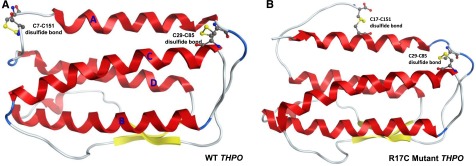
In silico model showing the effect of R17C mutation on disulfide bonding in THPO receptor-binding domain. (A) The THPO receptor-binding domain consists of a 4-helix bundle (red, shown as letters A-D) and a short antiparallel β sheet formed by 2 strands. The domain contains 4 highly conserved cysteine residues (C7, C29, C85, and C151), which form 2 disulfide bonds. Due to position constraints, the mutant C17 cannot form a disulfide bond with any of C7, C29, and C85 residues without disrupting the overall structure but can form a disulfide bond with C151 as shown in B.
Figure 6
Figure 6
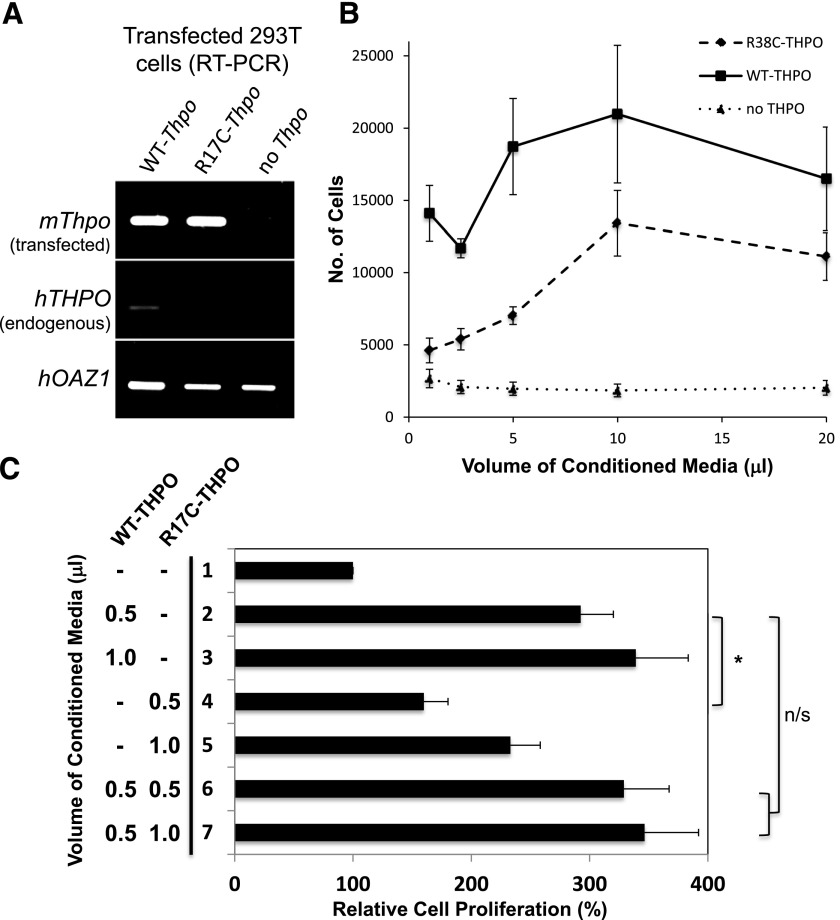
R17C mutant THPO protein is deficient in maintaining UT7-TPO cells. (A) Conditioned media were collected from human embryonic kidney (293T) cells transfected with murine WT-Thpo, mutagenized R17C-Thpo, and control (no Thpo) constructs. The transfected cells were analyzed by RT-PCR. In the top, both WT and R17C mutant mThpo transfections show equivalent expression and none with the control construct (no Thpo). There is no significant endogenous expression of hTHPO in mutant transfected human embryonic kidney cells (middle). The faint hTHPO background band visible in the WT-Thpo transfected sample is due to increased overall transcript levels for WT-Thpo compared with R17C-Thpo and no-Thpo, as seen with control hOAZ1 transcript levels (bottom). (B) 1 × 10⁴ UT7-TPO cells, starved for commercial THPO for 16 hours, were treated with indicated volumes of WT, R17C mutant, or control conditioned media in a 96-well plate. Following 3 days of growth, proliferation was measured using MTT assays. WT THPO-containing conditioned media is able to maintain significantly increased UT7-TPO cell proliferation than the R17C mutant conditioned media at volumes of 1 μL (P < .03), 2.5 μL (P < .0002), and 5 μL (P < .02). Conditioned media with no exogenous THPO were not able to maintain cell proliferation. All treatments were done in triplicate. Results indicate mean ± standard error of the mean from 4 independent experiments. (C) 1 × 10⁴ UT7-TPO cells were treated with indicated amounts of WT and R17C mutant conditioned media as above. MTT assay results following 3 days of growth are shown compared with baseline proliferation in the absence of THPO (lane 1). WT THPO shows significantly greater proliferation of UT7-TPO cells than mutant R17C THPO (lane 2 vs 4; *P < .01). Mutant R17C THPO is not able to reduce proliferation by WT THPO (lane 2 vs 6) even when twice as much mutant THPO is added (lane 2 vs 7). n/s, not significant. All treatments were done in triplicate. Results indicate mean ± standard error of the mean from 6 independent experiments.

References

    1. Young NS, Calado RT, Scheinberg P. Current concepts in the pathophysiology and treatment of aplastic anemia. Blood. 2006;108(8):2509–2519. - PMC - PubMed
    1. Calado RT. Telomeres and marrow failure. Hematology (Am Soc Hematol Educ Program) 2009:338–343. - PubMed
    1. Calado RT, Cooper JN, Padilla-Nash HM, et al. Short telomeres result in chromosomal instability in hematopoietic cells and precede malignant evolution in human aplastic anemia. Leukemia. 2012;26(4):700–707. - PMC - PubMed
    1. Aalbers AM, Kajigaya S, van den Heuvel-Eibrink MM, van der Velden VH, Calado RT, Young NS. Human telomere disease due to disruption of the CCAAT box of the TERC promoter. Blood. 2012;119(13):3060–3063. - PMC - PubMed
    1. Walne AJ, Dokal A, Plagnol V, et al. Exome sequencing identifies MPL as a causative gene in familial aplastic anemia. Haematologica. 2012;97(4):524–528. - PMC - PubMed

Publication types

MeSH terms