. 2013;9(9):e1003601.
doi: 10.1371/journal.ppat.1003601. Epub 2013 Sep 26.

Host adaptation is contingent upon the infection route taken by pathogens

Affiliations

Host adaptation is contingent upon the infection route taken by pathogens

Nelson E Martins et al. PLoS Pathog. 2013.

Abstract

Evolution of pathogen virulence is affected by the route of infection. Also, alternate infection routes trigger different physiological responses on hosts, impinging on host adaptation and on its interaction with pathogens. Yet, how route of infection may shape adaptation to pathogens has not received much attention at the experimental level. We addressed this question through the experimental evolution of an outbred Drosophila melanogaster population infected by two different routes (oral and systemic) with Pseudomonas entomophila. The two selection regimes led to markedly different evolutionary trajectories. Adaptation to infection through one route did not protect from infection through the alternate route, indicating distinct genetic bases. Finally, relatively to the control population, evolved flies were not more resistant to bacteria other than Pseudomonas and showed higher susceptibility to viral infections. These specificities and trade-offs may contribute to the maintenance of genetic variation for resistance in natural populations. Our data shows that the infection route affects host adaptation and thus, must be considered in studies of host-pathogen interaction.


Conflict of interest statement

The authors have declared that no competing interests exist.

Figures
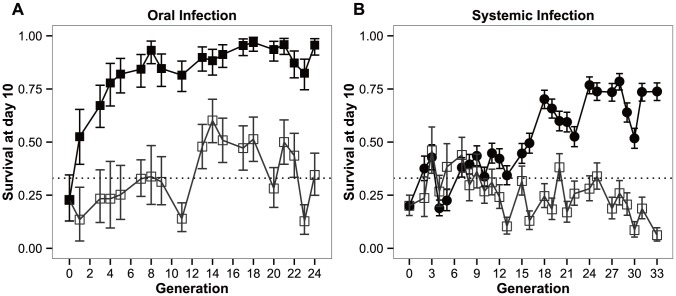
Figure 1
Figure 1. Response to selection.
Experimental evolution trajectories of populations evolving with a Pseudomonas entomophila oral (a) or systemic (b) infection and their respective control populations. Shown is the survival of flies from each selection regime when infected with P. entomophila either by (a) ingestion (orally) or, (b) pricking (systemic). Closed symbols: populations evolving in presence of the pathogen; open symbols: control lines. Vertical bars correspond to standard error across means of replicate lines; the straight dotted line corresponds to the original mortality rate imposed on the populations (66%).
Figure 2
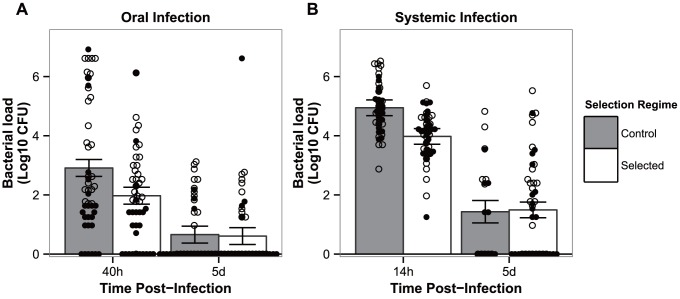
Figure 2. Flies have evolved resistance against P. entomophila infection.
Bacterial loads in flies from both control populations (grey bars) and populations evolving in presence of a pathogen (white bars) when exposed to oral (a) or systemic (b) infection. Males (full diamonds) and females (empty diamonds) are represented separately. Vertical bars correspond to the standard error of the mean pathogen load of each selection regime at each time point. (N = 48, except for panel b) systemic infection on control lines after 5 days where N = 22).
Figure 3
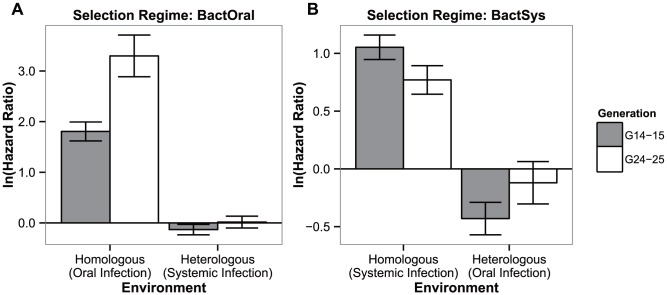
Figure 3. Test of adaptation and its correlated response.
Hazard ratios of lines evolving in presence of a pathogen relative to controls at generations 14–15 (grey bars) and 24–25 (white bars) of adaptation, when exposed to the challenge they have evolved with or to the other infection route. (a) Oral infection selection regime (BactOral) and (b) systemic infection evolved flies (BactSyst). All populations spent one generation in a common environment before being tested. Vertical bars correspond to the standard error of the estimated ratio between the two selection regimes.
Figure 4
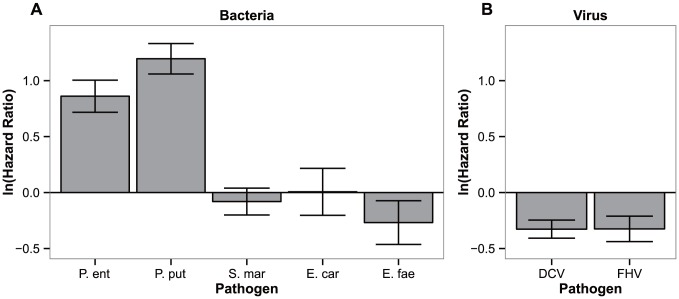
Figure 4. Specificity of the response.
Differences in hazard ratios between control lines (ContSys) and evolved lines with Pseudomonas entomophila systemic infection (BactSys), when exposed to (a) bacterial pathogens, P.e (P. entomophila), P. put (Pseudomonas putida), S.mar (Serratia marcescens), E.fae (Enterococcus faecalis); and (b) viral pathogens, DCV (Drosophila C Virus), FHV (Flock House Virus). Vertical bars correspond to the standard error of the estimated ratio between the selection regime and controls.

References

    1. Anderson RM, May RM (1982) Coevolution of hosts and parasites. Parasitology 85 Pt 2: 411–426. - PubMed
    1. Ewald PW (1995) The evolution of virulence: a unifying link between parasitology and ecology. J Parasitol 81: 659–669. - PubMed
    1. Lipstich M, Siller S, Norwak MA (1996) The evolution of virulence in pathogens with vertical and horizontal transmission. Evolution 50: 1729–1741. - PubMed
    1. Ebert D, Mangin KL (1997) The influence of host demography on the evolution of virulence of a microsporidian gut parasite. Evolution 51: 1828–1837. - PubMed
    1. Messenger SL, Molineux IJ, Bull JJ (1999) Virulence evolution in a virus obeys a trade-off. Proc Biol Sci 266: 397–404. - PMC - PubMed

Publication types

MeSH terms