


Air pollution and newly diagnostic autism spectrum disorders: a population-based cohort study in Taiwan
- PMID: 24086549
- PMCID: PMC3783370
- DOI: 10.1371/journal.pone.0075510
Air pollution and newly diagnostic autism spectrum disorders: a population-based cohort study in Taiwan
Erratum in
-
Correction: Air Pollution and Newly Diagnostic Autism Spectrum Disorders: A Population-Based Cohort Study in Taiwan.PLoS One. 2018 Aug 22;13(8):e0202996. doi: 10.1371/journal.pone.0202996. eCollection 2018. PLoS One. 2018. PMID: 30133530 Free PMC article.
Abstract
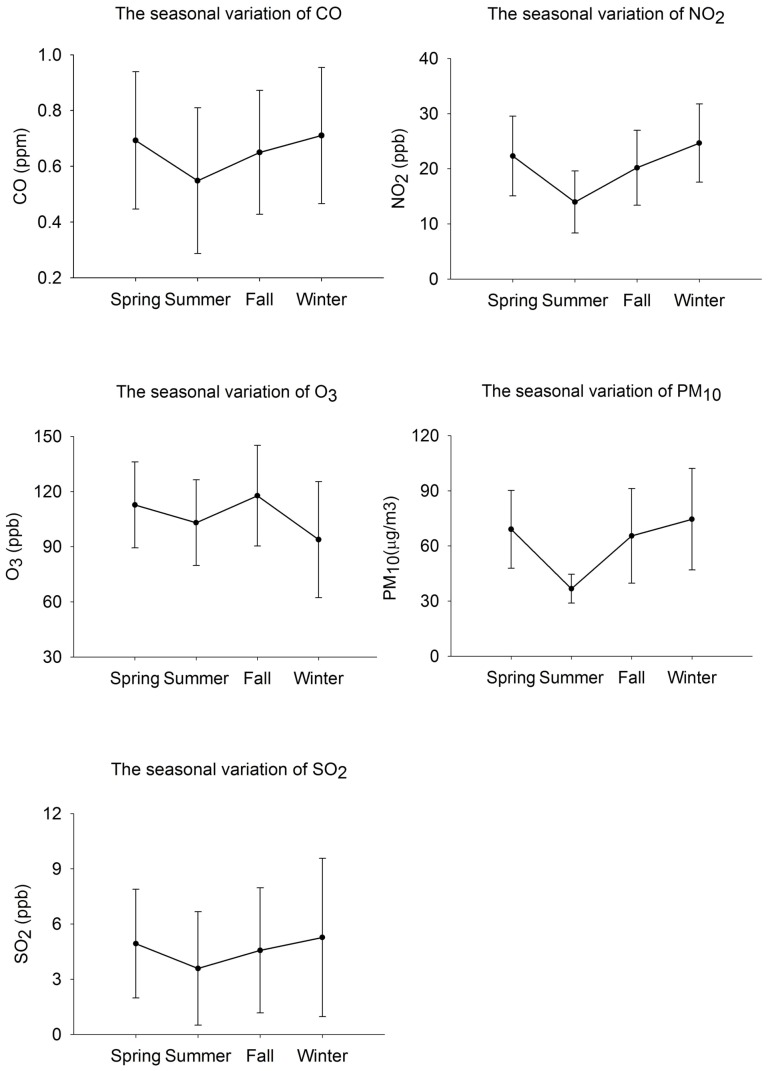
There is limited evidence that long-term exposure to ambient air pollution increases the risk of childhood autism spectrum disorder (ASD). The objective of the study was to investigate the associations between long-term exposure to air pollution and newly diagnostic ASD in Taiwan. We conducted a population-based cohort of 49,073 children age less than 3 years in 2000 that were retrieved from Taiwan National Insurance Research Database and followed up from 2000 through 2010. Inverse distance weighting method was used to form exposure parameter for ozone (O3), carbon monoxide (CO), nitrogen dioxide (NO2), sulfur dioxide (SO2), and particles with aerodynamic diameter less than 10 µm (PM10). Time-dependent Cox proportional hazards (PH) model was performed to evaluate the relationship between yearly average exposure air pollutants of preceding years and newly diagnostic ASD. The risk of newly diagnostic ASD increased according to increasing O3, CO, NO2, and SO2 levels. The effect estimate indicating an approximately 59% risk increase per 10 ppb increase in O3 level (95% CI 1.42–1.79), 37% risk increase per 100 ppb in CO (95% CI 1.31–1.44), 340% risk increase per 10 ppb increase in NO2 level (95% CI 3.31–5.85), and 17% risk increase per 1 ppb in SO2 level (95% CI 1.09–1.27) was stable with different combinations of air pollutants in the multi-pollutant models. Our results provide evident that children exposure to O3, CO, NO2, and SO2 in the preceding 1 year to 4 years may increase the risk of ASD diagnosis.
Conflict of interest statement
Figures
References
-
- Newschaffer CJ, Croen LA, Daniels J, Giarelli E, Grether JK, et al. (2007) The epidemiology of autism spectrum disorders. Annu Rev Public Health 28: 235–258. - PubMed
-
- American Psychiatirc Association (2000) Diagnostic and Statistical Manual of Mental Disorders, 4th edition, Text Revision. Washington, DC: American Psychiatirc Association Press.
-
- Rutter M (2005) Incidence of autism spectrum disorders: changes over time and their meaning. Acta Pædiatr 94: 2–15. - PubMed
Publication types
MeSH terms
Substances
LinkOut - more resources
Full Text Sources
Other Literature Sources
Medical
