. 2013 Dec 18;4(12):1514-9.
doi: 10.1021/cn400036j. Epub 2013 Oct 11.

Cationic amino acid based lipids as effective nonviral gene delivery vectors for primary cultured neurons

Affiliations

Cationic amino acid based lipids as effective nonviral gene delivery vectors for primary cultured neurons

Yumiko Aoshima et al. ACS Chem Neurosci. .

Abstract

The delivery of specific genes into neurons offers a potent approach for treatment of diseases as well as for the study of neuronal cell biology. Here we investigated the capabilities of cationic amino acid based lipid assemblies to act as nonviral gene delivery vectors in primary cultured neurons. An arginine-based lipid, Arg-C3-Glu2C14, and a lysine-based lipid, Lys-C3-Glu2C14, with two different types of counterion, chloride ion (Cl-) and trifluoroacetic acid (TFA-), were shown to successfully mediate transfection of primary cultured neurons with plasmid DNA encoding green fluorescent protein. Among four types of lipids, we optimized their conditions such as the lipid-to-DNA ratio and the amount of pDNA and conducted a cytotoxicity assay at the same time. Overall, Arg-C3-Glu2C14 with TFA- induced a rate of transfection in primary cultured neurons higher than that of Lys-C3-Glu2C14 using an optimal weight ratio of lipid-to-plasmid DNA of 1. Moreover, it was suggested that Arg-C3-Glu2C14 with TFA- showed the optimized value higher than that of Lipofectamine2000 in experimental conditions. Thus, Arg-C3-Glu2C14 with TFA- is a promising candidate as a reliable transfection reagent for primary cultured neurons with a relatively low cytotoxicity.


Figures
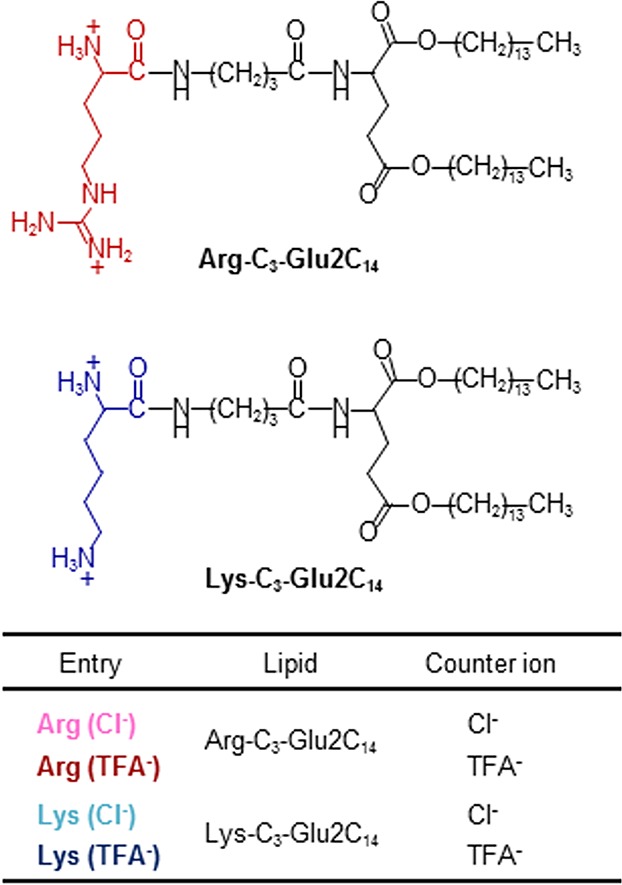
Figure 1
Figure 1
Chemical structures of the cationic amino acid based lipids Arg-C3-Glu2C14 and Lys-C3-Glu2C14. These lipids were further characterized by their counterion as Arg (Cl), Arg (TFA), Lys (Cl), and Lys (TFA).
Figure 2
Figure 2
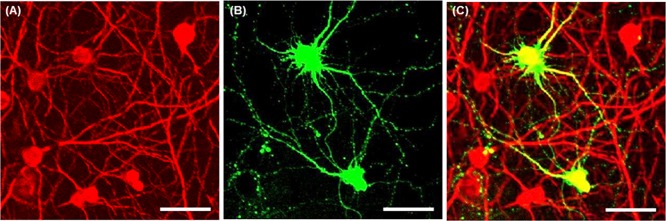
pEGFP-N1 transfected neurons viewed using a confocal microscope. (A) Neurons stained using an anti-MAP-2 antibody. (B) EGFP expression in some of the neurons. Arg (Cl); lipid-to-pDNA ratio of 1, [pDNA] = 0.8 μg/well. (C) Merged image of (A) and (B). Scale bar = 50 μm.
Figure 3
Figure 3
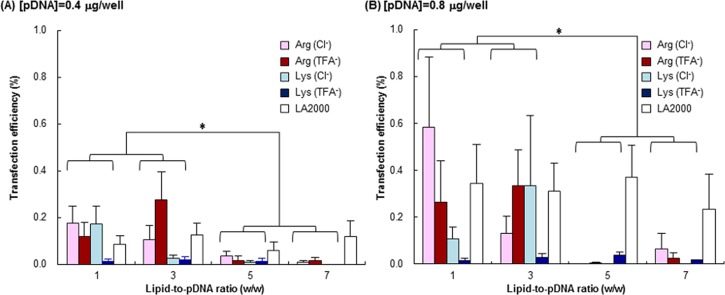
Effect of varying a lipid-to-pDNA ratio on the transfection efficiency of cationic amino acid based lipid assemblies compared to LA2000. The total amounts of pDNA per well are (A) 0.4 μg and (B) 0.8 μg. The concentrations of lipid are (A) 2, 6, 10, and 14 μg/mL at the lipid-to-pDNA ratios of 1, 3, 5, and 7, and (B) 4, 12, 20, and 28 μg/mL at the lipid-to-pDNA ratios of 1, 3, 5, and 7, respectively. Data are shown as means ± SEM of three or more replicate experiments. Statistical significance was determined by a two-way analysis of variance (ANOVA) (*P < 0.05).
Figure 4
Figure 4
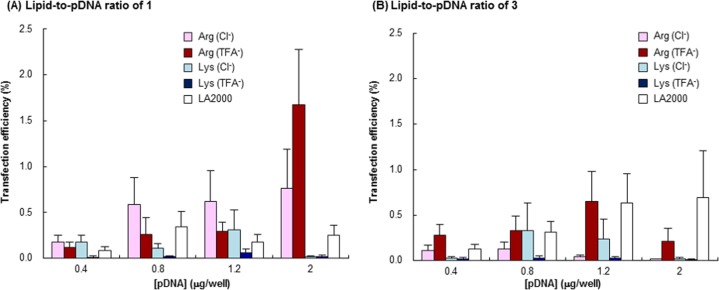
Effect of total amount of pDNA on the transfection efficiency of cationic amino acid based lipid assemblies compared to LA2000. Lipid-to-pDNA ratios of 1 (A) and 3 (B) were used. The concentrations of lipid are (A) 2, 4, 6, and 10 μg/mL at [pDNA] of 0.4, 0.8, 1.2, and 2 μg/mL, and (B) 6, 12, 18, and 30 μg/mL at [pDNA] of 0.4, 0.8, 1.2, and 2 μg/mL, respectively. Data are shown as means ± SEM of eight replicate experiments. Significant dose-dependent increase of the Arg (TFA) value at a lipid-to-pDNA ratios of 1 were observed in a Kruskal–Wallis test (P < 0.05).
Figure 5
Figure 5
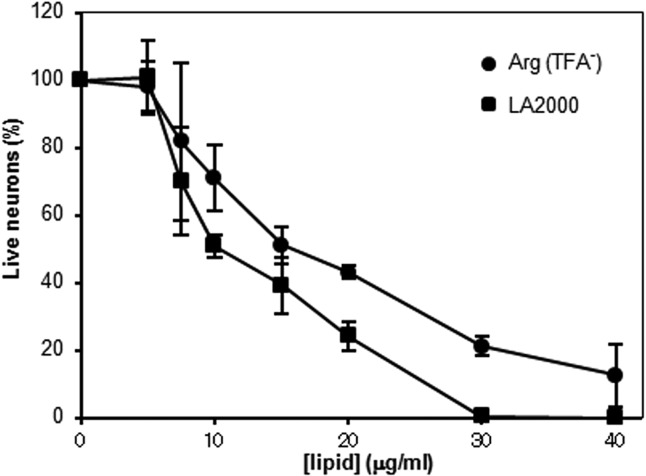
Cytotoxicity of cationic amino acid based lipid assemblies, Arg (TFA), and LA2000 to primary cultured neurons as a function of lipid concentration. After 48 h of exposure with lipids, live neurons were stained and counted (Supporting Information Figure S2). Data are shown as means ± SD (n = 3). Number of surviving neurons is significantly different between Arg (TFA) and LA2000 (two-way ANOVA, P < 0.01).

References

    1. During M. J.; Naegele J. R.; O’Malley K. L.; Geller A. I. (1994) Long-term behavioral recovery in parkinsonian rats by an HSV vector expressing tyrosine hydroxylase. Science 266, 1399–403. - PMC - PubMed
    1. Kumar P.; Wu H.; McBride J. L.; Jung K. E.; Kim M. H.; Davidson B. L.; Lee S. K.; Shankar P.; Manjunath N. (2007) Transvascular delivery of small interfering RNA to the central nervous system. Nature 448, 39–43. - PubMed
    1. Bergen J. M.; Park I. K.; Horner P. J.; Pun S. H. (2008) Nonviral approaches for neuronal delivery of nucleic acids. Pharm. Res. 25, 983–98. - PMC - PubMed
    1. Chang D. T.; Honick A. S.; Reynolds I. J. (2006) Mitochondrial trafficking to synapses in cultured primary cortical neurons. J. Neurosci. 26, 7035–7045. - PMC - PubMed
    1. Halterman M. W.; Giuliano R.; Dejesus C.; Schor N. F. (2009) In-tube transfection improves the efficiency of gene transfer in primary neuronal cultures. J. Neurosci. Methods. 177, 348–354. - PMC - PubMed

Publication types

LinkOut - more resources