. 2013 Nov;140(21):4407-16.
doi: 10.1242/dev.099390. Epub 2013 Oct 2.

Evf2 (Dlx6as) lncRNA regulates ultraconserved enhancer methylation and the differential transcriptional control of adjacent genes

Affiliations

Evf2 (Dlx6as) lncRNA regulates ultraconserved enhancer methylation and the differential transcriptional control of adjacent genes

Emily G Berghoff et al. Development. 2013 Nov.

Abstract

Several lines of evidence suggest that long non-coding RNA (lncRNA)-dependent mechanisms regulate transcription and CpG DNA methylation. Whereas CpG island methylation has been studied in detail, the significance of enhancer DNA methylation and its relationship with lncRNAs is relatively unexplored. Previous experiments proposed that the ultraconserved lncRNA Evf2 represses transcription through Dlx6 antisense (Dlx6as) transcription and methyl-CpG binding protein (MECP2) recruitment to the Dlx5/6 ultraconserved DNA regulatory enhancer (Dlx5/6ei) in embryonic day 13.5 medial ganglionic eminence (E13.5 MGE). Here, genetic epistasis experiments show that MECP2 transcriptional repression of Evf2 and Dlx5, but not Dlx6, occurs through antagonism of DLX1/2 in E13.5 MGE. Analysis of E13.5 MGE from mice lacking Evf2 and of partially rescued Evf2 transgenic mice shows that Evf2 prevents site-specific CpG DNA methylation of Dlx5/6ei in trans, without altering Dlx5/6 expression. Dlx1/2 loss increases CpG DNA methylation, whereas Mecp2 loss does not affect Dlx5/6ei methylation. Based on these studies, we propose a model in which Evf2 inhibits enhancer DNA methylation, effectively modulating competition between the DLX1/2 activator and MECP2 repressor. Evf2 antisense transcription and Evf2-dependent balanced recruitment of activator and repressor proteins enables differential transcriptional control of adjacent genes with shared DNA regulatory elements.

Keywords: Forebrain; MECP2; Mouse; Ultraconserved enhancer methylation.


Figures
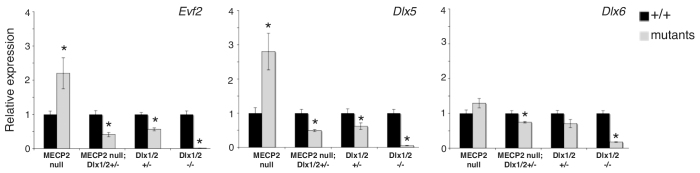
Fig. 1.
Fig. 1.
MECP2 represses Evf2 and Dlx5 expression through antagonism of DLX1/2. Quantitative PCR on cDNA isolated from E13.5 medial ganglionic eminence was performed to determine expression levels of Evf2, Dlx5 and Dlx6. Values are normalized to Actb, and expression compared from different genotypes with respective wild-type littermates (+/+, black). The following mutants (gray) were used: Mecp2null (Mecp2-/y), Mecp2null; Dlx1/2+/- [Mecp2-/y with one copy of Dlx1/2 (Anderson et al., 1997b)], Dlx1/2+/- (heterozygote with one copy of Dlx1/2) and Dlx1/2-/- (Dlx1/2 null lacking Dlx1 and Dlx2). Mecp2 represses Evf2 and Dlx5, but not Dlx6. Dlx1/2 are activators of Evf2, Dlx5 and Dlx6. Dlx1/2 control of Evf2 and Dlx5 is dose dependent, as removal of one copy (Dlx1/2+/-) reduces Evf2 and Dlx5 expression. n=3 each genotype. *P<0.01 (Student’s t-test). Error bars represent s.e.m.
Fig. 2.
Fig. 2.
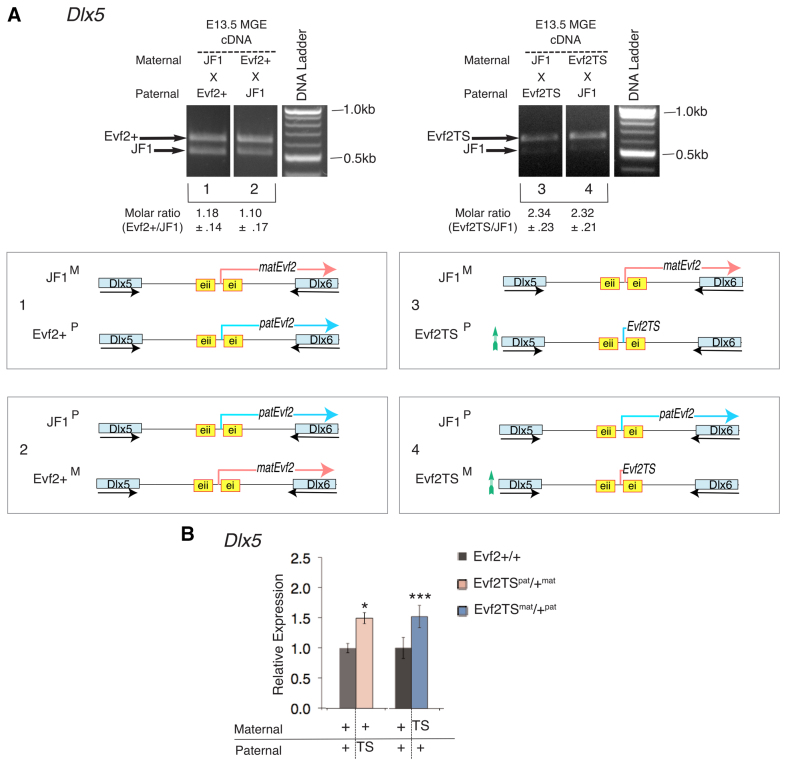
Evf2 represses Dlx5 equally on maternal and paternal alleles. (A) Imprinting analysis of Dlx5 RNA in E13.5 MGE. A SNP within Dlx5 generates a HindIII site in JF1 (Horike et al., 2005), distinguishing parental origin of Dlx5 transcripts in crosses of JF1 and Evf2+ (mixed 129/Bl6) mice. Evf2TS/+ mice are on a mixed 129/Bl6 background. Wild types are referred to as Evf2+ or Evf2+/+ to indicate littermate controls. Crosses of (1) JF1mat × Evf2+pat or (2) JF1pat × Evf2+mat indicate equal expression of Dlx5 from maternal and paternal alleles, showing that Dlx5 is not imprinted [ratios (1) Evf2+/JF1=1.18±0.14, (2) Evf2+/JF1=1.10±0.17; n=4, P>0.05]. Analysis of Dlx5 expression in (3) JF1mat × Evf2TSpat and (4) JF1pat × Evf2TSmat shows that Dlx5 expressed adjacent to transcription stop site insertion is increased (∼2.3-fold) for both maternal and paternal alleles; n=3 for each genotype, P>0.05. Schematics of the genotypes of crosses (1-4) corresponding to gel lanes are shown. M, maternal; P, paternal; pink, maternal Evf2 transcript; blue, paternal Evf2 transcript; TS, transcription stop; Evf2TS, truncated transcript from TS insertion; green arrow, increased Dlx5 expression adjacent to TS insertion. (B) Dlx5 expression increases to the same level upon maternal Evf2 or paternal Evf2 loss. Crosses of Evf2TS/+ with Evf2+/+ generate Evf2TSpat/+mat (pink) and Evf2TSpat/+mat (blue), depending on Evf2TS parental origin, as well as Evf2+/+ littermates (black). n=5 for Evf2TSpat/+mat, and n=5 Evf2+/+ littermates (*P=0.03), n=6 Evf2TSmat/+pat, n=6 Evf2+/+ littermates (***P=3.4×10⁻⁴). P values are generated by Student’s two-tailed t-test.
Fig. 3.
Fig. 3.
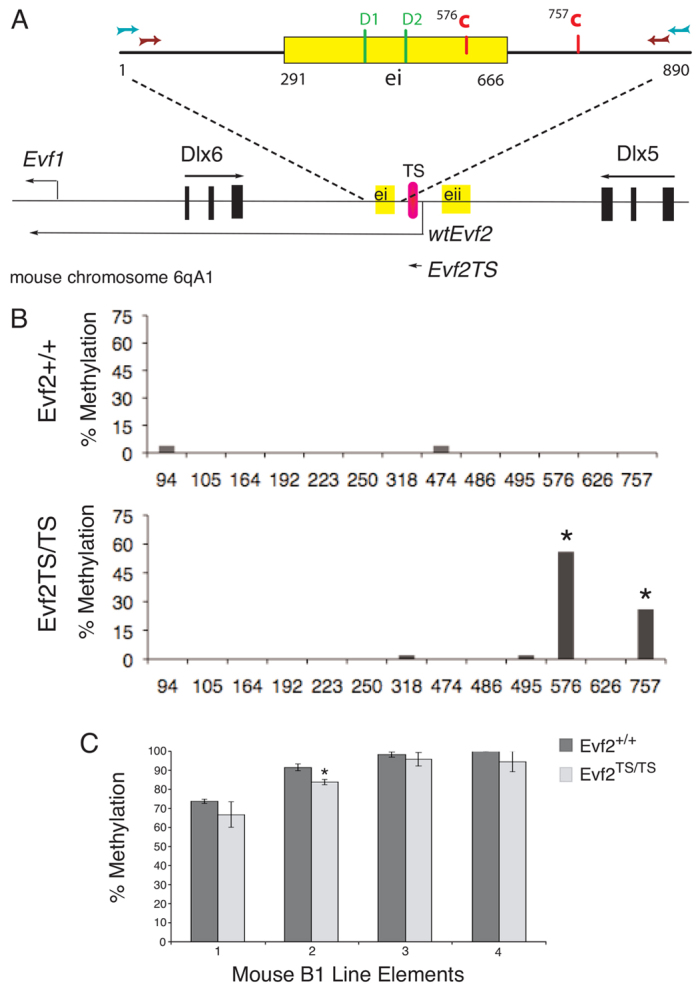
Evf2 lncRNA prevents site-specific CpG DNA methylation within the Dlx5/6 ultraconserved enhancer ei. E13.5 MGE DNA isolated from three Evf2+/+ and three Evf2TS/TS mutants was bisulfite treated, PCR amplified, subcloned, and individual clones sequenced. (A) Schematic of the Dlx5/6 intergenic region, containing the intergenic enhancers ei (ultraconserved) and eii, with expansion of the 890 PCR region spanning ei (blue and brown arrows indicate nested primers, where blue arrows indicate external primers, and brown arrows indicate internal primers). There are 13 possible CpG DNA methylation sites within this 890-nucleotide (nt) region. 576CpG and 757CpG are each marked by a red C. Pink oval represents the location of the triple poly(A) transcription stop (TS) insertion site at the 5′ end of Evf2 in Evf2TS/TS mice. The wild-type Evf2 transcript is ∼3.7 kb, whereas Evf2TS generates a predicted truncated transcript (80 nt) before transcription termination. DLX1/2 binding sites, as previously identified (Zerucha et al., 2000), within ei are in green (D1 and D2). (B) Graph of percentage methylation comparing Evf2+/+ and Evf2TS/TS E13.5 MGE at 13 possible CpG sites within the 890 PCR region shown in A. Data are obtained from 52 Evf2+/+ and 56 Evf2TS/TS individual clones. n=3 for each genotype. Loss of Evf2 results in increased methylation at sites 576CpG and 757CpG, *P<0.01. (C) Global methylation analysis of four different B1 line elements (1-4) in Evf2+/+ and Evf2TS/TS E13.5 MGE DNA shows that Evf2 loss does not increase global methylation. Error bars represent s.e.m.
Fig. 4.
Fig. 4.
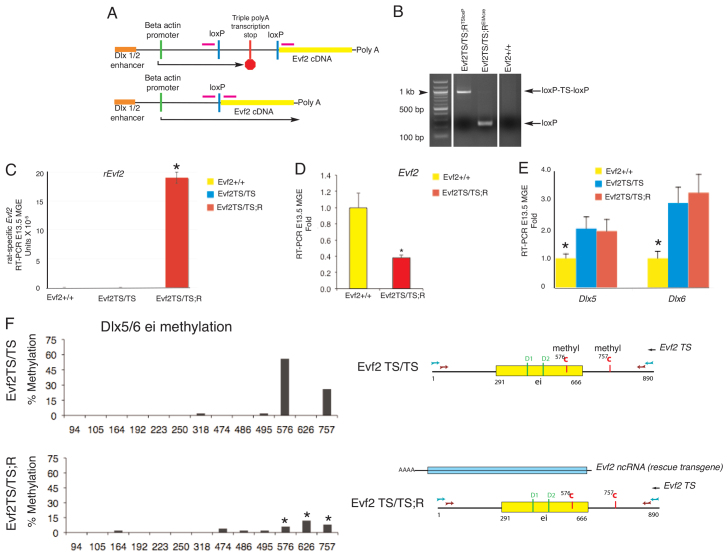
Evf2 lncRNA trans activity controls Dlx5/6 ultraconserved enhancer methylation. Evf2 rescue mice (Evf2R) were generated using a transgene expressing full-length rat Evf2 (3.7 kb) driven by Dlx1/2 enhancer 1b (Ghanem et al., 2007) and Actb promoter. (A) Schematic of the construct used to express rat Evf2; a floxed TS sequence precedes the 5′ end of Evf2, stopping transcription, and allowing transcription after cre-mediated removal. Pink bars show where genotyping primers are placed to distinguish loxP-TS-loxP from a single loxP remaining site after cre removal. (B) Genotyping results of Evf2TS/TS;R loxP-TS-loxP (longer fragment) and Evf2TS/TS;REIIAcre, loxP (shorter fragment). (C-E) Quantitative RT-PCR of E13.5 MGE from Evf2+/+ (yellow), Evf2TS/TS (blue) and Evf2TS/TS;R (red, Evf2TS/TS;REIIAcre, loxP). (C) Detection of rat-specific Evf2 transcripts, only expressed in Evf2TS/TS;R tissue (red bar). (D) Evf2 expressed from the transgene (red bar) is expressed at ∼0.38× wild-type levels (yellow bar). (E) Transgenic expression of Evf2 does not significantly change Dlx5 or Dlx6 expression in Evf2TS/TS mice. Evf2+/+ is significantly different from Evf2TS/TS and Evf2TS/TS;R (P<0.01, two-way ANOVA), n=3 for each genotype. Error bars represent s.e.m. (F) Evf2 transgene (Evf2TS/TS;R) reduces methylation at 576CpG and 757CpG in Dlx5/6ei, compared with Evf2TS/TS. Bisulfite sequencing of the same 890-bp region spanning Dlx5/6ei on E13.5 MGE DNA as in Fig. 3. Significant differences are detected at sites 576CpG and 757CpG, where Evf2TS/TS;R E13.5 MGE has decreased methylation compared with Evf2TS/TS. There is a slight increase in methylation at 626CpG (<15%). n=3 embryos for each genotype, *P<0.01 (Student’s t-test). A minimum of 45 clones were sequenced for each genotype.
Fig. 5.
Fig. 5.
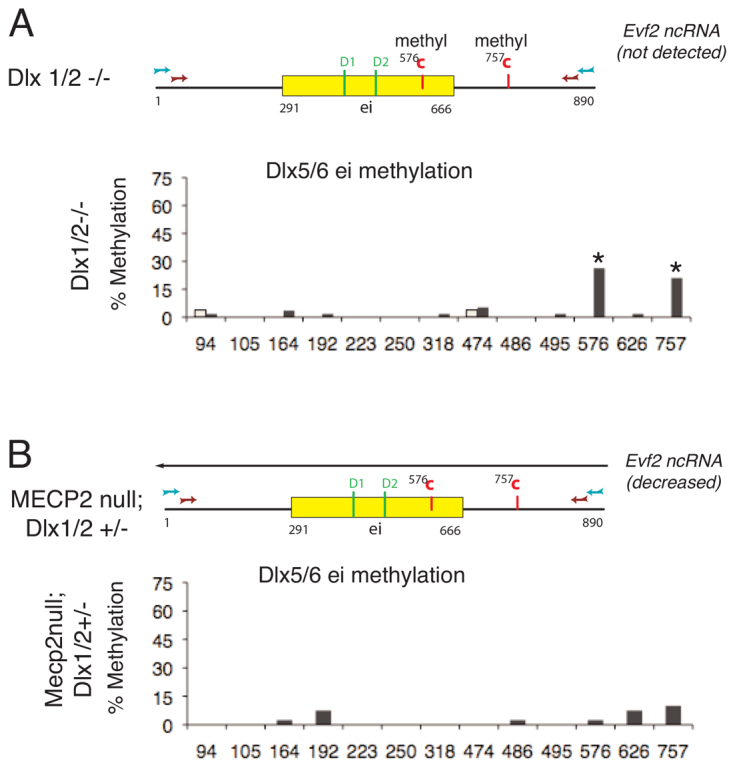
DLX1/2 but not MECP2 represses 576CpG and 757CpG methylation of Dlx5/6 ultraconserved enhancer. (A) Bisulfite sequencing of the same 890-bp region spanning Dlx5/6ei as described in Figs 3 and 4, was performed on E13.5 MGE DNA isolated from Dlx1/2-/- (black bars) compared with wild-type littermates (white bars). Loss of Dlx1/2 increases methylation at 576CpG and 757CpG; *P<0.01, n=3 for each genotype, minimum of 45 clones sequences for each genotype. (B) Mecp2null;Dlx1/2+/- (black bars) and wild-type littermates (shown in white bars in A) do not differ from each other. n=2 embryos/genotype and a minimum of 45 clones sequenced/genotype. P>0.05.
Fig. 6.
Fig. 6.
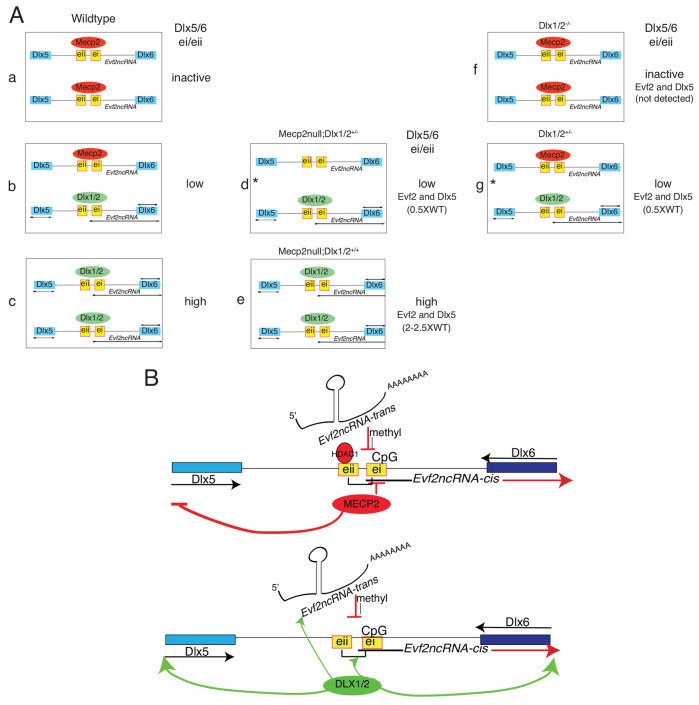
Models describing Mecp2, Dlx1/2 and Dlx5/6 enhancer interactions. (A) Model describing the relationship between Mecp2 and Dlx1/2 occupancy of Dlx5/6ei and eii enhancers and transcriptional activity (see Discussion for details). (B) Model describing how the Evf2 lncRNA facilitates differential dosage control of adjacent genes regulated by common enhancer elements. Evf2 lncRNA inhibits enhancer methylation and mediates recruitment of transcriptional repressor and activator. Schematic summarizes the relationship between enhancer methylation, Evf2 lncRNA trans- and cis-effects, and antagonism between recruited transcription factors DLX1/2 and MECP2. Genetic epistasis experiments support the hypothesis that binding of MECP2 occurs in competition with DLX1/2 at Dlx5/6ei and eii, rather than cooperatively. Removal of one copy of DLX1/2 from MECP2 null mice decreases levels of Evf2 and Dlx5, supporting antagonism between MECP2 and DLX1/2. Whereas MECP2 represses Dlx5 and Evf2, DLX1/2 activates Dlx5, Dlx6 and Evf2 expression. DLX1/2 increases Evf2 expression, which inhibits 576CpG and 757CpG site-specific methylation of Dlx5/6ei in trans.

References

    1. Anderson S. A., Eisenstat D. D., Shi L., Rubenstein J. L. (1997a). Interneuron migration from basal forebrain to neocortex: dependence on Dlx genes. Science 278, 474–476 - PubMed
    1. Anderson S. A., Qiu M., Bulfone A., Eisenstat D. D., Meneses J., Pedersen R., Rubenstein J. L. (1997b). Mutations of the homeobox genes Dlx-1 and Dlx-2 disrupt the striatal subventricular zone and differentiation of late born striatal neurons. Neuron 19, 27–37 - PubMed
    1. Barlow D. P. (2011). Genomic imprinting: a mammalian epigenetic discovery model. Annu. Rev. Genet. 45, 379–403 - PubMed
    1. Bond A. M., Vangompel M. J., Sametsky E. A., Clark M. F., Savage J. C., Disterhoft J. F., Kohtz J. D. (2009). Balanced gene regulation by an embryonic brain ncRNA is critical for adult hippocampal GABA circuitry. Nat. Neurosci. 12, 1020–1027 - PMC - PubMed
    1. Chahrour M., Jung S. Y., Shaw C., Zhou X., Wong S. T., Qin J., Zoghbi H. Y. (2008). MeCP2, a key contributor to neurological disease, activates and represses transcription. Science 320, 1224–1229 - PMC - PubMed

Publication types