


Randomized trial of infusion set function: steel versus teflon
- PMID: 24090124
- PMCID: PMC3887416
- DOI: 10.1089/dia.2013.0119
Randomized trial of infusion set function: steel versus teflon
Abstract
Background: This study compared infusion set function for up to 1 week using either a Teflon(®) (Dupont(™), Wilmington, DE) catheter or a steel catheter for insulin pump therapy in type 1 diabetes mellitus.
Subjects and methods: Twenty subjects participating in a randomized, open-labeled, crossover study were asked to wear two Quick-Set(®) and two Sure-T(®) infusion sets (both from Medtronic Minimed, Northridge, CA) until the infusion set failed or was worn for 1 week. All subjects wore a MiniMed continuous glucose monitoring system for the duration of the study.
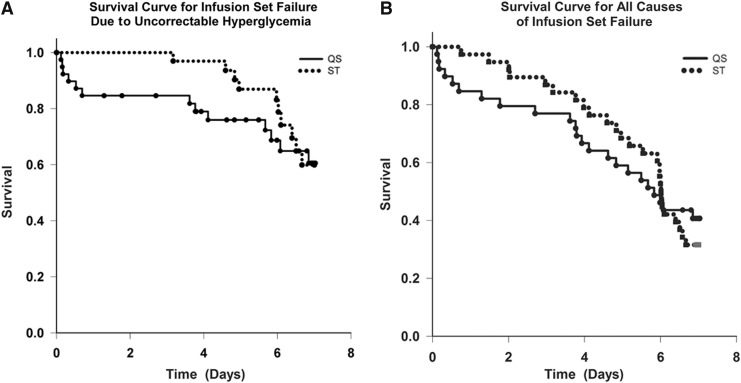
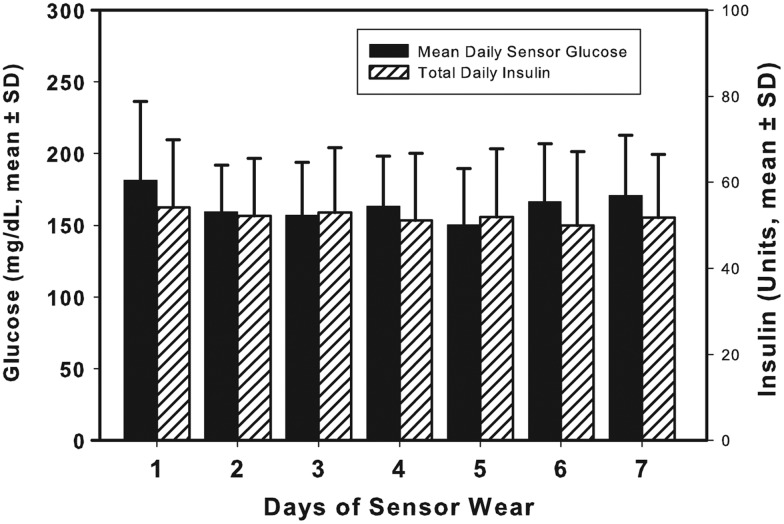
Results: One subject withdrew from the study. There were 38 weeks of Sure-T wear and 39 weeks of Quick-Set wear with no difference in the survival curves of the infusion sets. There was, however, a 15% initial failure rate with the Teflon infusion set. After 7 days, both types of infusion sets had a 64% failure rate. Overall, 30% failed because of hyperglycemia and a failed correction dose, 13% were removed for pain, 10% were pulled out by accident, 10% had erythema and/or induration of>10 mm, 5% fell out because of loss of adhesion, and 4% were removed for infection. The main predictor of length of wear was the individual subject. There was no increase in hyperglycemia or daily insulin requirements when an infusion set was successfully used for 7 days (n=25 of 77 weeks).
Conclusions: We found no difference between steel and Teflon infusion sets in their function over 7 days, although 15% of Teflon sets failed because of kinking on insertion. The strongest predictor of prolonged 7-day infusion set function was the individual subject, not the type of infusion set.
Figures

Comment in
-
Comments on Patel et al.'s "Randomized trial of infusion set function: steel versus teflon": early catheter failures may differ according to teflon catheter model.Diabetes Technol Ther. 2014 Aug;16(8):545-6. doi: 10.1089/dia.2014.0058. Epub 2014 Jun 26. Diabetes Technol Ther. 2014. PMID: 24967507 No abstract available.
References
-
- Pickup JC, Sutton AJ: Severe hypoglycaemia and glycaemic control in Type 1 diabetes: meta-analysis of multiple daily insulin injections compared with continuous subcutaneous insulin infusion. Diabet Med 2008;25:765–774 - PubMed
-
- Centers for Disease Control: Toxic-shock syndrome in a patient using a continuous subcutaneous insulin infusion pump—Idaho. MMWR Morb Mortal Wkly Rep 1983;32:404–406, 412. - PubMed
-
- Højbjerre L, Skov-Jensen C, Kaastrup P, Pedersen PE, Stallknecht B: Effect of steel and Teflon infusion catheters on subcutaneous adipose tissue blood flow and infusion counter pressure in humans. Diabetes Technol Ther 2009;11:301–306 - PubMed
Publication types
MeSH terms
Substances
LinkOut - more resources
Full Text Sources
Other Literature Sources
Medical
