


Parent-administered exposure to increase children's vegetable acceptance: a randomized controlled trial
- PMID: 24091061
- PMCID: PMC4037818
- DOI: 10.1016/j.jand.2013.07.040
Parent-administered exposure to increase children's vegetable acceptance: a randomized controlled trial
Abstract
Background: Repeated taste exposure, in combination with small rewards, has been shown to increase children's acceptance of disliked foods. However, previous studies have used direct contact with researchers or professionals for the implementation of the repeated exposure procedure. If mailed taste exposure instructions to parents produced comparable outcomes, this could be a cost-effective and easily disseminable strategy to promote healthier diets in children.
Objective: Our randomized controlled study aimed to test the efficacy and acceptability of mailed materials giving instructions on taste exposure as a means of increasing acceptance of vegetables in preschool-aged children.
Design: Participants were families of 3-year-old twins from the Gemini cohort who took part between March 2011 and April 2012. Families were randomized to a mailed intervention or a no treatment control condition. The intervention involved offering each child 14 daily tastes of a disliked (target) vegetable with a small reward (a sticker) if the child complied.
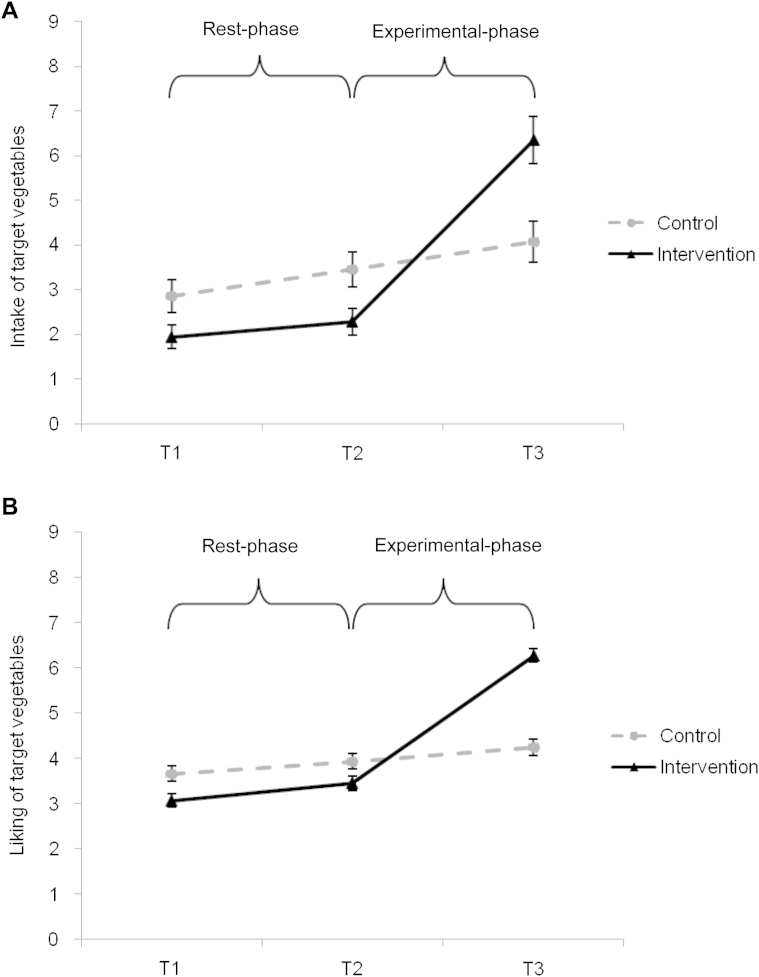
Main outcome measures: Outcomes were the child's intake of the target vegetable (number of pieces) and parent reports of the child's liking at two baseline (T1 and T2) and one postintervention (T3) behavior assessment.
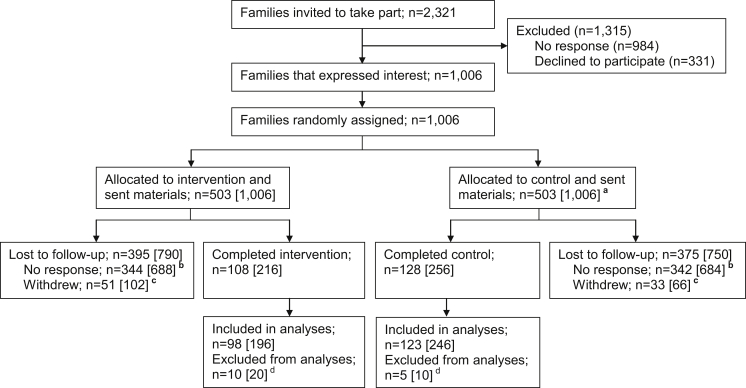
Results: Record sheets with intake and liking data from T1, T2, and T3 were returned for 472 children, of which 442 were complete (94%). Over the intervention period (T2 to T3) intake and liking of the target vegetable increased significantly more in the intervention group than in the control group (intake: odds ratio 12.05, 95% CI 8.05 to 18.03, P<0.001; liking: odds ratio 12.34, CI 7.97 to 19.12, P<0.001). Acceptability of the procedure was very high among parents who completed the protocol.
Conclusions: Mailed instructions for taste exposure were effective in increasing children's acceptance of an initially disliked vegetable. These results support the value of parent-administered exposure to increase children's vegetable acceptance, and suggest that it can be carried out without direct health professional contact.
Keywords: Children; Exposure; Food preferences; Vegetables.
Copyright © 2014 Academy of Nutrition and Dietetics. Published by Elsevier Inc. All rights reserved.
Figures
References
-
- Cooke L.J., Wardle J. Age and gender differences in children's food preferences. Br J Nutr. 2005;93(5):741–746. - PubMed
-
- Skinner J.D., Carruth B.R., Wendy B., Ziegler P.J. Children's food preferences: A longitudinal analysis. J Am Diet Assoc. 2002;102(11):1638–1647. - PubMed
-
- Yngve A., Wolf A., Poortvliet E. Fruit and vegetable intake in a sample of 11-year-old children in 9 European countries: The Pro Children Cross-sectional Survey. Ann Nutr Metab. 2005;49(4):236–245. - PubMed
-
- Government UK Department of Health. National Diet and Nutrition Survey: Headline results from Years 1 and 2 (combined) of the rolling programme 2008/9 - 2009/10. 2012. http://www.dh.gov.uk/en/Publicationsandstatistics/Publications/Publicati.... Accessed November 23, 2012.
Publication types
MeSH terms
Associated data
Grants and funding
LinkOut - more resources
Full Text Sources
Other Literature Sources
Miscellaneous
