


doi: 10.1172/JCI72707.
Epub 2013 Sep 9.
Hearing restoration: Graeme Clark, Ingeborg Hochmair, and Blake Wilson receive the 2013 Lasker~DeBakey Clinical Medical Research Award
- PMID: 24091320
- PMCID: PMC3784556
- DOI: 10.1172/JCI72707
Item in Clipboard
Hearing restoration: Graeme Clark, Ingeborg Hochmair, and Blake Wilson receive the 2013 Lasker~DeBakey Clinical Medical Research Award
J Clin Invest.
2013 Oct.
No abstract available
Figures

Graeme Clark (left) of the University of Melbourne, Ingeborg Hochmair (center) of MED-EL, and Blake Wilson of Duke University (right) have been honored for their contributions to the development of the modern cochlear implant.
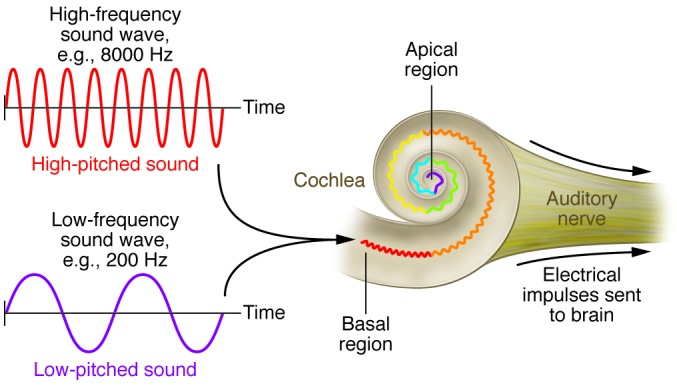
Perceived pitch of a sound depends on the location in the cochlea that the sound wave stimulated. High-frequency sound waves, which correspond to high-pitched noises, stimulate the basal region of the cochlea (red). Low-frequency sound waves are targeted to the apical region of the cochlear structure and correspond with low-pitched sounds (purple). Therefore, it is important for the cochlear implant electrode array to provide stimuli at multiple positions along the length of the cochlea.
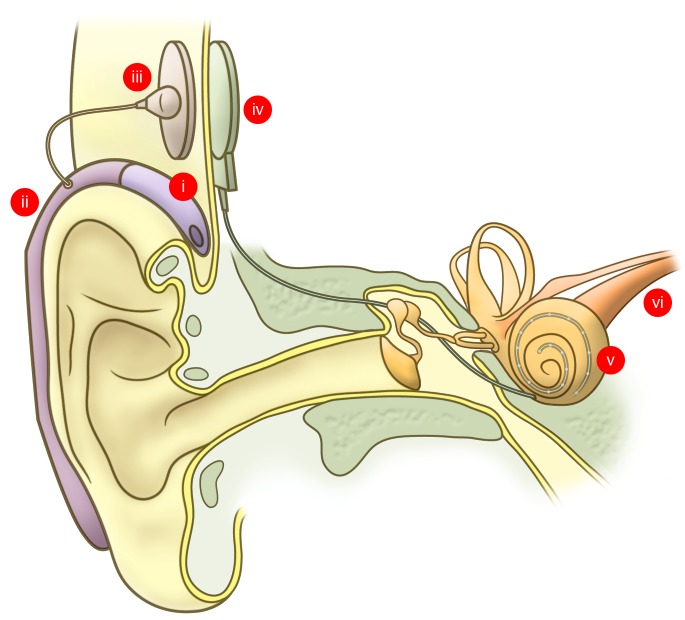
Sound is detected by the microphone (i), which in this illustration is integrated into a behind-the-ear processing unit (ii). The processing unit translates sound into a digital signal that is passed from the transmitter (iii) to the internal receiver stimulator (iv). The receiver stimulator decodes sound information from the processing unit into electric stimuli that are delivered to the cochlea via an electrode array (v). Electric signals from the cochlea are transmitted to the brain by the auditory nerve (vi).
References
-
- Wever EG, Bray CW. The nature of acoustic response: The relation between sound frequency and frequency of impulses in the auditory nerve. J Exp Psychol. 1930;13(5):373–387. doi: 10.1037/h0075820. - DOI
-
- Djourno A, Eyries C. [Auditory prosthesis by means of a distant electrical stimulation of the sensory nerve with the use of an indwelt coiling]. Presse Med. 1957;65(63):1417. - PubMed
-
- House WF, Urban J. Long term results of electrode implantation and electronic stimulation of the cochlea in man. Ann Otol Rhinol Laryngol. 1973;82(4):504–517. - PubMed
-
- House WF. Cochlear implants. Ann Otol Rhinol Laryngol. 1976;85 suppl 27(3 pt 2):1–93. - PubMed
-
- Simmons FBF. Electrical stimulation of the auditory nerve in man. Arch Otolaryngol. 1966;84(1):2–54. - PubMed
Publication types
MeSH terms
LinkOut - more resources
Full Text Sources
Other Literature Sources
Medical
