. 2013 Dec 26;178(2):264-71.
doi: 10.1016/j.virusres.2013.09.033. Epub 2013 Sep 30.

The evolution of codon usage in structural and non-structural viral genes: the case of Avian coronavirus and its natural host Gallus gallus

Affiliations

The evolution of codon usage in structural and non-structural viral genes: the case of Avian coronavirus and its natural host Gallus gallus

Paulo Eduardo Brandão. Virus Res. .

Abstract

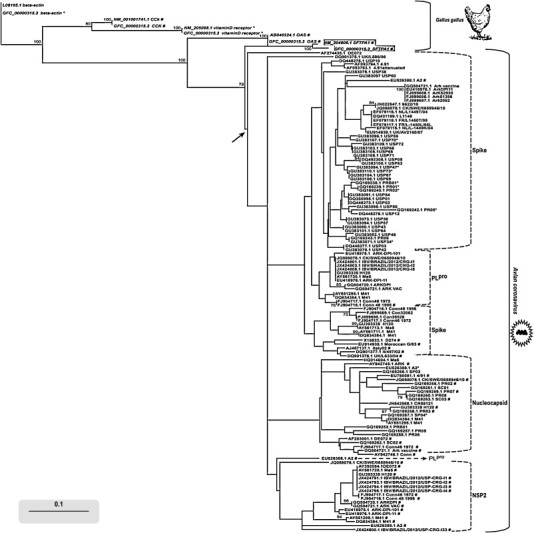
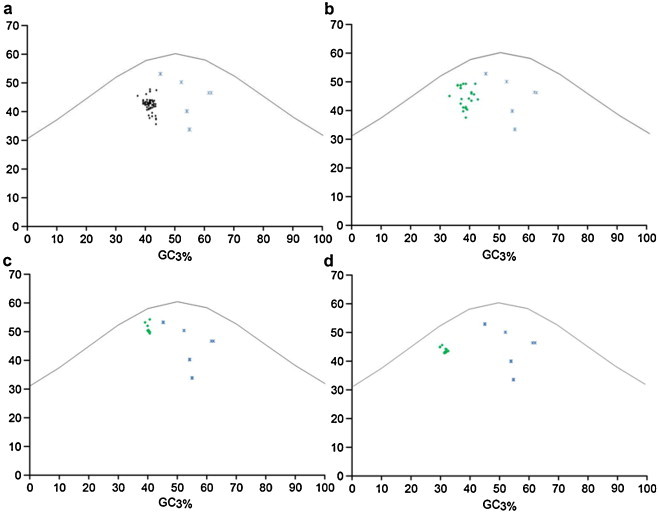
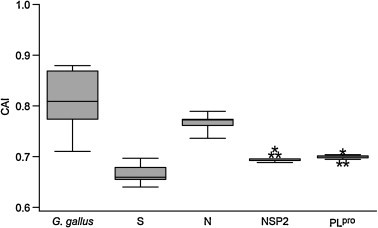
To assess the codon evolution in virus-host systems, Avian coronavirus and its natural host Gallus gallus were used as a model. Codon usage (CU) was measured for the viral spike (S), nucleocapsid (N), nonstructural protein 2 (NSP2) and papain-like protease (PL(pro)) genes from a diverse set of A. coronavirus lineages and for G. gallus genes (lung surfactant protein A, intestinal cholecystokinin, oviduct ovomucin alpha subunit, kidney vitamin D receptor and the ubiquitary beta-actin) for different A. coronavirus replicating sites. Relative synonymous codon usage (RSCU) trees accommodating all virus and host genes in a single topology showed a higher proximity of A. coronavirus CU to the respiratory tract for all genes. The codon adaptation index (CAI) showed a lower adaptation of S to G. gallus compared to NSP2, PL(pro) and N. The effective number of codons (Nc) and GC3% revealed that natural selection and genetic drift are the evolutionary forces driving the codon usage evolution of both A. coronavirus and G. gallus regardless of the gene being considered. The spike gene showed only one 100% conserved amino acid position coded by an A. coronavirus preferred codon, a significantly low number when compared to the three other genes (p<0.0001). Virus CU evolves independently for each gene in a manner predicted by the protein function, with a balance between natural selection and mutation pressure, giving further molecular basis for the viruses' ability to exploit the host's cellular environment in a concerted virus-host molecular evolution.

Keywords: Avian coronavirus; Codon usage; Gallus gallus; Virus–host.


Figures

Fig. 1
Fig. 1
Neighbor-joining distance tree for the relative synonymous codon usage (RSCU) for the Avian coronavirus spike (S), nucleocapsid (N), non-structural protein 2 (NSP2) and papain-like protease (PLpro) genes and the Gallus gallus beta-actin, lung surfactant protein A (SFTPA1, gray background), intestinal cholecystokinin (CCK), oviduct ovomucin alpha subunit (OSA) and kidney vitamin D receptor genes. The tree was based on binary data using the value 1 for RSCUs > 1 (codon is preferred) or 0 for RSCUs ≤ 1 when the codon is not preferred (RSCU < 1) or is neutral (RSCU = 1). ENC (effective number of codons) values <40 and >45 are marked with an asterisk and a hash, respectively; sequences with ENC values between 40 and 45 have no marks. The arrow indicates the separation between G. gallus and Avian coronavirus clusters. Numbers at each node are bootstrap values (1000 replicates, only values >50 are shown). The bar represents the codon usage preferences distance.
Fig. 2
Fig. 2
Four graphs showing the expected (seen in the curves of each graph) and observed (seen in the points of each graph) effective number of codons (ENC and Nc, respectively) (Y axis) and the expected and observed GC3% (X axis) for (a) Avian coronavirus spike (S); (b) nucleocapsid (N); (c) non-structural protein 2 (NSP2) and (d) papain-like protease (PLpro) (dots) and Gallus gallus beta-actin, lung surfactant protein A, intestinal cholecystokinin, oviduct ovomucin alpha subunit and kidney vitamin D receptor (asterisks).
Fig. 3
Fig. 3
Boxplot distribution for the codon adaptation index (CAI) for Avian coronavirus spike (S), nucleocapsid (N), non-structural protein 2 (NSP2) and papain-like protease (PLpro) and Gallus gallus beta-actin, lung surfactant protein A, intestinal cholecystokinin, oviduct ovomucin alpha subunit and kidney vitamin D receptor (represented together in a single boxplot).

References

    1. Aragonés L., Guix S., Ribes E., Bosch A., Pintó R.M. Fine-tuning translation kinetics selection as the driving force of codon usage bias in hepatitis A virus capsid. PLOS Pathogens. 2010;6:e1000797. - PMC - PubMed
    1. Bahir I., Fromer M., Yosef P., Linial M. Viral adaptation to host: a proteome-based analysis of codon usage and amino acid preferences. Molecular Systems Biology. 2009;5:311. - PMC - PubMed
    1. Brandão P.E. Avian coronavirus spike glycoprotein ectodomain shows a low codon adaptation to Gallus gallus with virus-exclusive codons in strategic amino acids positions. Journal of Molecular Evolution. 2012;75(1–2):19–24. - PMC - PubMed
    1. Cardinale D.J., DeRosa K., Duffy S. Base composition and translational selection are insufficient to explain codon usage bias in plant viruses. Viruses. 2013;5(1):162–181. - PMC - PubMed
    1. Cavanagh D. Coronavirus avian infectious bronchitis virus. Veterinary Research. 2007;38(2):281–297. - PubMed

LinkOut - more resources