


Patient activation and 30-day post-discharge hospital utilization
- PMID: 24091935
- PMCID: PMC3912296
- DOI: 10.1007/s11606-013-2647-2
Patient activation and 30-day post-discharge hospital utilization
Abstract
Background: Patient activation is linked to better health outcomes and lower rates of health service utilization. The role of patient activation in the rate of hospital readmission within 30 days of hospital discharge has not been examined.
Methods: A secondary analysis using data from the Project RED-LIT randomized controlled trial conducted at an urban safety net hospital. Data from 695 English-speaking general medical inpatient subjects were analyzed. We used an adapted, eight-item version of the validated Patient Activation Measure (PAM). Total scores were categorized, according to standardized methods, as one of four PAM levels of activation: Level 1 (lowest activation) through Level 4 (highest activation). The primary outcome measure was total 30-day post-discharge hospital utilization, defined as total emergency department (ED) visits plus hospital readmissions including observation stays. Poisson regression was used to control for confounding.
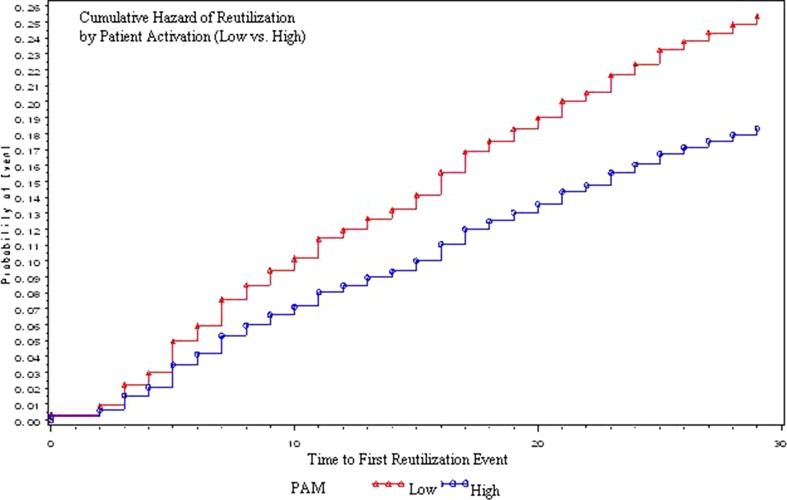
Results: Of the 695 subjects, 67 (9.6 %) were PAM Level 1, 123 (17.7 %) were Level 2, 193 (27.8 %) were Level 3, and 312 (44.9 %) were Level 4. Compared with highly activated patients (PAM Level 4), a higher rate of 30-day post-discharge hospital utilization was observed for patients at lower levels of activation (PAM Level 1, incident rate ratio [IRR] 1.75, 95 % CI,1.18 to 2.60) and (PAM Level 2, IRR 1.50, 95 % CI 1.06 to 2.13). The rate of returning to the hospital among patients at PAM Level 3 was not statistically different than patients with PAM Level 4 (IRR 1.30, 95 % CI, 0.94 to 1.80). The rate ratio for PAM Level 1 was also higher compared with Level 4 for ED use alone (1.68(1.07 to 2.63)) and for hospital readmissions alone (1.93 [1.22 to 3.06]).
Conclusion: Hospitalized adult medical patients in an urban academic safety net hospital with lower levels of Patient Activation had a higher rate of post-discharge 30-day hospital utilization.
References
-
- Steiner C, Barrett M, Hunter K. Hospital Readmissions and Multiple Emergency Department Visits, in Selected States, 2006–2007: Statistical Brief #90. Healthcare Cost and Utilization Project (HCUP) Statistical Briefs [Internet] Rockville: Agency for Health Care Policy and Research (US); 2010. - PubMed
-
- Rising KL, White LF, Fernandez WG, Boutwell AE. Emergency department visits after hospital discharge: a missing part of the equation. Ann Emerg Med. 2013. - PubMed
Publication types
MeSH terms
Grants and funding
LinkOut - more resources
Full Text Sources
Other Literature Sources
Medical
Miscellaneous
