


Strategies for partner notification for sexually transmitted infections, including HIV
- PMID: 24092529
- PMCID: PMC7138045
- DOI: 10.1002/14651858.CD002843.pub2
Strategies for partner notification for sexually transmitted infections, including HIV
Abstract
Background: Partner notification (PN) is the process whereby sexual partners of an index patient are informed of their exposure to a sexually transmitted infection (STI) and the need to obtain treatment. For the person (index patient) with a curable STI, PN aims to eradicate infection and prevent re-infection. For sexual partners, PN aims to identify and treat undiagnosed STIs. At the level of sexual networks and populations, the aim of PN is to interrupt chains of STI transmission. For people with viral STI, PN aims to identify undiagnosed infections, which can facilitate access for their sexual partners to treatment and help prevent transmission.
Objectives: To assess the effects of different PN strategies in people with STI, including human immunodeficiency virus (HIV) infection.
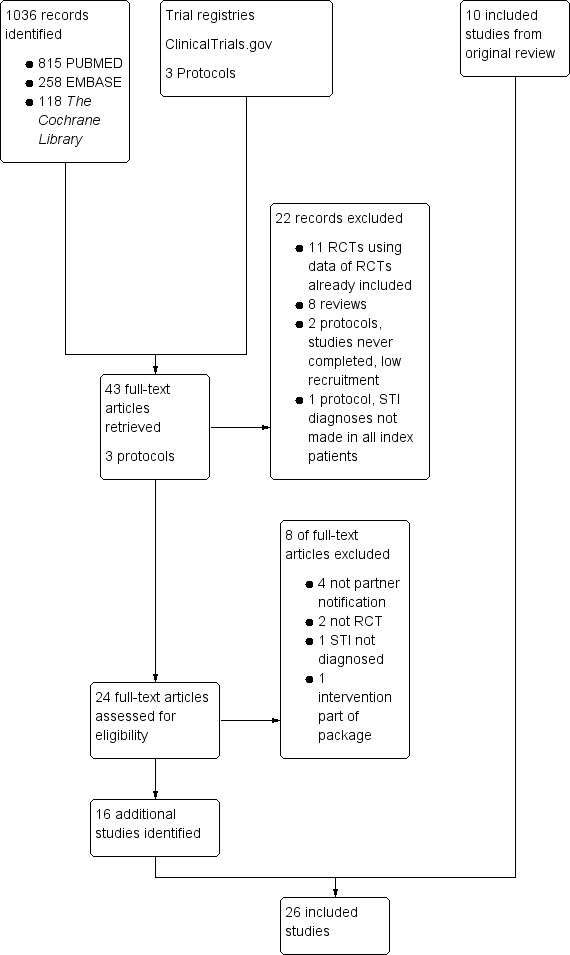
Search methods: We searched electronic databases (the Cochrane Central Register of Controlled Trials (CENTRAL), MEDLINE and EMBASE) without language restrictions. We scanned reference lists of potential studies and previous reviews and contacted experts in the field. We searched three trial registries. We conducted the most recent search on 31 August 2012.
Selection criteria: Published or unpublished randomised controlled trials (RCTs) or quasi-RCTs comparing two or more PN strategies. Four main PN strategies were included: patient referral, expedited partner therapy, provider referral and contract referral. Patient referral means that the patient notifies their sexual partners, either with (enhanced patient referral) or without (simple patient referral) additional verbal or written support. In expedited partner therapy, the patient delivers medication or a prescription for medication to their partner(s) without the need for a medical examination of the partner. In provider referral, health service personnel notify the partners. In contract referral, the index patient is encouraged to notify partner, with the understanding that the partners will be contacted if they do not visit the health service by a certain date.
Data collection and analysis: We analysed data according to paired partner referral strategies. We organised the comparisons first according to four main PN strategies (1. enhanced patient referral, 2. expedited partner therapy, 3. contract referral, 4. provider referral). We compared each main strategy with simple patient referral and then with each other, if trials were available. For continuous outcome measures, we calculated the mean difference (MD) with 95% confidence intervals (CI). For dichotomous variables, we calculated the risk ratio (RR) with 95% CI. We performed meta-analyses where appropriate. We performed a sensitivity analysis for the primary outcome re-infection rate of the index patient by excluding studies with attrition of greater than 20%. Two review authors independently assessed the risk of bias and extracted data. We contacted study authors for additional information.
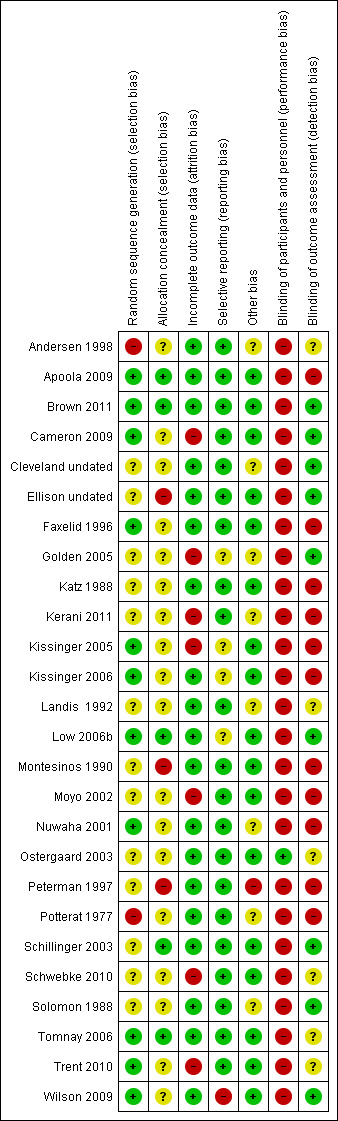
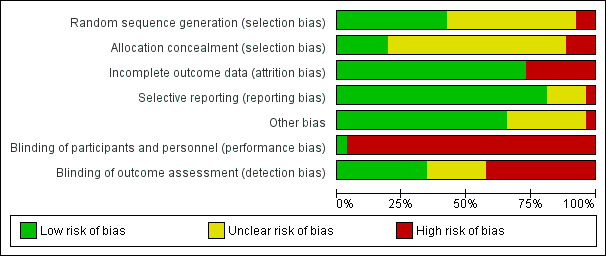
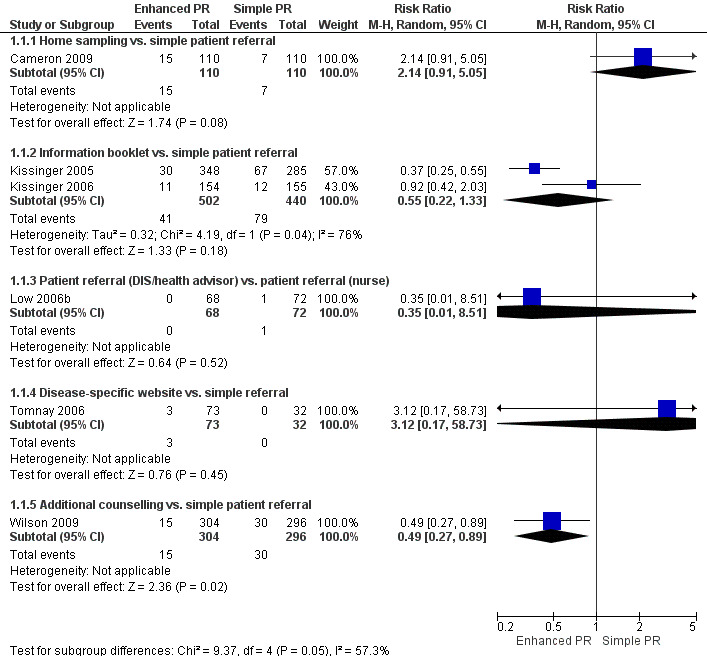
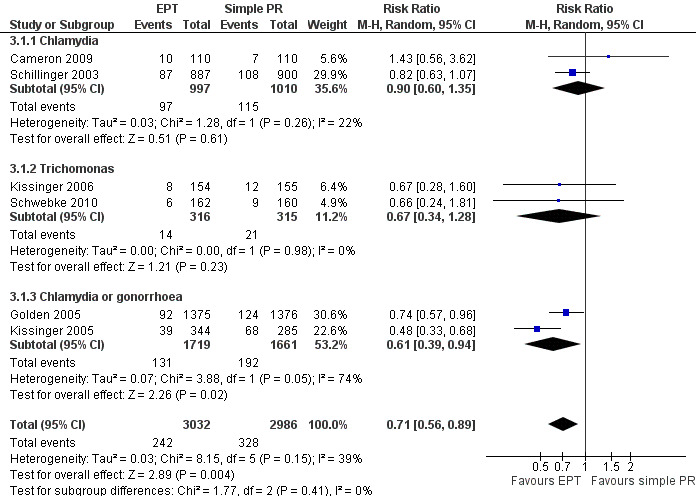
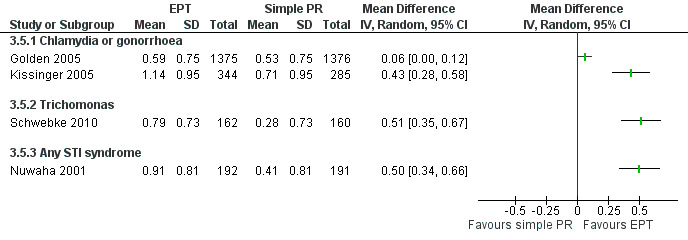
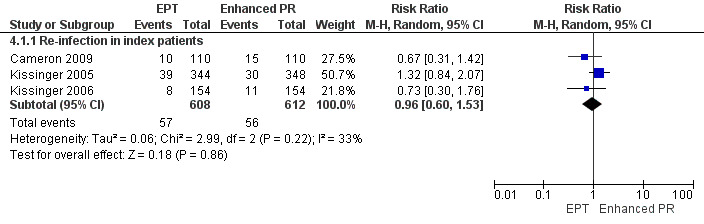
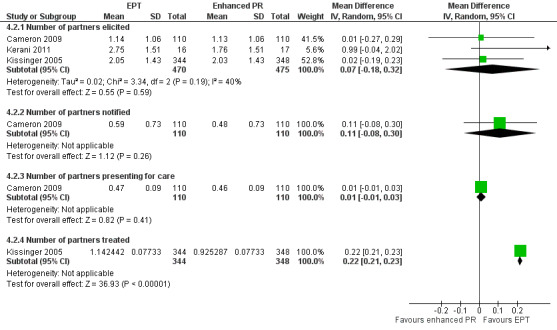
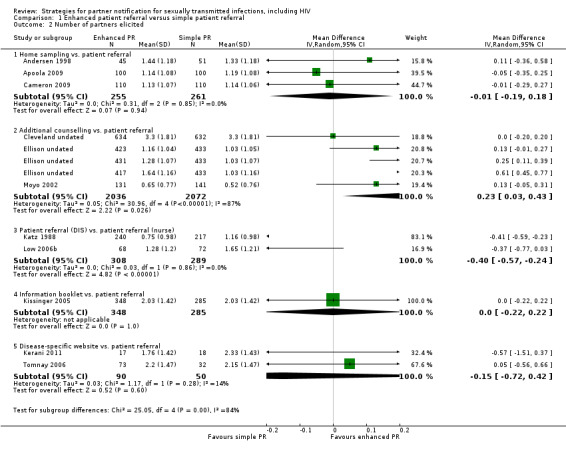
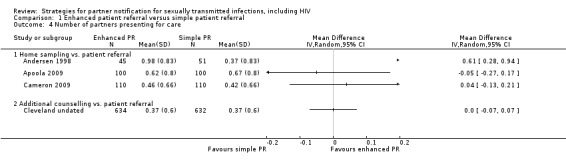
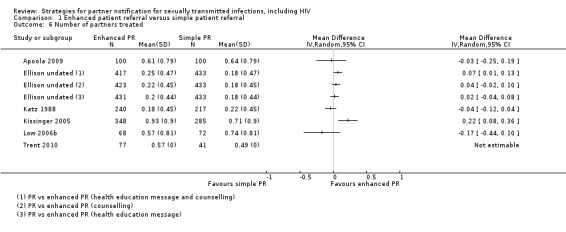
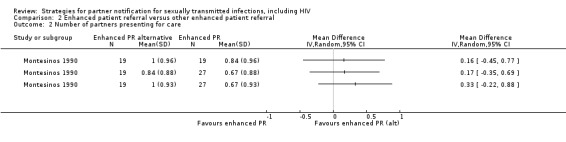
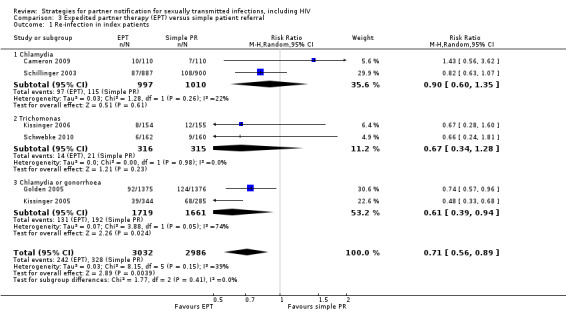
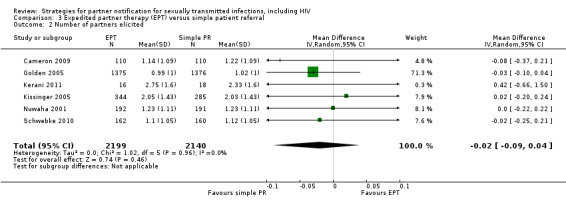
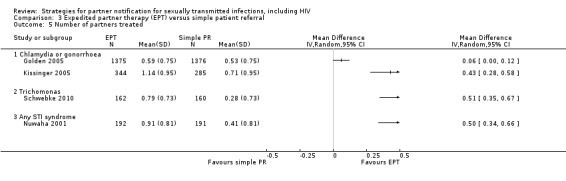
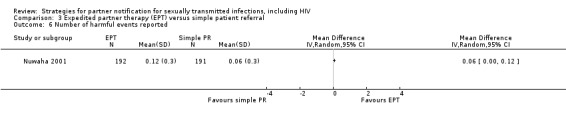
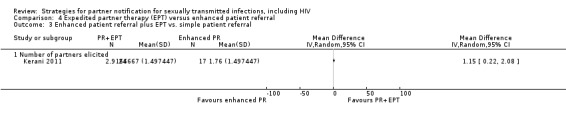
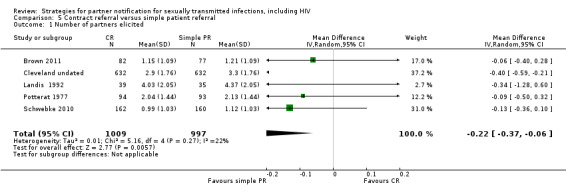
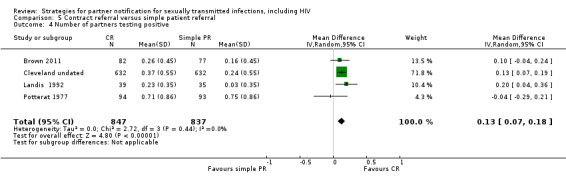
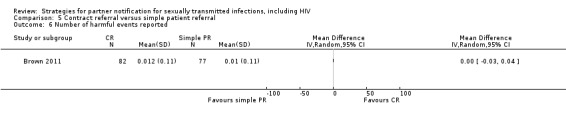
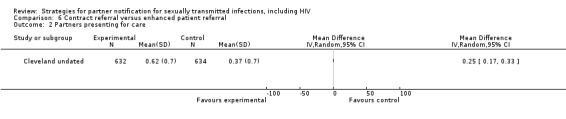
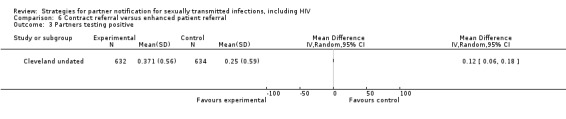
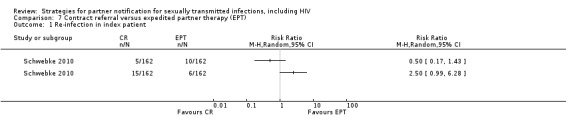
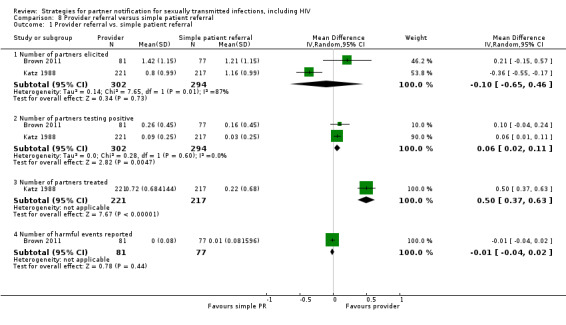
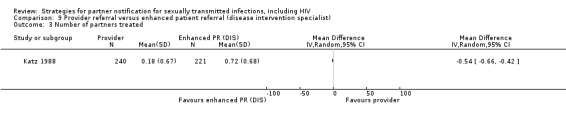
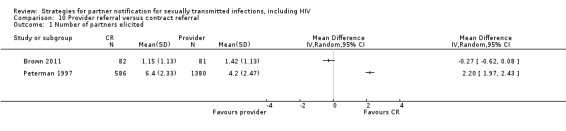
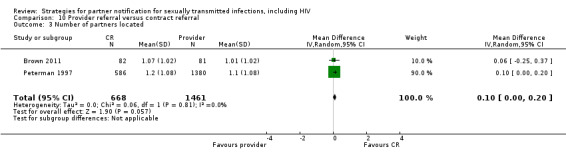
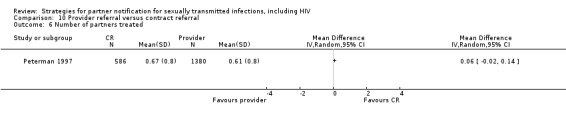
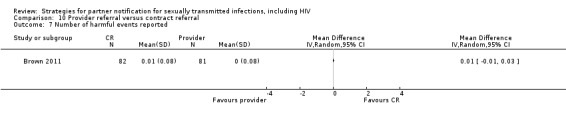
Main results: We included 26 trials (17,578 participants, 9015 women and 8563 men). Five trials were conducted in developing countries. Only two trials were conducted among HIV-positive patients. There was potential for selection bias, owing to the methods of allocation used and of performance bias, owing to the lack of blinding in most included studies. Seven trials had attrition of greater than 20%, increasing the risk of bias.The review found moderate-quality evidence that expedited partner therapy is better than simple patient referral for preventing re-infection of index patients when combining trials of STIs that caused urethritis or cervicitis (6 trials; RR 0.71, 95% CI 0.56 to 0.89, I(2) = 39%). When studies with attrition greater than 20% were excluded, the effect of expedited partner therapy was attenuated (2 trials; RR 0.8, 95% CI 0.62 to 1.04, I(2) = 0%). In trials restricted to index patients with chlamydia, the effect was attenuated (2 trials; RR 0.90, 95% CI 0.60 to 1.35, I(2) = 22%). Expedited partner therapy also increased the number of partners treated per index patient (three trials) when compared with simple patient referral in people with chlamydia or gonorrhoea (MD 0.43, 95% CI 0.28 to 0.58) or trichomonas (MD 0.51, 95% CI 0.35 to 0.67), and people with any STI syndrome (MD 0.5, 95% CI 0.34 to 0.67). Expedited partner therapy was not superior to enhanced patient referral in preventing re-infection (3 trials; RR 0.96, 95% CI 0.60 to 1.53, I(2) = 33%, low-quality evidence). Home sampling kits for partners (four trials) did not result in lower rates of re-infection in the index case (measured in one trial), or higher numbers of partners elicited (three trials), notified (two trials) or treated (one trial) when compared with simple patient referral. There was no consistent evidence for the relative effects of provider, contract or other patient referral methods. In one trial among men with non-gonococcal urethritis, more partners were treated with provider referral than with simple patient referral (MD 0.5, 95% CI 0.37 to 0.63). In one study among people with syphilis, contract referral elicited treatment of more partners than provider referral (MD 2.2, 95% CI 1.95 to 2.45), but the number of partners receiving treatment was the same in both groups. Where measured, there was no statistical evidence of differences in the incidence of adverse effects between PN strategies.
Authors' conclusions: The evidence assessed in this review does not identify a single optimal strategy for PN for any particular STI. When combining trials of STI causing urethritis or cervicitis, expedited partner therapy was more successful than simple patient referral for preventing re-infection of the index patient but was not superior to enhanced patient referral. Expedited partner therapy interventions should include all components that were part of the trial intervention package. There was insufficient evidence to determine the most effective components of an enhanced patient referral strategy. There are too few trials to allow consistent conclusions about the relative effects of provider, contract or other patient referral methods for different STIs. More high-quality RCTs of PN strategies for HIV and syphilis, using biological outcomes, are needed.
Conflict of interest statement
Taryn Young and Catherine Mathews are co‐authors of studies cited in the Background section.
Nicola Low is a co‐author on one of the included RCTs and a systematic review that is cited in the Background and Discussion section.
Figures


















Update of
-
Strategies for partner notification for sexually transmitted diseases.Cochrane Database Syst Rev. 2001;(4):CD002843. doi: 10.1002/14651858.CD002843. Cochrane Database Syst Rev. 2001. Update in: Cochrane Database Syst Rev. 2013 Oct 03;(10):CD002843. doi: 10.1002/14651858.CD002843.pub2. PMID: 11687164 Updated.
References
References to studies included in this review
Andersen 1998 {published data only}
Apoola 2009 {published data only}
-
- Apoola A, Beardsley J. Does the addition of a urine testing kit to use of contact slips increase the partner notification rates for genital chlamydial infection. International Journal of STD & AIDS 2009;20:775‐7. - PubMed
Brown 2011 {published data only}
Cameron 2009 {published data only}
-
- Cameron ST, Glasier A, Scott G, Young, Melvin L, Johnstone A, et al. Novel interventions to reduce re‐infection in women with chlamydia: a randomized controlled trial. Human Reproduction 2009;24(4):888‐95. - PubMed
-
- Melvin L, Cameron ST, Glasier A, Scott G, Johnstone A, Elton R. Preferred strategies of men and women for managing chlamydial infection. BJOG 2009;116:357‐65. - PubMed
Cleveland undated {unpublished data only}
-
- Cleveland JQ. A cost‐effective study of alternate methods for gonorrhea contact referral and rescreening. Data on file.
Ellison undated {unpublished data only}
-
- Ellison GTH, Moniez V, Stein J. Improving partner notification for sexually transmitted disease using a standardised health message and patient‐centred counselling. Data on file.
Faxelid 1996 {published data only}
-
- Faxelid E, Tembo G, Ndulo J, Krantz I. Individual counselling of patients with sexually transmitted diseases: a way to improve partner notification in a Zambian setting?. Sexually Transmitted Diseases 1996;23:289‐92. - PubMed
Golden 2005 {published data only}
-
- Golden MR, Whittington WLH, Handsfield HH, Clark A, Malinski C, Helmers JR, et al. Failure of family‐planning referral and high interest in advanced provision emergency contraception among women contacted for STD partner notification. Contraception 2004;69:241‐6. - PubMed
-
- Golden MR, Whittington WLH, Handsfield HH, Hughes JP, Stamm WE, Hogben M, et al. Effect of expedited treatment of sex partners on recurrent or persistent gonorrhea or chlamydial infection. New England Journal of Medicine 2005;352:676‐85. - PubMed
-
- Golden MR, Whittington WLH, Handsfield HH, Malinski C, Clark A, Hughes JP, et al. Partner management for gonococcal and chlamydial infection expansion of public health services to the private sector and expedited sex partner treatment through a partnership with commercial pharmacies. Sexually Transmitted Disease 2001;28(11):658‐65. - PubMed
-
- Shiely F, Hayes K, Thomas KK, Kerani RP, Hughes JP, Whittington WLH, et al. Expedited partner therapy: a robust intervention. Sexually Transmitted Diseases 2010;37(10):602‐7. - PubMed
Katz 1988 {published data only}
-
- Katz BP, Danos CS. Efficiency and cost‐effectiveness of field follow‐up for patients with chlamydia trachomatis infection in a sexually transmitted disease clinic. Sexually Transmitted Diseases 1988;15(1):11‐6. - PubMed
Kerani 2011 {published data only}
-
- Kerani RP, Fleming M, DeYoung B, Golden MR. A randomized, controlled trial of inSPOT and patient‐delivered partner therapy for gonorrhea and chlamydial infection among men who have sex with men. Sexually Transmitted Diseases 2011;38(10):941‐6. - PubMed
Kissinger 2005 {published data only}
-
- Kissinger P, Mohammed H, Richardson‐Alston G, Leichliter JS, Taylor SN, Martin DH, et al. Patient‐delivered partner treatment for male urethritis: a randomized, controlled trial. Clinical Infectious Diseases 2005;41:623‐9. - PubMed
-
- Mohammed H, Leichliter JS, Schmidt N, Kissinger P. Does patient‐delivered partner treatment improve disclosure for treatable sexually transmitted diseases?. AIDS Patient Care and STDs 2010;24(3):183‐8. - PubMed
Kissinger 2006 {published data only}
-
- Kissinger P, Schmidt N, Mohammed H, Leichliter JS, Gift TL, Meadors B, et al. Patient‐delivered partner treatment for Trichomonas vaginalis infection: a randomized controlled trial. Sexually Transmitted Diseases 2006;33(7):445‐50. - PubMed
Landis 1992 {published data only}
-
- Landis SE, Schoenbach VJ. Results of a randomized trial of partner notification in cases of HIV infection in North Carolina. New England Journal of Medicine 1992;326(2):101‐6. - PubMed
Low 2006b {published data only}
-
- Low N, McCarthy A, Macleod J, Salisbury C, Campbell R, Roberts TE, et al. Epidemiological, social, diagnostic and economic evaluation of population screening for genital chlamydial infection (executive summary). Health Technology Assessment 2007;11(8):1‐165. - PubMed
Montesinos 1990 {published data only}
Moyo 2002 {published data only}
-
- Moyo W, Chirenje ZM, Mandel J, Schwarcz SK, Klausner J, Rutherford G, et al. Impact of a single session of counseling on partner referral for sexually transmitted disease treatment, Harare, Zimbabwe. AIDS and Behavior 2002;6(3):237‐43.
Nuwaha 2001 {published data only}
-
- Nuwaha F, Kambugu F, Nsubuga PSJ, Hojer B, Faxelid E. Efficacy of patient‐delivered partner medication in the treatment of sexual partners in Uganda. Sexually Transmitted Diseases 2001;28:105‐10. - PubMed
Ostergaard 2003 {published data only}
Peterman 1997 {published data only}
-
- Peterman TA, Toomey KE, Dicker LW, Zaidi AA, Wroten JE, Carolina J. Partner notification for syphilis: a randomised controlled trial of three approaches. Sexually Transmitted Diseases 1997;24(9):511‐18. - PubMed
Potterat 1977 {published data only}
Schillinger 2003 {published data only}
-
- Magnus M, Schillinger JA, Fortenberry JD, Berman SM, Kissinger P. Partner age not associated with recurrent Chlamydia trachomatis infection, condom use, or partner treatment and referral among adolescent women. Journal of Adolescent Health 2006;39:396‐403. - PubMed
-
- Schillinger JA, Kissinger P, Calvet H, Whittington WLH, Ransom RL, Sternberg MR, et al. Patient‐delivered partner treatment with azithromycin to prevent repeated Chlamydia trachomatis infection among women. Sexually Transmitted Diseases 2003;30:49‐56. - PubMed
Schwebke 2010 {published data only}
Solomon 1988 {published data only}
-
- Solomon MZ, DeJong W. The impact of a clinic‐based educational videotape on knowledge and treatment behavior of men with gonorrhea. Sexually Transmitted Diseases 1988;15:127‐32. - PubMed
Tomnay 2006 {published data only}
-
- Tomnay JE, Pitts MK, Kuo TC, Fairley CK. Does the Internet assist clients to carry out contact tracing? A randomized controlled trial using web‐based information. International Journal of STD & AIDS 2006;17(6):391. - PubMed
Trent 2010 {published data only}
-
- Trent M, Chung S, Burke M, Walker A, Ellen J. Results of a randomized controlled trial of a brief behavioral intervention for pelvic inflammatory disease in adolescents. Journal of Pediatric and Adolescent Gynecology 2010;23:96‐101. - PubMed
Wilson 2009 {published data only}
References to studies excluded from this review
Colvin 2006 {published data only}
Garcia 2003 {published data only}
Hogben 2005 {published data only}
-
- Hogben M, Madico G. The Participant Agreement for Contact Tracing (PACT) study: enhancing partner notification services. clinicaltrials.gov/show/NCT00207493 (accessed 17 June 2013).
Marion 2009 {published data only}
-
- Marion LN, Finnegan L, Campbell RT, Szalacha LA. The Well Woman Program: a community‐based randomized trial to prevent sexually transmitted infections in low‐income African American women. Research in Nursing & Health 2009;32:274‐85. - PubMed
Okonofua 2003 {published data only}
-
- Okonofua FE, Coplan P, Collins S, Oronsaye F, Ogunsaki D, Ogonor JT, et al. Impact of an intervention to improve treatment‐seeking behavior and prevent sexually transmitted diseases among Nigerian youths. International Journal of Infectious Diseases 2003;7:61‐73. - PubMed
Richens 2010 {published data only}
-
- Richens J, Copas A, Sadiq ST, Kingori P, McCarthy O, Jones V, et al. A randomised controlled trial of computer‐assisted interviewing in sexual health clinics. Sexually Transmitted Infections 2010;86(4):310‐37. - PubMed
Shain 2004 {published data only}
-
- Shain RN, Piper JM, Holden AEC, Champion JD, Perdue ST, Korte JE, et al. Prevention of gonorrhea and chlamydia through behavioral intervention results of a two‐year controlled randomized trial in minority women. Sexually Transmitted Diseases 2004;31(7):401‐8. - PubMed
Sherman 2005 {published data only}
-
- Sherman C, Hogben M. Computer‐assisted STD partner notification. clinicaltrials.gov/ct2/show/NCT00207571 (accessed 17 June 2013).
Thurman 2008 {published data only}
-
- Thurman AS, Holden AEC, Shain R, Perdue S, Piper J. Partner notification of sexually transmitted infections among pregnant women. International Journal of STD & AIDS 2008;19:309‐15. - PubMed
Wu 2009 {published data only}
-
- Wu Z, Yen W. A randomized community intervention trial on reducing HIV infection among drug users attending methadone maintenance treatment (MMT) and preventing secondary transmission from HIV positive clients to their sexual partners in China. http://clinicaltrials.gov/show/NCT01108614 (Accessed 14 September 2013).
Young 2007 {published data only}
-
- Young IT, Kock A, Jones, Altini L, Ferguson T, Wijgert J. A comparison of two methods of partner notification for sexually transmitted infections in South Africa: patient‐delivered partner medication and patient‐based partner referral. International Journal of STD & AIDS 2007;18:338‐40. - PubMed
References to studies awaiting assessment
References to ongoing studies
Cassell 2010 {published data only}
-
- Different Approaches to Partner Notification in Primary Care. Ongoing study 1 May 2010.
Falk 2012 {published data only}
-
- Home‐Sampling in Partner Notification of Chlamydia. Ongoing study November 2006.
Farquhar 2012 {published data only}
-
- Assisted‐Partner Notification Services. Ongoing study June 2012.
Golden 2012 {published data only}
-
- Washington State Community Expedited Partner Treatment (EPT) Trial. Ongoing study July 2007.
Additional references
Alam 2010
Arnold 2008
-
- Arnold EM, Rice E, Flannery D, Rotherham‐Borus MJ. HIV disclosure among adults living with HIV. Aids Care 2008;20(1):80‐92. - PubMed
CDC 2006
-
- Centers for Disease Control and Prevention. Expedited partner therapy in the management of sexually transmitted diseases. US Department of Health and Human Services 2006.
Deeks 2011
-
- Deeks JJ, Higgins JPT, Altman DG. Chapter 9: Analysing data and undertaking meta‐analysis. In: Higgins JPT, Green S (editors). Cochrane Handbook for Systematic Reviews of Interventions Version 5.1.0. [updated March 2011]. The Cochrane Collaboration, 2011. Available from www.cochrane‐handbook.org.
ECDC 2013
-
- European Centre for Disease Prevention and Control. Public health benefits of partnernotification for sexually transmitted infections and HIV, 2013. http://optimisation.ecdc.europa.eu/en/publications/publications/partner‐..... Stockholm: ECDC, (accessed 16 September 2013).
Fenton 1997
-
- Fenton KA, Peterman TA. HIV partner notification: taking a new look. AIDS 1997;11:1535‐46. - PubMed
Gerbase 1998
-
- Gerbase AC, Rowley JT, Heymann DHL, Berkley SFB, Piot P. Global prevalence and incidence estimate of selected curable STDs. Sexually Transmitted Infections 1998;74 Suppl 1:S12‐6. - PubMed
Glasier 2006
GRADE 2004 [Computer program]
-
- Brozek J, Oxman A, Schunemann H. GRADEpro. Version 3.2 for Windows. 2008.
Higgins 2011
-
- Higgins JPT, Green S (editors). Cochrane Handbook for Systematic Reviews of Interventions Version 5.1.0 [updated March 2011]. The Cochrane Collaboration, 2011. Available from www.cochrane‐handbook.org.
Higgins 2011a
-
- Higgins JPT, Altman DG. Chapter 8: Assessing risk of bias in included studies. In: Higgins JPT, Green S (editors). Cochrane Handbook for Systematic Reviews of Interventions Version 5.1.0 [updated March 2011]. The Cochrane Collaboration, 2011. Available from www.cochrane‐handbook.org.
Higgins 2011b
-
- Higgins JPT, Deeks JJ, Altman DG. Chapter 16: Special topics in statistics. In: Higgins JPT, Green S (editors). Cochrane Handbook for Systematic Reviews of Interventions Version 5.1.0 [updated March 2011]. The Cochrane Collaboration, 2011. Available from www.cochrane‐handbook.org.
Kissinger 2003
-
- Kissinger PJ, Niccolai LM, Magnus M. Partner notification for HIV and syphilis: effects on sexual behaviors and relationship stability. Sexually Transmitted Diseases 2003;30:75‐82. - PubMed
Low 2006a
-
- Low N, Broutet N, Adu‐Sarkodie Y, Barton P, Hassain M, Hawkes S. Global control of sexually transmitted infections. Lancet 2006;368(9551):2001‐16. - PubMed
Macke 1999
-
- Macke BA, Maher JE. Partner notification in the United States: an evidence‐based review. American Journal of Preventive Medicine 1999;17(3):230‐42. - PubMed
Mathews 2001
Niccolai 2007
-
- Niccolai L, Livingston K, Teng F, Pettigrew M. Behavioral intentions in sexual partnerships following a diagnosis of Chlamydia trachomatis. Preventive Medicine 2007;46(2008):170‐6. - PubMed
Oxman 1994
-
- Oxman AD, Scott EAF, Sellors JW, Clarke JH, Millson ME, Rasooly I, et al. Partner notification for sexually transmitted diseases: an overview of the evidence. Canadian Journal of Public Health 1994;85:127‐32. - PubMed
RevMan 2011 [Computer program]
-
- The Nordic Cochrane Centre, The Cochrane Collaboration. Review Manager (RevMan). Version 5.1. Copenhagen: The Nordic Cochrane Centre, The Cochrane Collaboration, 2011.
Rosenthal 1995
-
- Rosenthal SL, Baker JG, Biro FM. Secondary prevention of STD transmission during adolescence: partner notification. Adolescent & Pediatric Gynecology 1995;8:183‐7.
Sahasrabuddhe 2002
-
- Sahasrabuddhe VV, Gholap TA, Jethava YS, Joglekar NS, Brahme RG, Gaikwad BA, et al. Patient‐led partner referral in a district hospital based STD clinic. Journal of Postgraduate Medicine 2002;48(2):105‐8. - PubMed
Simbayi 2007
Toomey 1996
-
- Toomey KE, Latif AS, Steen RC. Partner management. In: Dallabetta GA, Laga M, Lamptey PR editor(s). Control of Sexually Transmitted Diseases. A Handbook for the Design and Management of Programs. Arlington, VA: Family Health International, AIDS Control and Prevention Project, 1996:211‐224.
Trelle 2007
Trollope‐Kumar 2006
-
- Trollope‐Kumar K, Guyatt G. Syndromic approach for treatment of STIs: time for a change. Lancet 2006;367:1380‐1. - PubMed
UNAIDS 1999
-
- UNAIDS/World Health Organization. Sexually transmitted diseases: policies and principles for prevention and care, 1999. www.who.int/hiv/pub/sti/pubstiprevcare/en/index.html (accessed 17 June 2013).
UNAIDS 2010
-
- UNAIDS. UNAIDS report on the global AIDS epidemic, 2010. www.unaids.org/globalreport/global_report.htm (accessed 17 June 2013).
WHO 2004
-
- World Health Organization. Global burden of disease, 2004. www.who.org (accessed 17 June 2013).
WHO 2007
-
- World Health Organization. Global strategy for the prevention and control of sexually transmitted infections: 2006‐2015: breaking the chain of transmission. www.who.int/reproductivehealth/publications/rtis/9789241563475/en/ (accessed 17 June 2013).
WHO 2012
-
- World Health Organization. Global incidence and prevalence of selected curable sexually transmitted infections ‐ 2008. www.who.int/reproductivehealth/publications/rtis/stisestimates/en/ (accessed 17 June 2013).
World Bank 2012
-
- World Bank. World Bank Data, 2012. http://data.worldbank.org/income‐level/MIC (accessed 14 September 2013).
Publication types
MeSH terms
LinkOut - more resources
Full Text Sources
Other Literature Sources
Medical
