


Dance therapy for schizophrenia
- PMID: 24092546
- PMCID: PMC11440587
- DOI: 10.1002/14651858.CD006868.pub3
Dance therapy for schizophrenia
Abstract
Background: Dance therapy or dance movement therapy (DMT) is defined as 'the psychotherapeutic use of movement as a process which furthers the emotional, social, cognitive, and physical integration of the individual'. It may be of value for people with developmental, medical, social, physical or psychological impairments. Dance therapy can be practiced in mental health rehabilitation units, nursing homes, day care centres and incorporated into disease prevention and health promotion programmes.
Objectives: To evaluate the effects of dance therapy for people with schizophrenia or schizophrenia-like illnesses compared with standard care and other interventions.
Search methods: We updated the original July 2007 search of the Cochrane Schizophrenia Group' register in July 2012. We also searched Chinese main medical databases.
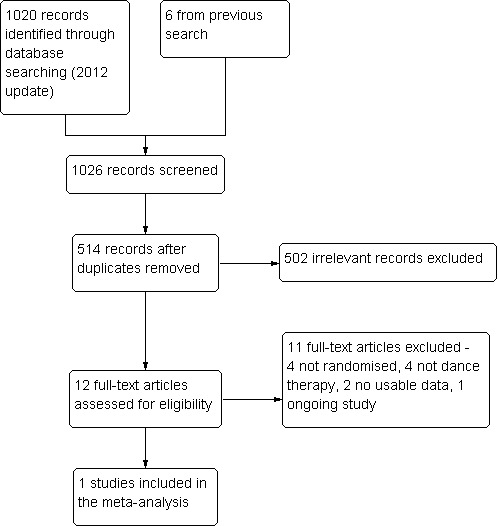
Selection criteria: We included one randomised controlled trial (RCT) comparing dance therapy and related approaches with standard care or other psychosocial interventions for people with schizophrenia.
Data collection and analysis: We reliably selected, quality assessed and extracted data. For continuous outcomes, we calculated a mean difference (MD); for binary outcomes we calculated a fixed-effect risk ratio (RR) and their 95% confidence intervals (CI). We created a 'Summary of findings' table using the GRADE approach.
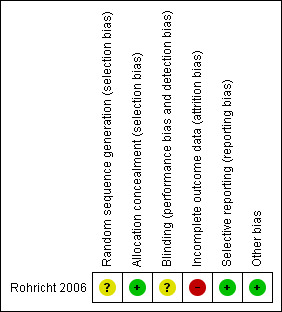
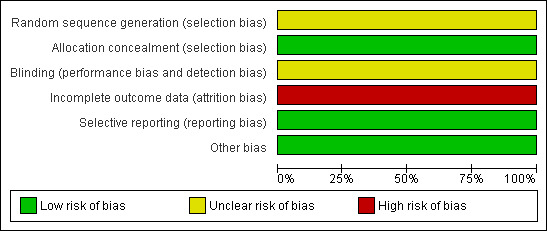
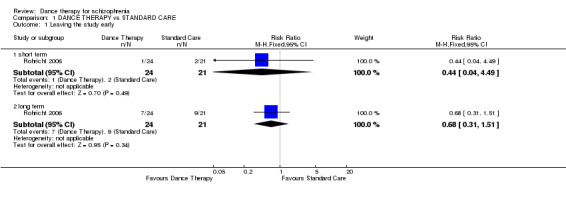
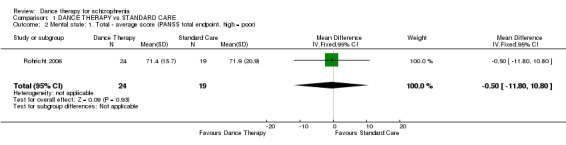
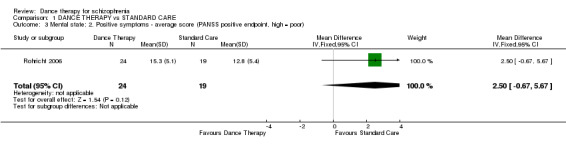
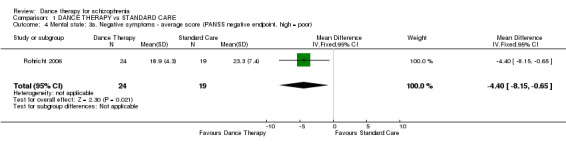
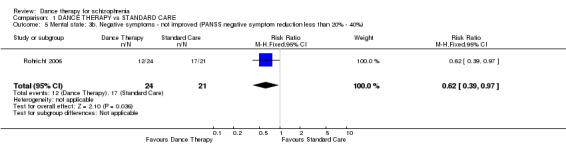
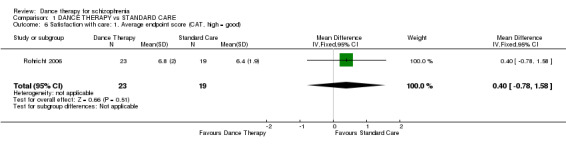
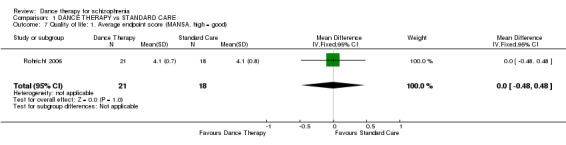
Main results: We included one single blind study (total n = 45) of reasonable quality. It compared dance therapy plus routine care with routine care alone. Most people tolerated the treatment package but nearly 40% were lost in both groups by four months (1 RCT n = 45, RR 0.68 95% CI 0.31 to 1.51, low quality evidence). The Positive and Negative Syndrome Scale (PANSS) average endpoint total scores were similar in both groups (1 RCT n = 43, MD -0.50 95% CI -11.80 to 10.80, moderate quality evidence) as were the positive sub-scores (1 RCT n = 43, MD 2.50 CI -0.67 to 5.67, moderate quality evidence). At the end of treatment, significantly more people in the dance therapy group had a greater than 20% reduction in PANSS negative symptom score (1 RCT n = 45, RR 0.62 CI 0.39 to 0.97, moderate quality evidence), and overall, average negative endpoint scores were lower (1 RCT n = 43, MD -4.40 CI -8.15 to -0.65, moderate quality evidence). There was no difference in satisfaction score (average Client's Assessment of Treatment Scale (CAT) score, 1 RCT n = 42, MD 0.40 CI -0.78 to 1.58, moderate quality evidence) and quality of life data were also equivocal (average Manchester Short Assessment of Quality of life (MANSA) score, 1 RCT n = 39, MD 0.00 CI -0.48 to 0.48, moderate quality evidence).
Authors' conclusions: Based on predominantly moderate quality data, there is no evidence to support - or refute - the use of dance therapy in this group of people. This therapy remains unproven and those with schizophrenia, their carers, trialists and funders of research may wish to encourage future work to increase high quality evidence in this area.
Conflict of interest statement
Juanjuan Ren ‐ no known conflict for interest.
Jun Xia ‐ no known conflict of interest.
Tessa Grant ‐ no known conflict of interest (2009 version of the review).
Figures

Update of
-
Dance therapy for schizophrenia.Cochrane Database Syst Rev. 2009 Jan 21;(1):CD006868. doi: 10.1002/14651858.CD006868.pub2. Cochrane Database Syst Rev. 2009. Update in: Cochrane Database Syst Rev. 2013 Oct 04;(10):CD006868. doi: 10.1002/14651858.CD006868.pub3. PMID: 19160306 Updated.
References
References to studies included in this review
Rohricht 2006 {published data only}
-
- Rohricht F, Priebe S. Effect of body‐oriented psychological therapy on negative symptoms in schizophrenia: a randomized controlled trial. Psychological Medicine 2006;36(5):669‐78. [EMBASE: 171807; MEDLINE: ] - PubMed
References to studies excluded from this review
Apter 1978 {published data only}
-
- Apter A, Sharir I, Tyano S, Wijsenbeek H. Movement therapy with psychotic adolescents. British Journal of Medical Psychology 1978;51(2):155‐9. - PubMed
ISRCTN 2012a {unpublished data only}
-
- Effectiveness and cost‐effectiveness of body psychotherapy in the treatment of negative symptoms of schizophrenia. http://www.controlled‐trials.com/ISRCTN84216587 2010.
Killaspy 1997 {published data only}
-
- Killaspy H. Interactive group art therapy as an adjunctive treatment for people with schizophrenia. National Research Register 1997. [ISRCTN46150447]
Qu 2007 {published data only}
-
- Qu Y, Xiao G, Ma Y. Effect of congnitive remediation therapy on improving clinical symtoms and social functions in patients with chronic schizophrenia [认知矫正治疗对慢性精神分裂症患者临床症状和社会功能的影响]. Journal of Clinical Rehabilitative Tissue Engineering Research 2007;11(52):10553‐6.
Su 1999 {published data only}
-
- Su L, Fan Z, Qu Y. The effect of dance therapy for chronic schizophrenic patients . Chinese Journal of Psychiatry 1999;32(3):167‐9. [MEDI19911]
Tan 2010 {published data only}
-
- Tan S, Zhou Y, Wang J. Effect of cognitive remediation therapy and computerized congnitive remediation therapy on cognitive defiicits in patients with schizophrenia: a randomized controlled study. Chinese Journal of Psychiatry 2010;43(3):140‐5.
Tang 2011 {published data only}
-
- Tang Z, Peng L, Tian F. The clinical observation of dance therapy for chronic schizophrenia [舞蹈疗法对慢性精神分裂症的临床观察]. Sichun Mental Health 2011;24(3):182‐4.
Wu 2003 {published data only}
-
- Wu Y, Zhao F. Effect of music and dance on recovery of schizophrenia. Health Psychology Journal 2003;11(3):207‐8. [MEDI0308]
Yang 2005 {published data only}
-
- Yang R, Lv H, Lou F. The rehabilitation effect of group psychotherapy on chronic schizophrenic patient. Occupation and Health 2005;21(6):936. [CAJ: MEDI0507S1]
Yao 2008 {published data only}
-
- Yao Y. Rehabilitation of music and dance therapy for patients with schizophrenia [音乐舞蹈治疗对精神分裂症患者的康复作用]. Chinese Medicine Research and Clinical 2008;6(2):13‐5.
Zhou 2009 {published data only}
-
- Zhou C, Dai F, Pan D. Act on of dance therapy improved the maladjustment in hospital patient with psychosis [舞蹈疗法对改善住院精神病患者适应不良的作用研究]. Medical Journal of Chinese People's Health 2009;21(23):3048‐9.
References to ongoing studies
Additional references
Altman 1996
Bland 1997
Boissel 1999
-
- Boissel JP, Cucherat M, Li W, Chatellier G, Gueyffier F, Buyse M, et al. The problem of therapeutic efficacy indices. 3. Comparison of the indices and their use [Apercu sur la problematique des indices d'efficacite therapeutique, 3: comparaison des indices et utilisation. Groupe d'Etude des Indices D'efficacite]. Therapie 1999;54(4):405‐11. [PUBMED: 10667106] - PubMed
Chodorow 1991
-
- Chodorow J. Dance Therapy and Depth Psychology: the Moving Imagination. London: Routledge, 1991. [ISBN 0‐415‐05301‐3]
Deeks 2000
-
- Deeks J. Issues in the selection for meta‐analyses of binary data. Proceedings of the 8th International Cochrane Colloquium; 2000 Oct 25‐28; Cape Town. Cape Town: The Cochrane Collaboration, 2000.
Divine 1992
-
- Divine GW, Brown JT, Frazier LM. The unit of analysis error in studies about physicians' patient care behavior. Journal of General Internal Medicine 1992;7(6):623‐9. - PubMed
Donner 2002
-
- Donner A, Klar N. Issues in the meta‐analysis of cluster randomized trials. Statistics in Medicine 2002;21:2971‐80. - PubMed
Egger 1997
Elbourne 2002
-
- Elbourne D, Altman DG, Higgins JPT, Curtina F, Worthingtond HV, Vaile A. Meta‐analyses involving cross‐over trials: methodological issues. International Journal of Epidemiology 2002;31(1):140‐9. - PubMed
Espenak 1981
-
- Espenak L, Adler A, Lowen A. Dance Therapy ‐ Theory and Application. Springfield, IL: Charles C Thomas, 1981.
Exiner 1994
-
- Exiner J, Kelynack D. Dance Therapy Redefined ‐ a Body Approach to Therapeutic Dance. Springfield, IL: Charles C Thomas, 1994. [ISBN 0‐398‐05913‐6]
Fortinash 2000
-
- Fortinash KM, Holoday‐Worret PA. Psychiatric Mental Health Nursing. London: Mosby, 2000.
Furukawa 2006
-
- Furukawa TA, Barbui C, Cipriani A, Brambilla P, Watanabe N. Imputing missing standard deviations in meta‐analyses can provide accurate results. Journal of Clinical Epidemiology 2006;59(7):7‐10. - PubMed
Gulliford 1999
-
- Gulliford MC. Components of variance and intraclass correlations for the design of community‐based surveys and intervention studies: data from the Health Survey for England 1994. American Journal of Epidemiology 1999;149:876‐83. - PubMed
Higgins 2003
Higgins 2005
-
- Higgins JPT, Green S, editors. Cochrane Handbook for Systematic Reviews of Interventions 4.2.5 [updated May 2005]. www.cochrane.org/resources/handbook/hbook.htm (accessed 04 February 2006).
Higgins 2011
-
- Higgins JPT, Green S (editors). Cochrane Handbook for Systematic Reviews of Interventions Version 5.0.2 [updated September 2011]. The Cochrane Collaboration, 2011. Available from www.cochrane‐handbook.org..
Hutton 2009
-
- Hutton JL. Number needed to treat and number needed to harm are not the best way to report and assess the results of randomised clinical trials. British Journal of Haematology 2009;146(1):27‐30. - PubMed
Kay 1986
-
- Kay SR, Opler LA, Fiszbein A. Positive and Negative Syndrome Scale (PANSS) Manual. North Tonawanda, NY: Multi‐Health Systems, 1986.
Leucht 2005
-
- Leucht S, Kane JM, Kissling W, Hamann J, Etschel E, Engel RR. What does the PANSS mean?. Schizophrenia Research 2005;79(2‐3):231‐8. [PUBMED: 15982856] - PubMed
Leucht 2005a
-
- Leucht S, Kane JM, Kissling W, Hamann J, Etschel E, Engel R. Clinical implications of brief psychiatric rating scale scores. British Journal of Psychiatry 2005;187:366‐71. [PUBMED: 16199797] - PubMed
Leucht 2007
Marshall 2000
-
- Marshall M, Lockwood A, Bradley C, Adams C, Joy C, Fenton M. Unpublished rating scales: a major source of bias in randomised controlled trials of treatments for schizophrenia. British Journal of Psychiatry 2000;176:249‐52. - PubMed
McGrath 2000
Mössler 2011
Overall 1962
-
- Overall JE, Gorham DR. The brief psychiatric rating scale. Psychological Reports 1962;10:799‐812.
Payne 2006
-
- Payne H. Dance Movement Therapy ‐ Theory, Research and Practice. 2nd Edition. Sussex: Routledge, 2006.
Priebe 1995
-
- Priebe S, Gruyters T, Heinze M, Hoffmann C, Jakel A. Subjective criteria in psychiatric care ‐ methods of assessment for research and routine care. Psychiatrische Praxis 1995;22:140‐4. - PubMed
Priebe 1999
-
- Priebe S, Huxley P, Knight S, Evans S. Application and results of the Manchester Short Assessment of Quality of Life. International Journal of Social Psychiatry 1999;45:7‐12. - PubMed
Ruddy 2005
Schünemann 2008
-
- Schünemann HJ, Oxman AD, Vist GE, Higgins JPT, Deeks JJ, Glasziou P, et al. Chapter 12: Interpreting results and drawing conclusions. In: Higgins JPT, Green S editor(s). Cochrane Handbook for Systematic Reviews of Interventions. The Cochrane Collaboration, 2008:359‐83.
Simpson 1970
-
- Simpson GM, Angus JW. A rating scale for extrapyramidal side effects. Acta Psychiatrica Scandinavica Supplementum 1970;212:11‐9. - PubMed
Ukoumunne 1999
-
- Ukoumunne OC, Gulliford MC, Chinn S, Sterne JAC, Burney PGJ. Methods for evaluating area‐wide and organisation‐based intervention in health and health care: a systematic review. Health Technology Assessment 1999;3(5):1‐75. - PubMed
Välimäki 2012
-
- Välimäki M, Hätönen H, Adams CE, Arifulla D, Kostiainen J, Kostamo P. Information and communication technology‐based cognitive remediation for supporting treatment compliance for people with serious mental illness. Cochrane Database of Systematic Reviews 2012, Issue 5. [DOI: 10.1002/14651858.CD009766; CD009766] - DOI
Xia 2009
-
- Xia J, Adams CE, Bhagat N, Bhagat V, Bhoopathi P, El‐Sayeh H, et al. Loss to outcomes stakeholder survey: the LOSS study. Psychiatric Bulletin 2009;33(7):254‐7.
Publication types
MeSH terms
LinkOut - more resources
Full Text Sources
Other Literature Sources
Medical
Miscellaneous
