. 2013 Nov 15;288(46):32932-40.
doi: 10.1074/jbc.M113.517011. Epub 2013 Oct 3.

Human eukaryotic initiation factor 4G (eIF4G) protein binds to eIF3c, -d, and -e to promote mRNA recruitment to the ribosome

Affiliations

Human eukaryotic initiation factor 4G (eIF4G) protein binds to eIF3c, -d, and -e to promote mRNA recruitment to the ribosome

Nancy Villa et al. J Biol Chem. .

Abstract

Recruitment of mRNA to the 40S ribosomal subunit requires the coordinated interaction of a large number of translation initiation factors. In mammals, the direct interaction between eukaryotic initiation factor 4G (eIF4G) and eIF3 is thought to act as the molecular bridge between the mRNA cap-binding complex and the 40S subunit. A discrete ∼90 amino acid domain in eIF4G is responsible for binding to eIF3, but the identity of the eIF3 subunit(s) involved is less clear. The eIF3e subunit has been shown to directly bind eIF4G, but the potential role of other eIF3 subunits in stabilizing this interaction has not been investigated. It is also not clear if the eIF4A helicase plays a role in stabilizing the interaction between eIF4G and eIF3. Here, we have used a fluorescence anisotropy assay to demonstrate that eIF4G binds to eIF3 independently of eIF4A binding to the middle region of eIF4G. By using a site-specific cross-linking approach, we unexpectedly show that the eIF4G-binding surface in eIF3 is comprised of the -c, -d and -e subunits. Screening multiple cross-linker positions reveals that eIF4G contains two distinct eIF3-binding subdomains within the previously identified eIF3-binding domain. Finally, by employing an eIF4G-dependent translation assay, we establish that both of these subdomains are required for efficient mRNA recruitment to the ribosome and stimulate translation. Our study reveals unexpected complexity to the eIF3-eIF4G interaction that provides new insight into the regulation of mRNA recruitment to the human ribosome.

Keywords: Initiation; Protein Cross-linking; Protein-Protein Interactions; Ribosomes; Translation; eIF3; eIF4G; mRNA.


Figures
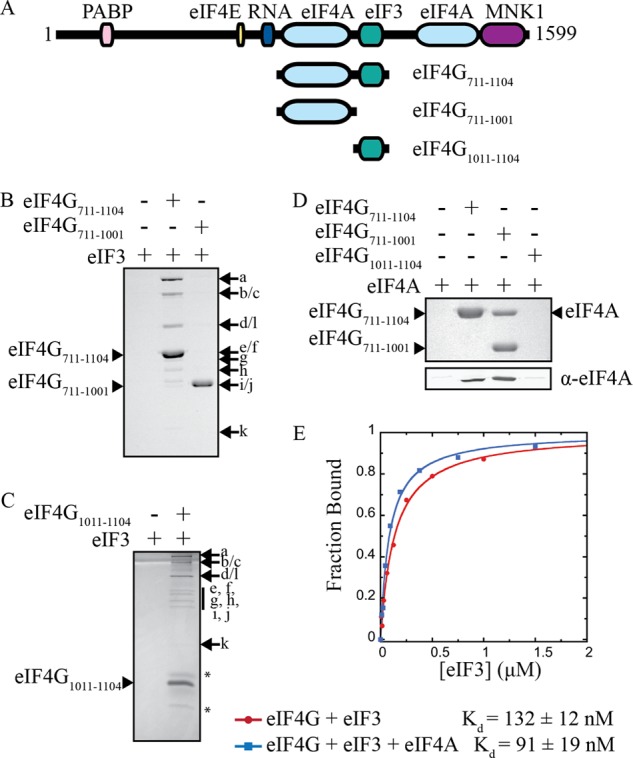
FIGURE 1.
FIGURE 1.
Characterization of eIF4G binding domains. A, domain map of full-length human eIF4G, and constructs used in this study. All constructs are C terminally FLAG-tagged, and eIF4G1011–1104 is also N terminally HIS-tagged. B and C, immunoprecipitation of FLAG-tagged eIF4G constructs and purified eIF3, as indicated. Eluted proteins are separated by SDS-PAGE and visualized with Coomassie Blue. Asterisks (*) denote degradation products. D, immunoprecipitation of FLAG-tagged eIF4G with purified eIF4A. Eluted proteins are separated by SDS-PAGE and visualized with Coomassie Blue (top panel) or by immunoblotting with eIF4A antiserum (bottom panel). E, representative plots of fluorescence polarization assays used to determine the equilibrium dissociation constant (Kd) of the eIF3-eIF4G711–1104 interaction in the absence or presence of a saturating amount of eIF4A. The Kd values shown are the average of at least 3 trials ± S.E.
FIGURE 2.
FIGURE 2.
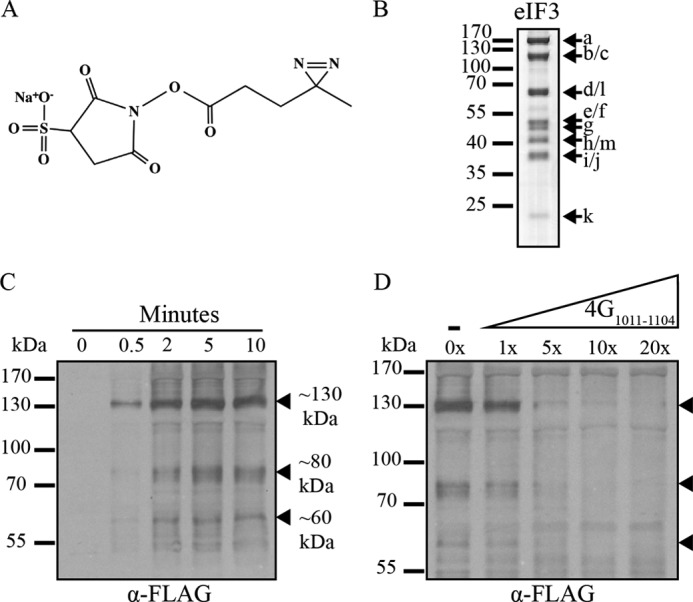
eIF4G1011–1104-SDA site-specifically cross-links to 3 distinct eIF3 subunits. A, chemical structure of the Sulfo-NHS-Diazirine (sulfo-SDA, Pierce) cross-linker used to site-specifically modify eIF4G1011–1104 at Ser-1041. B, human eIF3 subunits are separated by SDS-PAGE and visualized with Coomassie Blue staining. C, time course study of eIF4G1011–1104-SDA cross-linking with eIF3. Products are separated by SDS-PAGE and analyzed by immunoblotting for FLAG-tagged eIF4G1011–1104-SDA. Filled arrows designate cross-linked eIF3 subunits. D, unmodified eIF4G1011–1104 competes for eIF3 binding to reduce eIF4G1011–1104-SDA cross-linking to eIF3. Lanes are labeled with the fold excess of unmodified eIF4G1011–1104 competitor over eIF4G1011–1104-SDA.
FIGURE 3.
FIGURE 3.
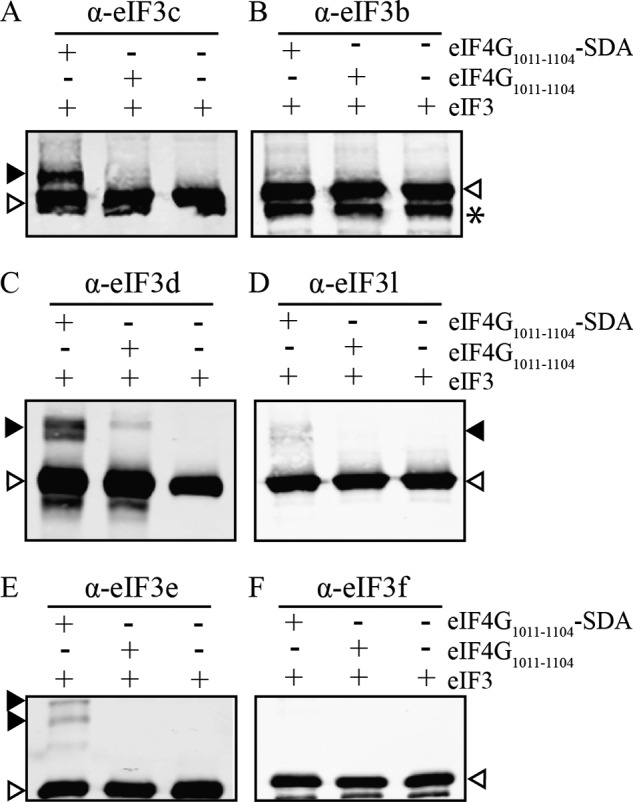
eIF4G1011–1104-SDA cross-links to eIF3 subunits -c, -d, and -e. A–F, eIF4G1011–1104 ± SDA was incubated with eIF3 and exposed to UV light as described under “Experimental Procedures.” Cross-linking reactions are separated by SDS-PAGE followed by immunoblot analysis for specific eIF3 subunits as indicated. Control lanes containing only eIF3 are shown in the third lane in each blot. Filled arrows in panels A, C, D, and E indicate eIF4G1011–1104-SDA cross-linking to subunits eIF3c, -d, -e, and to a lesser extent, -l. Empty arrows denote uncross-linked eIF3 subunits. The asterisk (*) in B denotes a degradation product of eIF3b, which is likely an artifact from the eIF3 purification process.
FIGURE 4.
FIGURE 4.
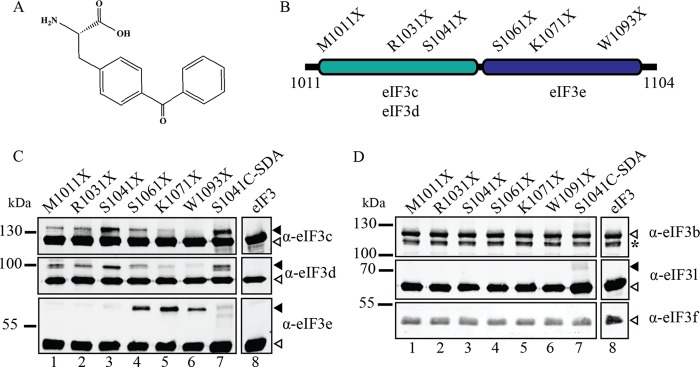
Identification of 2 independent eIF3-binding subdomains in eIF4G. A, chemical structure of the p-benzoyl-phenylalanine cross-linker (Bpa, Bachem) used for genetic incorporation. B, diagram of 4G1011–1104 with sites of amber mutations used for Bpa incorporation. The regions of maximal eIF3 subunit cross-linking from panels C and D are also depicted. C and D, results of eIF3 cross-linking with 4G1011–1104-Bpa labeled at single indicated sites (lanes 1–6), 4G1011–1104-SDA (lane 7), or eIF3 alone (lane 8) are shown. The eIF3 subunit specific antibody used for each immunoblot is indicated to the right of each panel. Filled arrows indicate cross-linked eIF3 subunits, while empty arrows indicate uncross-linked subunits. Asterisk (*) in D indicates an eIF3b degradation product.
FIGURE 5.
FIGURE 5.
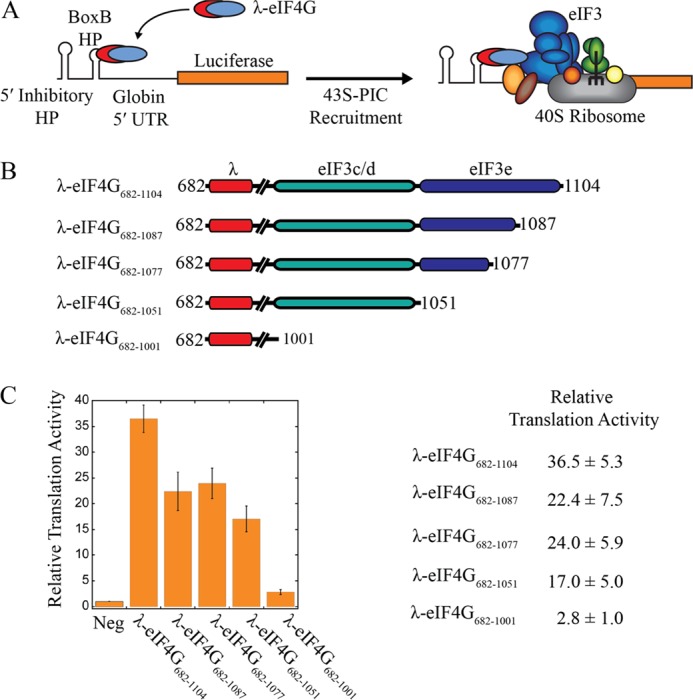
eIF3-binding subdomains in eIF4G both stimulate mRNA recruitment and translation. A, an eIF4G-dependent translation assay is depicted that mediates mRNA recruitment to the ribosome independent of cap binding. A boxB hairpin (BoxB HP) upstream of a beta globin 5′-UTR sequence specifically recruits λ-tagged eIF4G682–1104 to the Renilla luciferase reporter. A stable inhibitor hairpin at the 5′-end is positioned to prevent 5′-end dependent mRNA recruitment to the ribosome. B, diagrams of eIF4G constructs used, which are N-terminally HIS-tagged and fused with the RNA binding domain of bacteriophage λ transcription anti-terminator protein N. Amino acid numbering is shown to indicate each eIF4G truncation construct used. Line breaks in the diagrams represent the RNA and eIF4A binding domains of human eIF4G. C-terminal truncations of the eIF3-binding domain are used to define functional subdomains of this region. A summary of the relative luciferase translation over background (no λ-eIF4G added, Neg) that has been normalized to 1 is shown as the average of 4 trials ± S.E. C, plot of relative luciferase translation following incubation of the boxB Renilla luciferase reporter in nuclease treated reticulocyte lysate for 30 min at 30 °C. Each bar represents the relative luciferase activity in the absence (Neg) or presence of λ-eIF4G truncations, as indicated. Luciferase translation is shown as the average of 4 trials ± S.E.
FIGURE 6.
FIGURE 6.
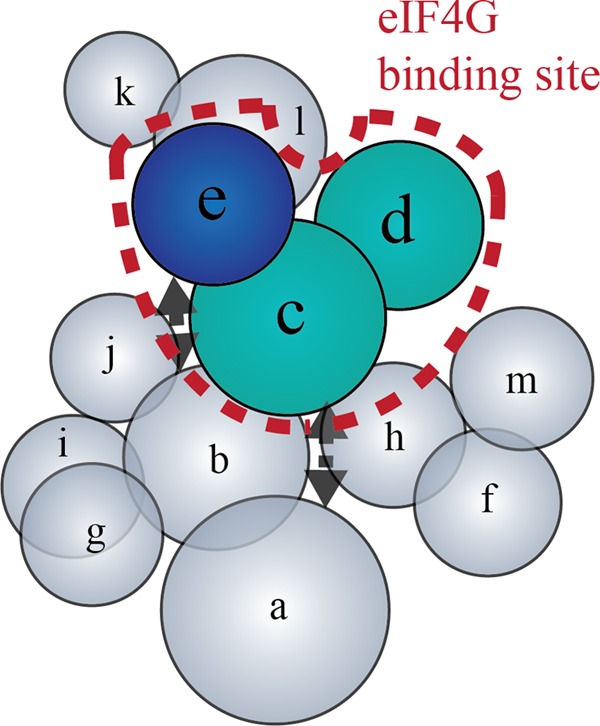
Model of eIF4G interaction sites on eIF3. The human eIF3 subunit interaction map is adapted from Zhou et al. (19). Placement of each subunit and the dotted black arrows reflect known intra-complex interactions between subunits. The dashed line encloses subunits involved in eIF4G binding. eIF3 subunits are colored according to the color schemes used in Figs. 4 and 5, which is based on the subdomain of eIF4G that each eIF3 subunit contacts.

References

    1. Fraser C. S. (2009) The molecular basis of translational control. Prog. Mol. Biol. Transl. Sci. 90, 1–51 - PubMed
    1. Gingras A. C., Raught B., Sonenberg N. (1999) eIF4 initiation factors: effectors of mRNA recruitment to ribosomes and regulators of translation. Annu. Rev. Biochem. 68, 913–963 - PubMed
    1. Hinnebusch A. G., Lorsch J. R. (2012) The mechanism of eukaryotic translation initiation: new insights and challenges. Cold Spring Harb. Perspect. Biol. 4 - PMC - PubMed
    1. Parsyan A., Svitkin Y., Shahbazian D., Gkogkas C., Lasko P., Merrick W. C., Sonenberg N. (2011) mRNA helicases: the tacticians of translational control. Nat. Rev. Mol. Cell Biol. 12, 235–245 - PubMed
    1. Özes A. R., Feoktistova K., Avanzino B. C., Fraser C. S. (2011) Duplex unwinding and ATPase activities of the DEAD-box helicase eIF4A are coupled by eIF4G and eIF4B. J. Mol. Biol. 412, 674–687 - PMC - PubMed

Publication types

MeSH terms

Substances