Review
. 2013 Oct;26(4):744-58.
doi: 10.1128/CMR.00023-13.

Trends in human fecal carriage of extended-spectrum β-lactamases in the community: toward the globalization of CTX-M

Affiliations
Review

Trends in human fecal carriage of extended-spectrum β-lactamases in the community: toward the globalization of CTX-M

Paul-Louis Woerther et al. Clin Microbiol Rev. 2013 Oct.

Abstract

In the last 10 years, extended-spectrum β-lactamase-producing enterobacteria (ESBL-E) have become one of the main challenges for antibiotic treatment of enterobacterial infections, largely because of the current CTX-M enzyme pandemic. However, most studies have focused on hospitalized patients, though today it appears that the community is strongly affected as well. We therefore decided to devote our investigation to trends in ESBL-E fecal carriage rates and comprehensively reviewed data from studies conducted on healthy populations in various parts of the world. We show that (i) community ESBL-E fecal carriage, which was unknown before the turn of the millennium, has since increased significantly everywhere, with developing countries being the most affected; (ii) intercontinental travel may have emphasized and globalized the issue; and (iii) CTX-M enzymes, especially CTX-M-15, are the dominant type of ESBL. Altogether, these results suggest that CTX-M carriage is evolving toward a global pandemic but is still insufficiently described. Only a better knowledge of its dynamics and biology will lead to further development of appropriate control measures.


Figures
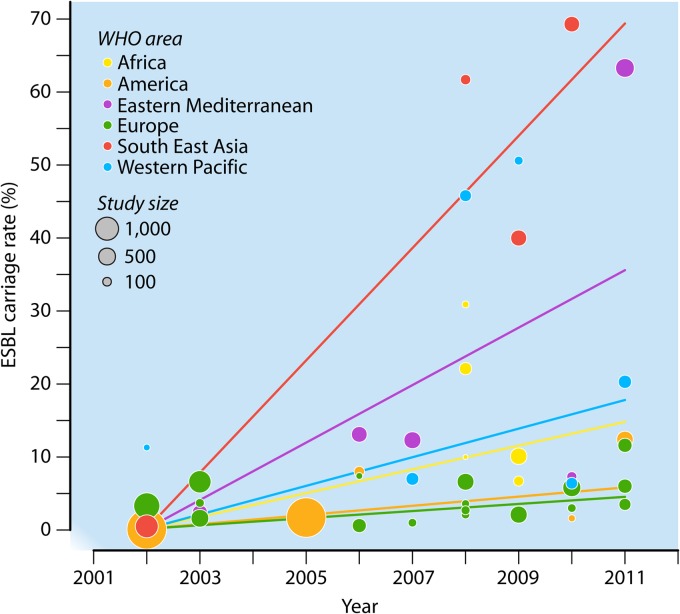
Fig 1
Fig 1
ESBL carriage rates in the community, according to their geographical and temporal distribution. Each bubble area is proportional to the size of the corresponding study. The lines represent the evolution of ESBL-E carriage rates over time for each geographical area, as established by a weighted linear regression model using the values reported in the literature from 2002 to 2011. Over this period, ESBL-E carriage increased significantly in all regions, with differences within regions. In Europe, the ESBL-E carriage rate increased significantly by 0.5% per year from 2002 to 2011 (95% confidence interval [95% CI] = 0.04% to 0.90%; P = 0.03). Compared to the rise in Europe, the progression rate was not different in Africa (difference in annual progression compared to that in Europe, +1.1% [95% CI = −0.4% to 2.7%]; P = 0.1) or America (+0.1% [95% CI = −0.6% to 0.9%]; P = 0.7) but was significantly higher in Southeast Asia (+7.2% [95% CI = 5.1% to 9.2%]; P < 10−7), the Eastern Mediterranean region (+3.5% [95% CI = 2.0% to 4.9%]; P < 10−4), and the Western Pacific region (+1.5% [95% CI = 0.04% to 2.90%]; P = 0.04). The differences in rate increases between Southeast Asia, the Eastern Mediterranean region, and the Western Pacific region were all significant.
Fig 2
Fig 2
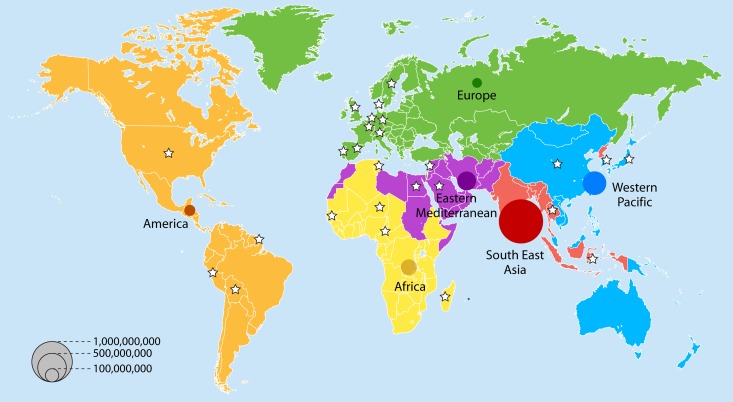
Number of ESBL carriers in the community in 2010, according to WHO region grouping. The 6 WHO regions are represented by different colors. WHO estimates of the population of each geographic area in 2010 (http://www.who.int/research; accessed 18 December 2012) were used to compute the number of ESBL-E carriers. ESBL carrier rates were established using the model presented in Fig. 1 for the year 2010. Stars represent countries with available data for modeling. Each bubble area is proportional to the estimated number of ESBL carriers in that region.
Fig 3
Fig 3
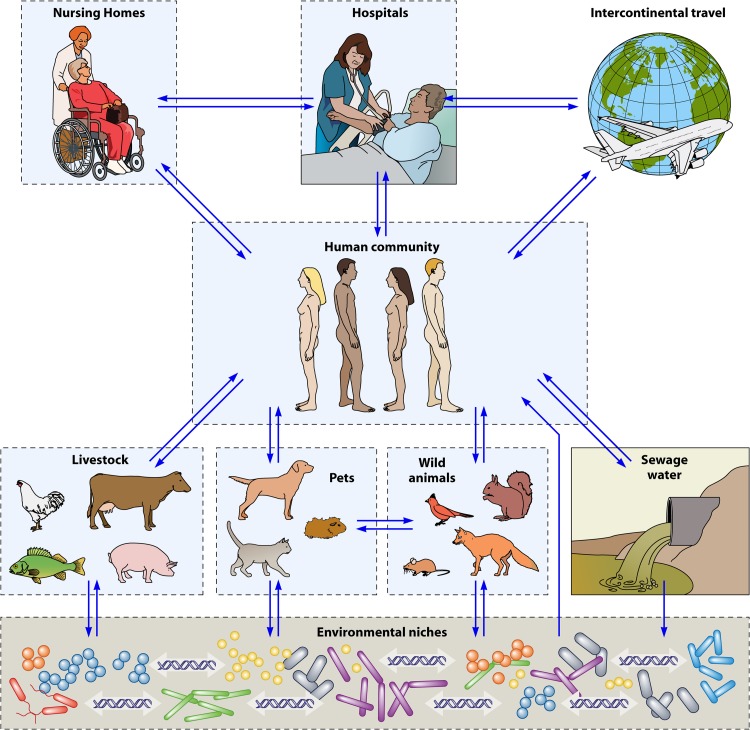
Representation of the main digestive or environmental reservoirs of ESBL-E to which the worldwide human community belongs and is also exposed. Each independent reservoir is included in a dashed black outline, inside which cross-transmission may occur. Arrows show the flux of ESBL-E from one reservoir to another. Environmental niches comprise mainly water, soils, and plants, where genetic material exchanges between bacteria of digestive and/or environmental origin occur.
None
None
None
None

References

    1. Knothe H, Shah P, Krcmery V, Antal M, Mitsuhashi S. 1983. Transferable resistance to cefotaxime, cefoxitin, cefamandole and cefuroxime in clinical isolates of Klebsiella pneumoniae and Serratia marcescens. Infection 11:315–317 - PubMed
    1. Jacoby GA, Medeiros AA. 1991. More extended-spectrum beta-lactamases. Antimicrob. Agents Chemother. 35:1697–1704 - PMC - PubMed
    1. Kliebe C, Nies BA, Meyer JF, Tolxdorff-Neutzling RM, Wiedemann B. 1985. Evolution of plasmid-coded resistance to broad-spectrum cephalosporins. Antimicrob. Agents Chemother. 28:302–307 - PMC - PubMed
    1. Petit A, Gerbaud G, Sirot D, Courvalin P, Sirot J. 1990. Molecular epidemiology of TEM-3 (CTX-1) beta-lactamase. Antimicrob. Agents Chemother. 34:219–224 - PMC - PubMed
    1. Philippon A, Ben Redjeb S, Fournier G, Ben Hassen A. 1989. Epidemiology of extended spectrum beta-lactamases. Infection 17:347–354 - PubMed

Publication types

MeSH terms

Substances