


Persisting primitive reflexes in medication-naïve girls with attention-deficit and hyperactivity disorder
- PMID: 24092983
- PMCID: PMC3788695
- DOI: 10.2147/NDT.S49343
Persisting primitive reflexes in medication-naïve girls with attention-deficit and hyperactivity disorder
Abstract
Background and objectives: Recent and historical findings suggest that later-developed functions during brain ontogenesis related to higher levels of cognitive and motor integration tend to replace the older, more primitive, ones, and the persistence of the older functions may be linked to specific neuropsychiatric disorders. Currently, there is growing evidence to suggest that persisting primitive reflexes may be related to developmental and neurodegenerative disorders. Preliminary data also suggest that persisting primitive reflexes may be specifically linked to attention-deficit and hyperactivity disorder (ADHD).
Methods: In the study reported here, we tested to what extent the persisting primitive asymmetric tonic neck reflex and symmetric tonic neck reflex are related to ADHD symptoms measured by Conners' Parent Questionnaire in 35 medication-naïve girls of school age (8-11 years) with ADHD. The results were compared with those of a control group of 30 girls of the same age.
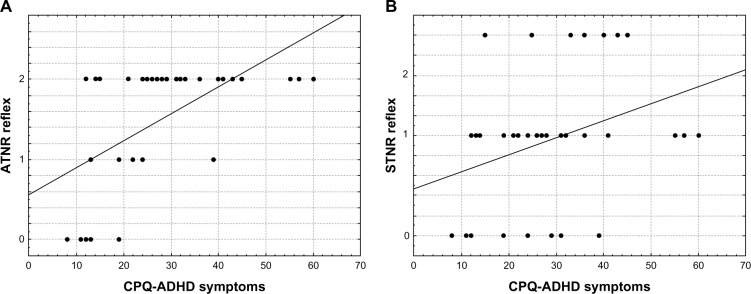
Results: This study showed that persisting primitive reflexes are closely linked to ADHD symptoms.
Conclusion: The data suggest that ADHD symptoms may be linked to more primitive neural mechanisms interfering with higher brain functions due to insufficiently developed cognitive and motor integration.
Keywords: ADHD; asymmetric tonic neck reflex; developmental disorders; symmetric tonic neck reflex.
Figures
References
-
- Teicher MH, Tomoda A, Andersen SL. Neurobiological consequences of early stress and childhood maltreatment: are results from human and animal studies comparable? Ann N Y Acad Sci. 2006;1071:313–323. - PubMed
-
- Hart H, Radua J, Nakao T, Mataix-Cols D, Rubia K. Meta-analysis of functional magnetic resonance imaging studies of inhibition and attention in attention-deficit/hyperactivity disorder: exploring task-specific, stimulant medication, and age effects. JAMA Psychiatry. 2013;70(2):185–198. - PubMed
-
- Zafeiriou DI. Primitive reflexes and postural reactions in the neurodevelopmental examination. Pediatr Neurol. 2004;31(1):1–8. - PubMed
-
- Youssef HA, Waddington JL. Primitive (developmental) reflexes and diffuse cerebral dysfunction in schizophrenia and bipolar affective disorder: overrepresentation in patients with tardive dyskinesia. Biol Psychiatry. 1988;23(8):791–796. - PubMed
LinkOut - more resources
Full Text Sources
Other Literature Sources
Medical
