


Bauhinia variegata leaf extracts exhibit considerable antibacterial, antioxidant, and anticancer activities
- PMID: 24093108
- PMCID: PMC3777169
- DOI: 10.1155/2013/915436
Bauhinia variegata leaf extracts exhibit considerable antibacterial, antioxidant, and anticancer activities
Abstract
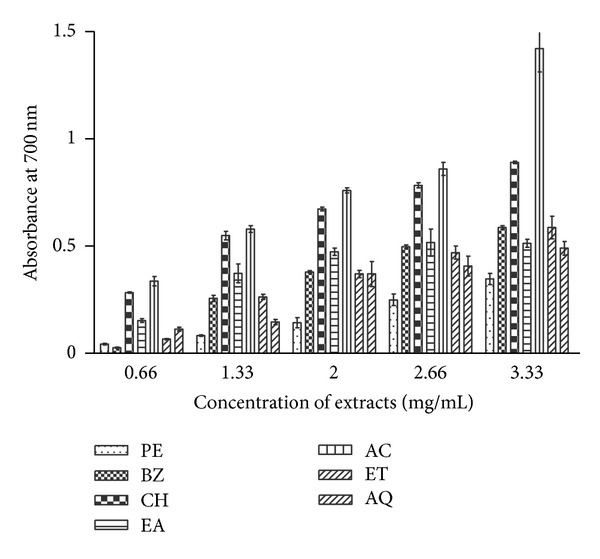
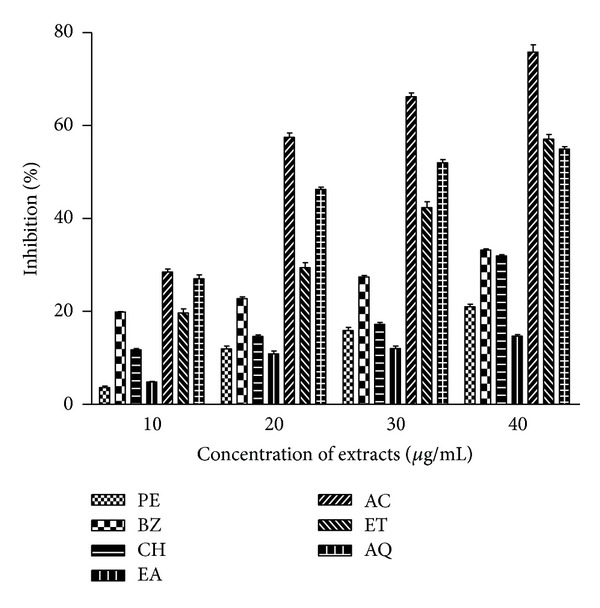
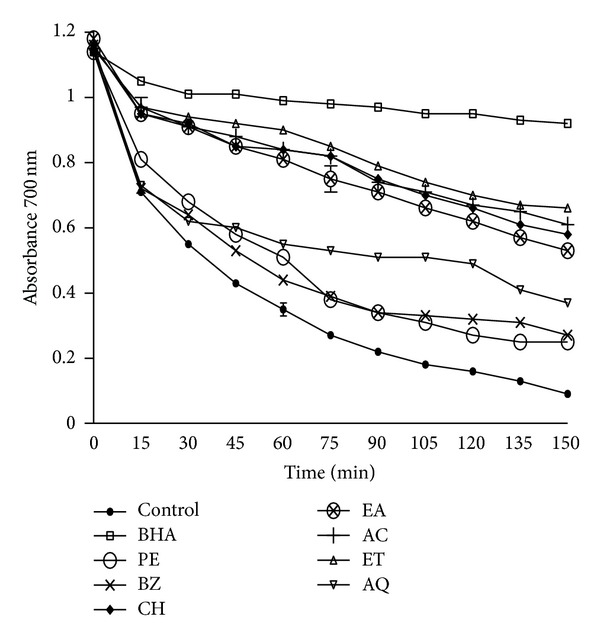
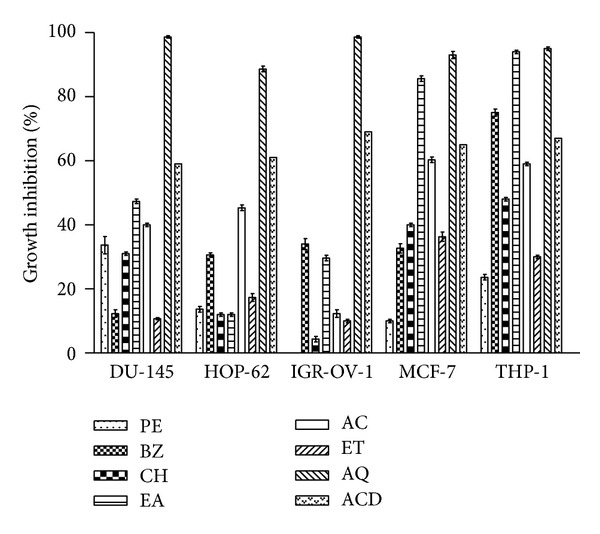
The present study reports the phytochemical profiling, antimicrobial, antioxidant, and anticancer activities of Bauhinia variegata leaf extracts. The reducing sugar, anthraquinone, and saponins were observed in polar extracts, while terpenoids and alkaloids were present in nonpolar and ethanol extracts. Total flavonoid contents in various extracts were found in the range of 11-222.67 mg QE/g. In disc diffusion assays, petroleum ether and chloroform fractions exhibited considerable inhibition against Klebsiella pneumoniae. Several other extracts also showed antibacterial activity against pathogenic strains of E. coli, Proteus spp. and Pseudomonas spp. Minimum bactericidal concentration (MBC) values of potential extracts were found between 3.5 and 28.40 mg/mL. The lowest MBC (3.5 mg/mL) was recorded for ethanol extract against Pseudomonas spp. The antioxidant activity of the extracts was compared with standard antioxidants. Dose dependent response was observed in reducing power of extracts. Polar extracts demonstrated appreciable metal ion chelating activity at lower concentrations (10-40 μg/mL). Many extracts showed significant antioxidant response in beta carotene bleaching assay. AQ fraction of B. variegata showed pronounced cytotoxic effect against DU-145, HOP-62, IGR-OV-1, MCF-7, and THP-1 human cancer cell lines with 90-99% cell growth inhibitory activity. Ethyl acetate fraction also produced considerable cytotoxicity against MCF-7 and THP-1 cell lines. The study demonstrates notable antibacterial, antioxidant, and anticancer activities in B. variegata leaf extracts.
Figures
References
-
- Okeke IN, Laxminarayan R, Bhutta ZA, et al. Antimicrobial resistance in developing countries. Part I: recent trends and current status. The Lancet Infectious Diseases. 2005;5(8):481–493. - PubMed
-
- Iwu MW, Duncan AR, Okunji CO. New antimicrobials of plant origin. In: Janick J, editor. Perspectives on New Crops and New Uses. Alexandria, Va, USA: ASHS Press; 1999. pp. 457–462.
-
- Fabio A, Cermelli C, Fabio G, Nicoletti P, Quaglio P. Screening of the antibacterial effects of a variety of essential oils on microorganisms responsible for respiratory infections. Phytotherapy Research. 2007;21(4):374–377. - PubMed
-
- Bagchi AK. Alternative medicine—old wine in a new bottle. Journal of the Indian Medical Association. 2000;98(6):332–333. - PubMed
-
- Mishra AK, Mishra A, Bhargava A, Pandey AK. Antimicrobial activity of essential oils from the leaves of Cinnamomum spp. National Academy Science Letters. 2008;31(11-12):341–345.
Publication types
MeSH terms
Substances
LinkOut - more resources
Full Text Sources
Other Literature Sources
Medical
Miscellaneous
