Review
. 2013 Oct 4;17(5):231.
doi: 10.1186/cc12693.

Bench-to-bedside review: future novel diagnostics for sepsis - a systems biology approach

Review

Bench-to-bedside review: future novel diagnostics for sepsis - a systems biology approach

Simon Skibsted et al. Crit Care. .

Abstract

The early, accurate diagnosis and risk stratification of sepsis remains an important challenge in the critically ill. Since traditional biomarker strategies have not yielded a gold standard marker for sepsis, focus is shifting towards novel strategies that improve assessment capabilities. The combination of technological advancements and information generated through the human genome project positions systems biology at the forefront of biomarker discovery. While previously available, developments in the technologies focusing on DNA, gene expression, gene regulatory mechanisms, protein and metabolite discovery have made these tools more feasible to implement and less costly, and they have taken on an enhanced capacity such that they are ripe for utilization as tools to advance our knowledge and clinical research. Medicine is in a genome-level era that can leverage the assessment of thousands of molecular signals beyond simply measuring selected circulating proteins. Genomics is the study of the entire complement of genetic material of an individual. Epigenetics is the regulation of gene activity by reversible modifications of the DNA. Transcriptomics is the quantification of the relative levels of messenger RNA for a large number of genes in specific cells or tissues to measure differences in the expression levels of different genes, and the utilization of patterns of differential gene expression to characterize different biological states of a tissue. Proteomics is the large-scale study of proteins. Metabolomics is the study of the small molecule profiles that are the terminal downstream products of the genome and consists of the total complement of all low-molecular-weight molecules that cellular processes leave behind. Taken together, these individual fields of study may be linked during a systems biology approach. There remains a valuable opportunity to deploy these technologies further in human research. The techniques described in this paper not only have the potential to increase the spectrum of diagnostic and prognostic biomarkers in sepsis, but they may also enable the discovery of new disease pathways. This may in turn lead us to improved therapeutic targets. The objective of this paper is to provide an overview and basic framework for clinicians and clinical researchers to better understand the 'omics technologies' to enhance further use of these valuable tools.


Figures
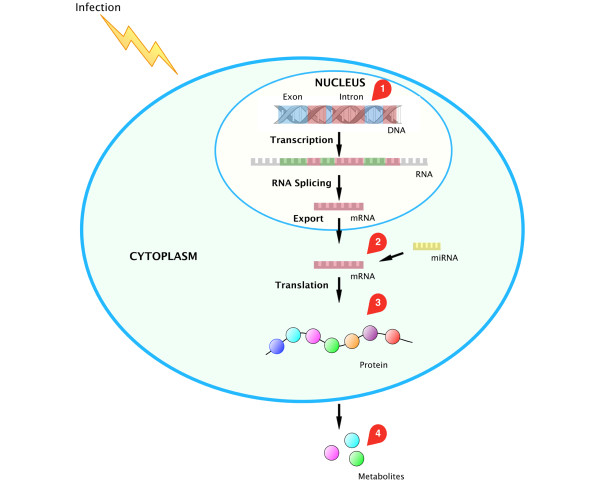
Figure 1
Figure 1
Central workflow from gene activation to protein metabolites in response to insults such as infection. Numbers denote different targets for diagnostic approaches: 1, epigenomics (methylation variable positions) and genomics (SNPs); 2, transcriptomics (mRNA and miRNA); 3, proteomics; and 4, metabolomics. The central workflow in molecular biology is that, upon gene activation, DNA is transcribed into mRNA and is then translated into proteins. DNA expresses its information by a process called transcription. In this process, segments of the DNA sequence are used as templates for the synthesis of shorter molecules of the closely related molecule RNA. This molecule consists of sequences of nucleotides faithfully representing a part of the cells genetic information. The transcription results in pre-mRNA, which through an additional splicing process produces a mature single strand of complementary RNA, mRNA. mRNA functions as an intermediate in the transfer of genetic information, mainly guiding the synthesis of proteins according to the genetic instructions stored in the DNA. Once mRNA is produced and transported out of the nucleus, the information present in the mRNA is used to synthesize a protein by the process called translation. This protein synthesis is performed in the cytosol of the cell by the ribosome, the workhorse of protein biosynthesis. mRNA is pulled through the ribosome and the nucleotide sequence is translated into an amino acid sequence, adding each amino acid to a growing polypeptide chain that constitutes a protein. miRNA can alter this step by binding to the mRNA, resulting in additional regulation of the mRNA expression. miRNA is complementary to a part of one or more mRNAs. While degradation of miRNA-targeted mRNA is well documented, whether or not translational repression is accomplished through mRNA degradation, translation inhibition or a combination of the two is hotly debated. After the polypeptide chain is produced, it folds up into its unique three-dimensional conformation, which is necessary in order to be useful to the cell. The result is the final product, a mature protein that is released into the bloodstream where it will have its effects [98].
Figure 2
Figure 2
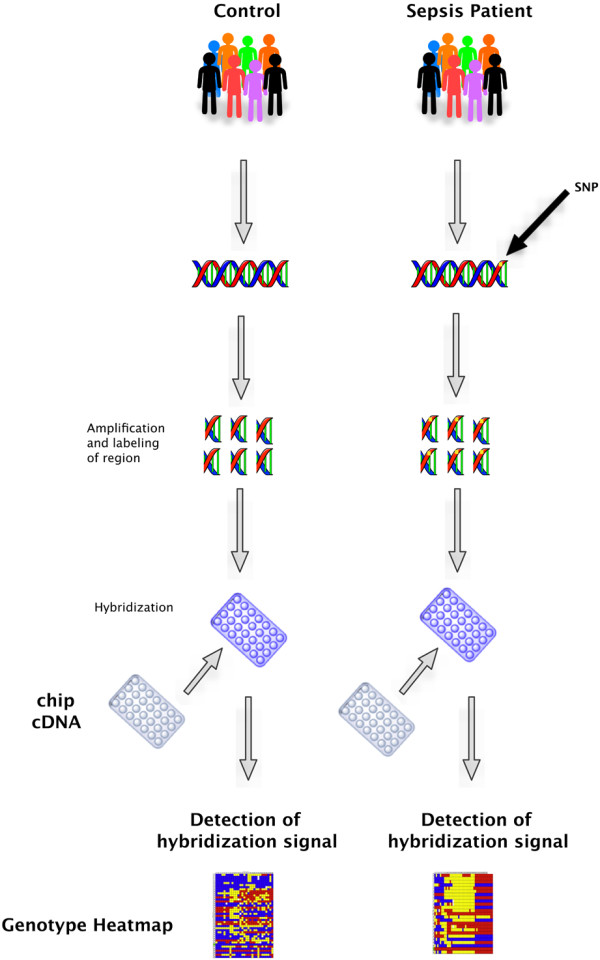
DNA microarrays in genomics. The core principle behind DNA microarray technology is hybridization of genomic DNA fragments to a fixed probe. The collected genomic DNA is amplified and labeled and is then hybridized to a cDNA chip that is loaded with various SNPs. The sample DNA will hybridize with greater frequency only to specific SNPs associated with that person. Those spots on the microarray chip will fluoresce with greater intensity. The workflow of this entire process is 3 to 5 days depending on the technology used.
Figure 3
Figure 3
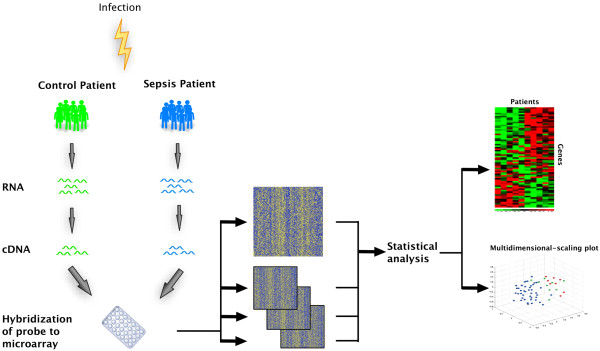
DNA microarrays in gene expression analysis. DNA microarrays consist of minuscule amounts of hundreds or thousands of gene sequences on a single microscopic plate. To determine which genes are turned on or off in a cell, mRNA is extracted from whole blood or tissues. This mRNA is then labeled using an enzyme to generate a complementary cDNA from mRNA. During this process, fluorescent nucleotides are attached to the cDNA. The sepsis and the control samples are labeled with different fluorescent dyes. The labeled cDNA is placed on the DNA microarray plate. When a given mRNA and its cDNA are present, they bind to the each other, leaving a fluorescent tag. The intensity of this fluorescence indicates how many mRNA have bound to the cDNA. If a particular gene is very active, it produces many copies of mRNA, thus more labeled cDNA will bind to the DNA on the microarray plate and generate a very bright fluorescent area. If there is no fluorescence, then none of the mRNA bound to the DNA, indicating that the gene is inactive.
Figure 4
Figure 4
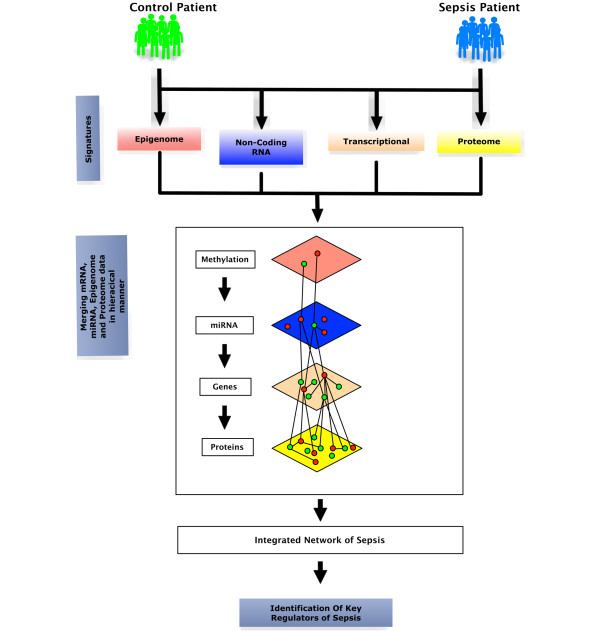
An integrated analysis. Integrated analysis of multidimensional genomics, epigenomics and proteomics data to capture the interaction between genetics, gene expression and regulatory RNA as well as proteomics. The analysis will enable identification of critical pathways or biological processes that drive the perturbation across multiple genome-level spaces, and thus are critical for disease pathophysiology.

References

    1. Friedman G, Silva E, Vincent JL. Has the mortality of septic shock changed with time. Crit Care Med. 1998;17:2078–2086. doi: 10.1097/00003246-199812000-00045. - DOI - PubMed
    1. Wheeler AP, Bernard GR. Treating patients with severe sepsis. N Engl J Med. 1999;17:207–214. doi: 10.1056/NEJM199901213400307. - DOI - PubMed
    1. Sands KE, Bates DW, Lanken PN, Graman PS, Hibberd PL, Kahn KL, Parsonnet J, Panzer R, Orav EJ, Snydman DR, Black E, Schwartz JS, Moore R, Johnson BL Jr, Platt R. Academic Medical Center Consortium Sepsis Project Working Group. Epidemiology of sepsis syndrome in 8 academic medical centers. JAMA. 1997;17:234–240. doi: 10.1001/jama.1997.03550030074038. - DOI - PubMed
    1. Rangel-Frausto MS, Pittet D, Costigan M, Hwang T, Davis CS, Wenzel RP. The natural history of the systemic inflammatory response syndrome (SIRS). A prospective study. JAMA. 1995;17:117–123. doi: 10.1001/jama.1995.03520260039030. - DOI - PubMed
    1. Vincent JL, Abraham E, Annane D, Bernard G, Rivers E, van den Berghe G. Reducing mortality in sepsis: new directions. Crit Care. 2002;17(Suppl 3):S1–S18. doi: 10.1186/cc1860. - DOI - PMC - PubMed

Publication types