Comparative Study
. 2013 Oct 7;14(1):100.
doi: 10.1186/1465-9921-14-100.

Comparative efficacy of long-acting bronchodilators for COPD: a network meta-analysis

Affiliations
Comparative Study

Comparative efficacy of long-acting bronchodilators for COPD: a network meta-analysis

Shannon Cope et al. Respir Res. .

Abstract

Background: Clinicians are faced with an increasingly difficult choice regarding the optimal bronchodilator for patients with chronic obstructive pulmonary disease (COPD) given the number of new treatments. The objective of this study is to evaluate the comparative efficacy of indacaterol 75/150/300 μg once daily (OD), glycopyrronium bromide 50 μg OD, tiotropium bromide 18 μg/5 μg OD, salmeterol 50 μg twice daily (BID), formoterol 12 μg BID, and placebo for moderate to severe COPD.

Methods: Forty randomized controlled trials were combined in a Bayesian network meta-analysis. Outcomes of interest were trough and post-dose forced expiratory volume in 1 second (FEV1), St. George's Respiratory Questionnaire (SGRQ) score and responders (≥4 points), and Transition Dyspnea Index (TDI) score and responders (≥1 point) at 6 months.

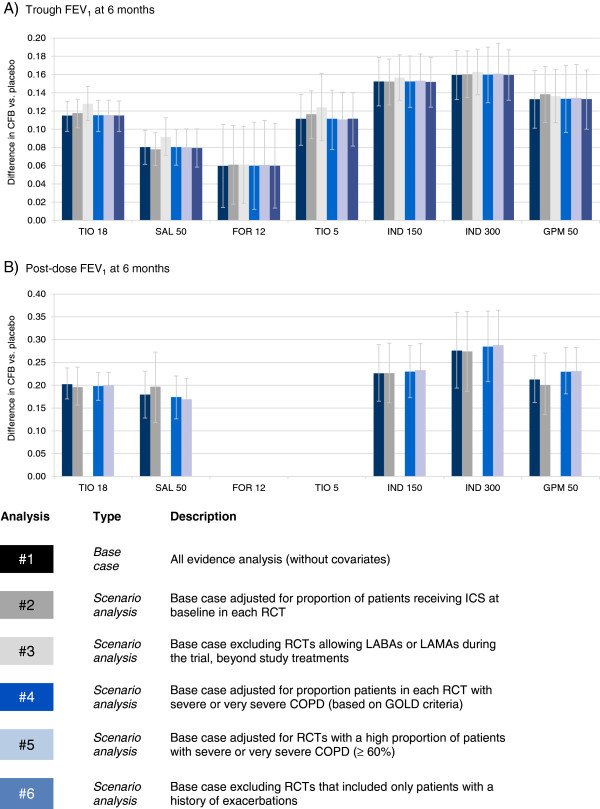
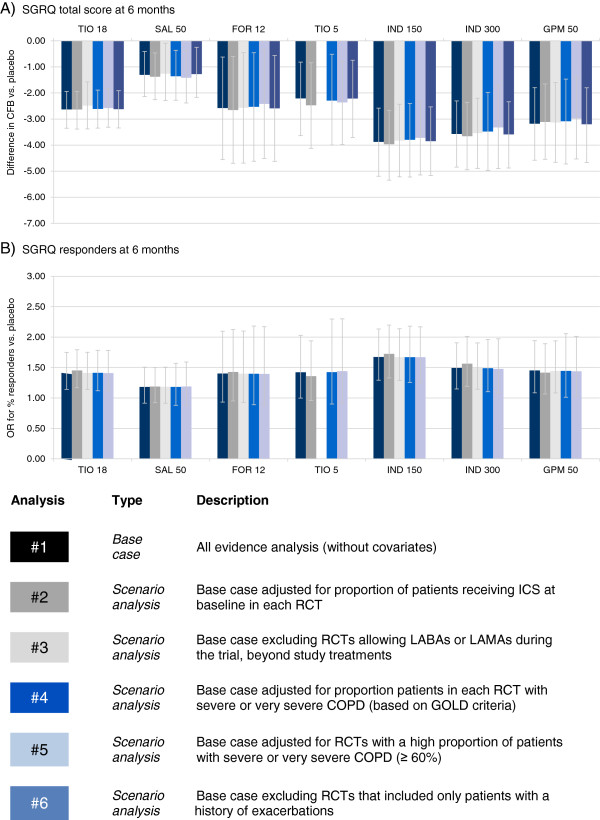
Results: Indacaterol was associated with a higher trough FEV1 than other active treatments (difference for indacaterol 150 μg and 300 μg versus placebo: 152 mL (95% credible interval (CrI): 126, 179); 160 mL (95% CrI: 133, 187)) and the greatest improvement in SGRQ score (difference for indacaterol 150 μg and 300 μg versus placebo: -3.9 (95% CrI -5.2, -2.6); -3.6 (95% CrI -4.8, -2.3)). Glycopyrronium and tiotropium 18 μg resulted in the next best estimates for both outcomes with minor differences (difference for glycopyrronium versus tiotropium for trough FEV1 and SGRQ: 18 mL (95% CrI: -16, 51); -0.55 (95% CrI: -2.04, 0.92).

Conclusion: In terms of trough FEV1 and SGRQ score indacaterol, glycopyrronium, and tiotropium are expected to be the most effective bronchodilators.


Figures
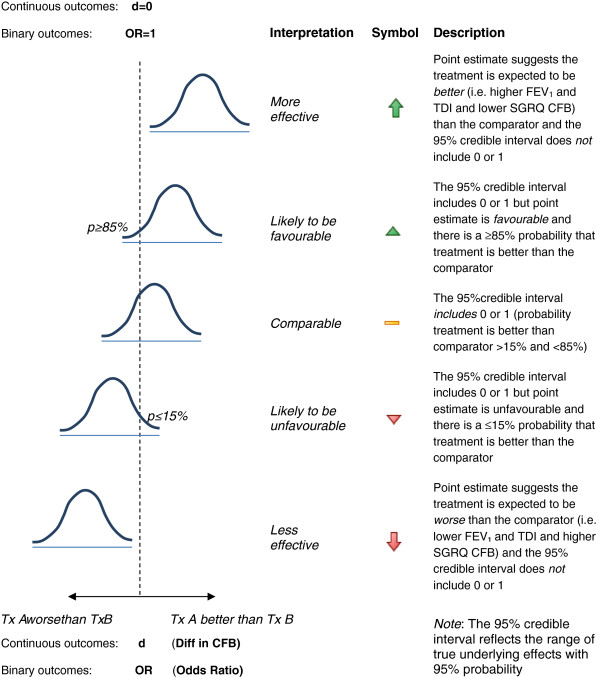
Figure 1
Figure 1
Interpretation of the relative treatment effects resulting from the network meta-analysis for continuous and binary outcomes. CFB=Change from baseline; D=difference in CFB; FEV1=Forced expiratory volume; OR=odds ratio; SGRQ=St. George’s Respiratory Questionnaire; TDI=Transitional Dyspnoea Index; d=0 indicates that the dotted line is equal to a difference in CFB between the treatments of zero for continuous endpoints (i.e. no difference between treatments); OR=1 indicates that the dotted line is equal to an odds ratio of one for binary endpoints (i.e. no difference between treatments).
Figure 2
Figure 2
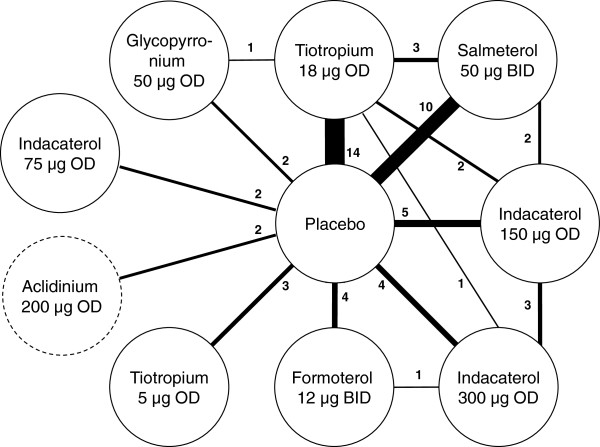
Network of RCTs included in the network meta-analysis. Note: The thickness of the lines corresponds to the number of RCTs available for each treatment comparison; Two RCTs comparing aclidinium 200 μg OD to placebo were included in the network of evidence but results were not presented since this dose has not been approved.
Figure 3
Figure 3
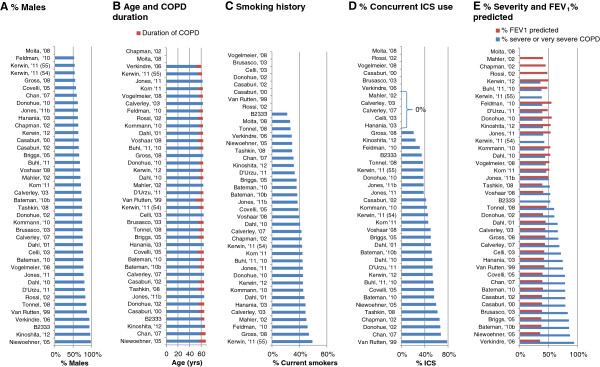
Patient characteristics of the randomized controlled trials used for the network meta-analysis. Note: Zero values indicate not reported unless otherwise indicated; Figure B presents the mean duration of COPD in years (red) per study and the mean age per study (blue+ red).
Figure 4
Figure 4
Trough and post-dose FEV1 network meta-analysis results at 6 months: Difference in change from baseline (CFB) versus placebo. Bars represent 95% Credible Interval; CFB = Change from baseline; FEV1 = Forced expiratory volume; FOR 12 = Formoterol 12 μg twice daily (BID); GPM 50 = Glycopyrronium 50 μg once daily (OD); IND 150 = Indacaterol 150 μg OD; IND 300 = Indacaterol 300 μg OD; SAL 50 = Salmeterol 50 μg BID; TIO 5 = Tiotropium 5 μg OD; TIO 18 = Tiotropium 18 μg OD.
Figure 5
Figure 5
SGRQ network meta-analysis results at 6 months: Difference in change from baseline (CFB) or odds ratio (OR) for responders versus placebo. Bars represent 95% Credible Interval; CFB = Change from baseline; FOR 12 = Formoterol 12 μg twice daily (BID); GPM 50 = Glycopyrronium 50 μg once daily (OD); IND 150 = Indacaterol 150 μg OD; IND 300 = Indacaterol 300 μg OD; OR = Odds ratio; SAL 50 = Salmeterol 50 μg BID; SGRQ = St. George’s Respiratory Questionnaire; TIO 5 = Tiotropium 5 μg OD; TIO 18 = Tiotropium 18 μg OD.
Figure 6
Figure 6
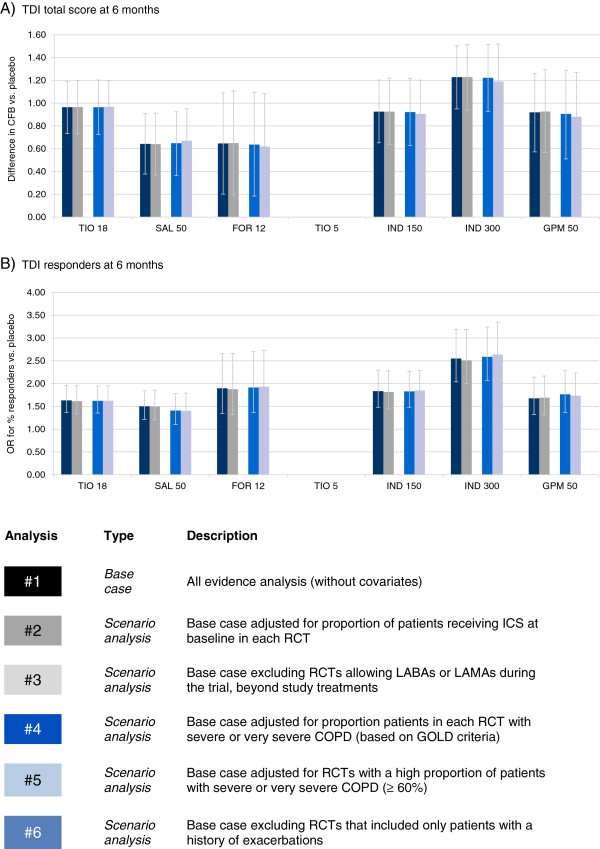
TDI network meta-analysis results at 6 months: Difference in change from baseline (CFB) or odds ratio (OR) for responders versus placebo. Bars represent 95% Credible Interval; CFB = Change from baseline; FOR 12 = Formoterol 12 μg twice daily (BID); GPM 50 = Glycopyrronium 50 μg once daily (OD); IND 150 = Indacaterol 150 μg OD; IND 300 = Indacaterol 300 μg OD; OR = Odds ratio; SAL 50 = Salmeterol 50 μg BID; TDI = Transition Dyspnoea Index; TIO 5 = Tiotropium 5 μg OD; TIO 18 = Tiotropium 18 μg OD.
Figure 7
Figure 7
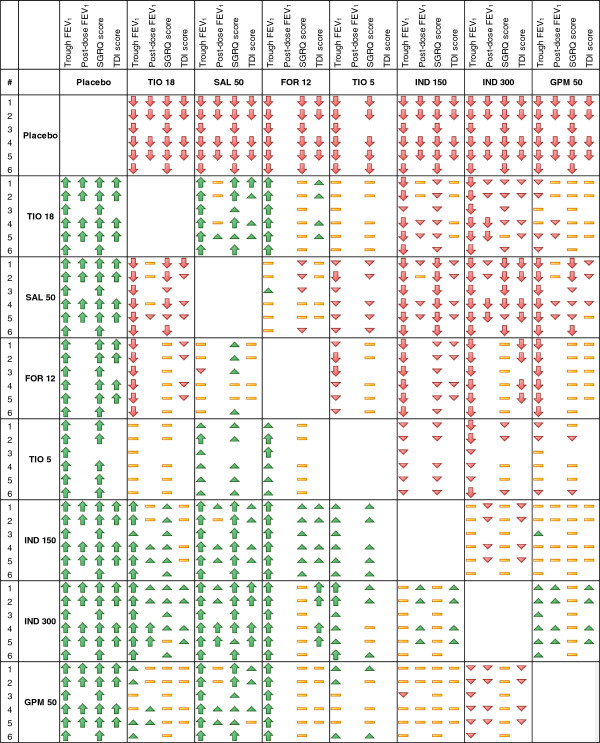
Overview of the network meta-analysis results for trough FEV1, post-dose FEV1, SGRQ total score, and TDI total score at 6 months. Symbols are explained in Figure 1; FEV1 = Forced expiratory volume in 1 second; FOR 12 = Formoterol 12 μg twice daily (BID); GPM 50 = Glycopyrronium 50 μg once daily (OD); IND 150 = Indacaterol 150 μg OD; IND 300 = Indacaterol 300 μg OD; SAL 50 = Salmeterol 50 μg BID; SGRQ = St. George’s Respiratory Questionnaire; TDI = Transition Dyspnoea Index; TIO 5 = Tiotropium 5 μg OD; TIO 18 = Tiotropium 18 μg OD.

References

    1. Global Initiative for Chronic Obstructive Lung Disease (GOLD): global strategy for the diagnosis management and prevention of chronic obstructive pulmonary disease. http://www.goldcopd.org/uploads/users/files/GOLD_Report_2013Feb13.pdf. - PubMed
    1. Jones PW. St. George’s Respiratory questionnaire: MCID. COPD. 2005;14:75–79. doi: 10.1081/COPD-200050513. - DOI - PubMed
    1. Witek TJ Jr, Mahler DA. Minimal important difference of the transition dyspnoea index in a multinational clinical trial. Eur Respir J. 2003;14:267–272. doi: 10.1183/09031936.03.00068503a. - DOI - PubMed
    1. Firth R, Henley M, Kramer B, Lassen C, Yang W, Owen R. Full clinical study report for study number QAB149B2333: a phase III, 26-week multi-center randomized double-blind, placebo-controlled, parallel-group study to assess the efficacy, safety and tolerability of indacaterol (150 and 300 μg od) in patients with chronic obstructive pulmonary disease. Novartis data on file. 2010.
    1. Buhl R, Dunn LJ, Disdier C, Lassen C, Amos C, Henley M, Kramer B. Blinded 12- week comparison of once-daily indacaterol and tiotropium in COPD. Eur Respir J. 2011;14:797–803. doi: 10.1183/09031936.00191810. - DOI - PubMed

Publication types

MeSH terms