Review
. 2013 Dec;28(12):719-28.
doi: 10.1016/j.tree.2013.09.004. Epub 2013 Oct 1.

Computational approaches to species phylogeny inference and gene tree reconciliation

Affiliations
Review

Computational approaches to species phylogeny inference and gene tree reconciliation

Luay Nakhleh. Trends Ecol Evol. 2013 Dec.

Abstract

An intricate relation exists between gene trees and species phylogenies, due to evolutionary processes that act on the genes within and across the branches of the species phylogeny. From an analytical perspective, gene trees serve as character states for inferring accurate species phylogenies, and species phylogenies serve as a backdrop against which gene trees are contrasted for elucidating evolutionary processes and parameters. In a 1997 paper, Maddison discussed this relation, reviewed the signatures left by three major evolutionary processes on the gene trees, and surveyed parsimony and likelihood criteria for utilizing these signatures to elucidate computationally this relation. Here, I review progress that has been made in developing computational methods for analyses under these two criteria, and survey remaining challenges.


Figures

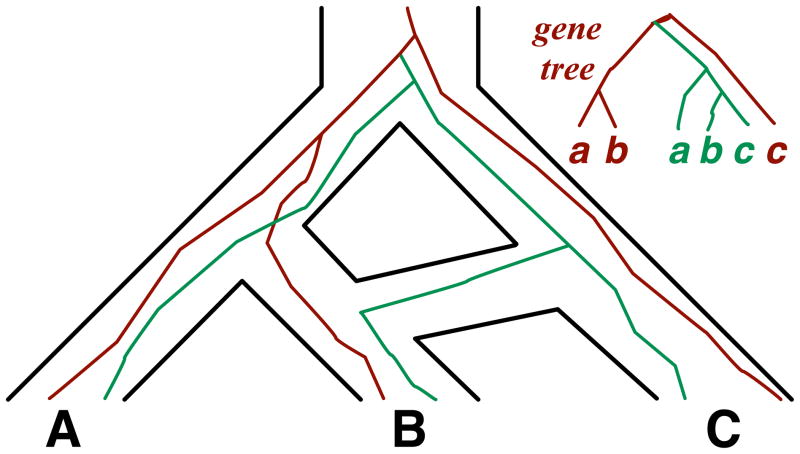
Figure 1
Figure 1. Evolutionary processes within and across species boundaries
(a) A gene duplication event at the most recent common ancestor (MRCA) of all three taxa, results in two copies (red and green) of a gene within the genome, and as the genome undergoes evolution, these copies evolve, diverge, and might have different fates. (b) In prokaryotic organisms, DNA containing genes might be transferred across species boundaries, e.g., from C to B, resulting in a new gene copy. Further, a similar signature might arise in cases of introgression in sexual species. (c) Hybridization between species A and C amounts to individuals from A and B mating and producing viable offspring such that the genetic material in individuals of B can be traced back to two parental species. The gene tree in each case is shown in the inset.
Figure 2
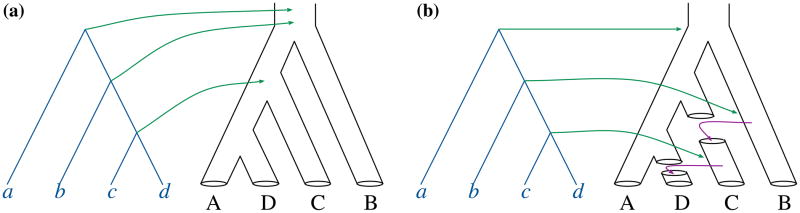
Figure 2. Fitting a gene tree onto a species tree
Gene trees are drawn with solid lines, and species trees are drawn with tubes. (a) In the case of DL (and ILS), each node x in the gene tree is mapped to (denoted by the green arrows) the most recent common ancestor (MRCA) of the species that contain gene copies descended from node x. (b) In the cases of HGT and hybridization, a smallest set of branch moves (denoted by the purple arrows) that makes the species tree identical to the gene tree and do not violate “a linear time order” is a parsimonious set of HGT or hybridization events that explain the difference between the species tree and gene tree.
Figure 3
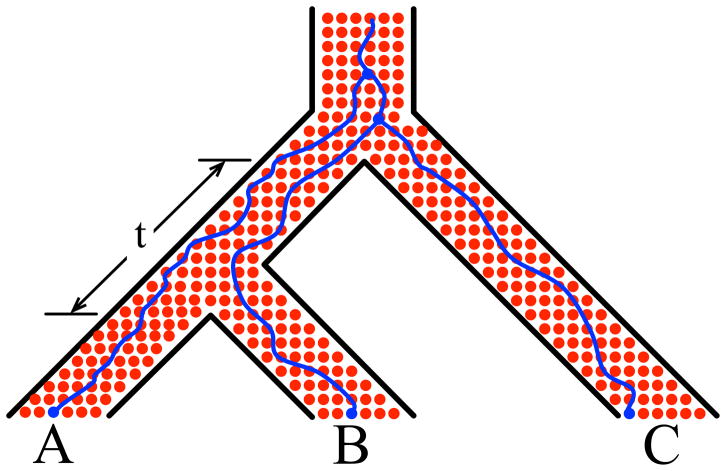
Figure 3. Incomplete lineage sorting
As the evolution of three sampled alleles (blue solid circles at the bottom) is traced backward in time, alleles from A and B might fail to coalesce in the ancestral population. This results in all three alleles entering the ancestral population of all three species, and the alleles from B and C coalescing first, by chance, giving rise to a gene tree that is incongruent with the species tree. The probability of this event happening in this scenario is a function of the branch length, t, as measured in coalescent units (one coalescent unit equals 2N generations, where N is the population size).
Figure 4
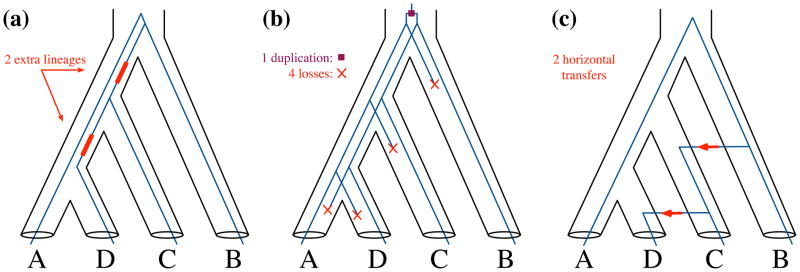
Figure 4. Reconciliation of a gene tree with a species tree
(a) Reconciliation assuming ILS results in two extra lineages, highlighted with thick red lines. (b) Reconciliation assuming DL results in a single duplication event and four losses. (c) Reconciliation assuming HGT (or hybridization) results in two horizontal transfer events, highlighted with red arrows.
Figure 5
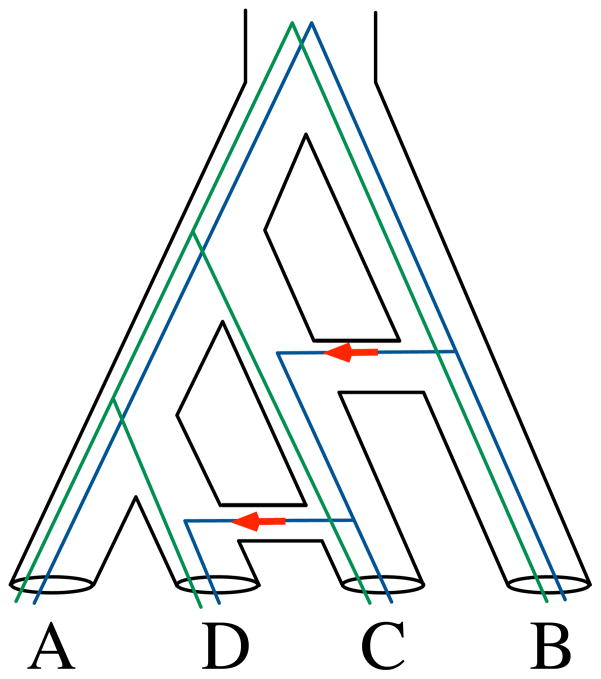
Figure 5. Gene trees within the branches of a phylogenetic network
The phylogenetic network, drawn with tubes, fits the evolutionary histories of all genes, including those that evolve vertically (e.g., the gene tree drawn with green lines) and those that involved horizontal transfer (e.g., the gene tree drawn with blue lines, and HGT or introgression events highlighted with red arrows).
Figure 6
Figure 6. Simultaneous modeling of hybridization and ILS with a phylogenetic networks
Two individuals are sampled per species, and there is a hybridization event that involves species B and C. Further, ILS patterns complicate the gene genealogy, giving rise to the gene-tree topology shown in the inset. For example, the gene copies in green coalesce with the ancestral copy of the genes in red from A and B, before the latter one coalesces with the copy from C.
Figure 7
Figure 7. Parsimonious reconciliation of a non-binary gene tree
(a) A binary species tree. (b) A non-binary gene tree. (c–e) The three possible refinements of the non-binary gene tree. Under parsimony, the refinement in (c) results in the best reconciliation with the species tree, as it results, assuming ILS, DL, or HGT, in 1 extra lineage, 1 duplication and 3 losses, and 1 HGT, respectively.

References

    1. Dittmar K, Liberles D, editors. Evolution after Gene Duplication. Wiley-Blackwell; Hoboken, New Jersey: 2010.
    1. Innan H, Kondrashov F. The evolution of gene duplications: classifying and distinguishing between models. Nature Reviews Genetics. 2010;11:97–108. - PubMed
    1. Lerat E, et al. Evolutionary origins of genomic repertoires in bacteria. PLoS Biology. 2005;3:0807–0814. - PMC - PubMed
    1. Boto L. Horizontal gene transfer in evolution: facts and challenges. Proceedings of the Royal Society B. 2010;277:819–827. - PMC - PubMed
    1. Abbott R, Rieseberg L. eLS. 2012. Hybrid speciation.

Publication types

LinkOut - more resources