. 2013 Oct 1;105(7):1710-9.
doi: 10.1016/j.bpj.2013.08.019.

Transmembrane current imaging in the heart during pacing and fibrillation

Affiliations

Transmembrane current imaging in the heart during pacing and fibrillation

Richard A Gray et al. Biophys J. .

Abstract

Recently, we described a method to quantify the time course of total transmembrane current (Im) and the relative role of its two components, a capacitive current (Ic) and a resistive current (Iion), corresponding to the cardiac action potential during stable propagation. That approach involved recording high-fidelity (200 kHz) transmembrane potential (Vm) signals with glass microelectrodes at one site using a spatiotemporal coordinate transformation via measured conduction velocity. Here we extend our method to compute these transmembrane currents during stable and unstable propagation from fluorescence signals of Vm at thousands of sites (3 kHz), thereby introducing transmembrane current imaging. In contrast to commonly used linear Laplacians of extracellular potential (Ve) to compute Im, we utilized nonlinear image processing to compute the required second spatial derivatives of Vm. We quantified the dynamic spatial patterns of current density of Im and Iion for both depolarization and repolarization during pacing (including nonplanar patterns) by calibrating data with the microelectrode signals. Compared to planar propagation, we found that the magnitude of Iion was significantly reduced at sites of wave collision during depolarization but not repolarization. Finally, we present uncalibrated dynamic patterns of Im during ventricular fibrillation and show that Im at singularity sites was monophasic and positive with a significant nonzero charge (Im integrated over 10 ms) in contrast with nonsingularity sites. Our approach should greatly enhance the understanding of the relative roles of functional (e.g., rate-dependent membrane dynamics and propagation patterns) and static spatial heterogeneities (e.g., spatial differences in tissue resistance) via recordings during normal and compromised propagation, including arrhythmias.


Figures

Figure 1
Figure 1
Schematic illustrating the measurement of Vi, Ve, and fluorescent transmembrane potential Fm from the surface of the isolated rabbit heart. The steps required for computing ion-current images involve the calibration (indicated by asterisks) of Fm, Im, Ic, and Iion. (RA, right atrium; LA, left atrium; RV, right ventricle; LV, left ventricle; CCD, charge-coupled device fluorescent-imaging camera; x, horizontal; y, vertical image axes of CCD; t, time; AR, anisotropy ratio; ϕ, fiber angle.) Other abbreviations are defined in Table 1. Im is computed as the second spatial derivative of Fm using a nonlinear local surface fit (polyfit); the details of the methodology shown here are provided in the text (see Methods; see Algorithm Development).
Figure 2
Figure 2
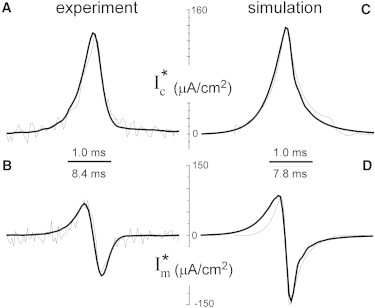
Calibration of transmembrane currents computed from fluorescence transmembrane signals in experiments (Fm) and simulations (Vopt). (A) Ic computed from microelectrode data (thick line) and Ic computed from Fm at a nearby site and scaled (thin line). (B) Im computed from microelectrode data (thick line) and Im computed from the spatial gradient of Fm at a site closest to the microelectrode and scaled (thin line). (C) Ic computed from simulated Vm (thick line) and Ic computed from Vopt at a the same site and scaled (thin line). (D) Im computed from simulated Vm (thick line) and Im computed from the spatial gradient of Vopt and scaled (thin line). Details of this calibration are provided in Algorithm Development.
Figure 3
Figure 3
Transmembrane current imaging during wave collision resulting from pacing at two sites (locations indicated by asterisks in the lower-left and upper-right corners). (A) Isochrone map indicating the position of the wave front at 1-ms intervals. (Gray solid lines) Direction of propagation. (Dashed gray lines) Intersection of two waves. (Parallel gray lines) Collision and block. (B) Time course of transmembrane potential as recorded using a fluorescence probe (Fm) in the upper-left panel and calibrated transmembrane current density (Iion, black; Im, red; Ic, blue) signals at the five labeled locations during depolarization. (C) Snapshots of Fm, Im, and Iion at two instants of time (indicated by the two vertical dashed lines in the Fm plot in panel B).
Figure 4
Figure 4
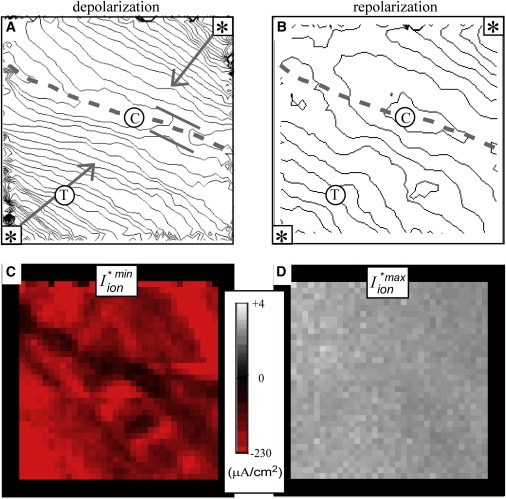
Analysis of Iion spatial distribution during a wave collision. (A) Isochrone map indicating the position of the wave front (depolarization) at 1-ms intervals. (B) Isochrone map indicating the position of the wave tail (repolarization) at 5-ms intervals. (C) Spatial distribution of I∗minion that occurs during depolarization. (D) Spatial distribution of I∗maxion that occurs during repolarization. Note the different timescale of isochrones and magnitude of Iion for depolarization and repolarization.
Figure 5
Figure 5
Transmembrane current imaging of focal activation and wave collision during fibrillation (noncalibrated Im values only). (A) Isochrone map indicating the position of the wave front at 1-ms intervals demonstrating focal activation from two locations followed by collision. Time course of transmembrane potential (B) as recorded using a fluorescence probe (Fm) at two sites (C) and the corresponding IFm signals. (D) Snapshots of Fm, IFm, and θ at two instants of time (indicated by vertical dashed lines in panels B and C). The value θ was computed at each site as arctan[Fm(t+τ)F50,Fm(t)F50], where F50 represents 50% of Fm range and τ = 10 ms.
Figure 6
Figure 6
Transmembrane current imaging of reentry during fibrillation (relative Im values only). (A) Isochrone map indicating the position of the wave front at 1-ms intervals demonstrating reentry. Time course of transmembrane potential (B) Fm at two sites and the corresponding IFm (C) signals. (D) Snapshots of Fm, IFm, and θ at two instants of time (indicated by vertical dashed lines in panels B and C). Phase singularity sites are indicated in θ images as minus signs, indicating counterclockwise rotation.
Figure 7
Figure 7
Comparison of membrane current IFm (A) and membrane charge QFm (B) at phase singularity sites (grey) and nonphase-singularity sites (black). The value n refers to values computed from every 10-ms interval at each location.

References

    1. Cabo C., Pertsov A.M., Jalife J. Wave-front curvature as a cause of slow conduction and block in isolated cardiac muscle. Circ. Res. 1994;75:1014–1028. - PubMed
    1. Gray R.A., Jalife J., Pertsov A.M. Nonstationary vortexlike reentrant activity as a mechanism of polymorphic ventricular tachycardia in the isolated rabbit heart. Circulation. 1995;91:2454–2469. - PubMed
    1. Wikswo J.P., Jr., Lin S.F., Abbas R.A. Virtual electrodes in cardiac tissue: a common mechanism for anodal and cathodal stimulation. Biophys. J. 1995;69:2195–2210. - PMC - PubMed
    1. Gray R.A., Jalife J., Pertsov A.M. Mechanisms of cardiac fibrillation. Science. 1995;270:1222–1223. - PubMed
    1. Gray R.A., Pertsov A.M., Jalife J. Spatial and temporal organization during cardiac fibrillation. Nature. 1998;392:75–78. - PubMed

Publication types

LinkOut - more resources