


Semen quality in relation to antioxidant intake in a healthy male population
- PMID: 24094424
- PMCID: PMC3843991
- DOI: 10.1016/j.fertnstert.2013.08.032
Semen quality in relation to antioxidant intake in a healthy male population
Abstract
Objective: To assess the relationship between dietary antioxidant intake and semen quality in young healthy males.
Design: Cross-sectional study.
Setting: University and college campuses in the Rochester, New York, area.
Patient(s): One hundred eighty-nine university-aged men.
Intervention(s): None.
Main outcome measure(s): Semen volume, total sperm count, concentration, motility, total motile count, and morphology.
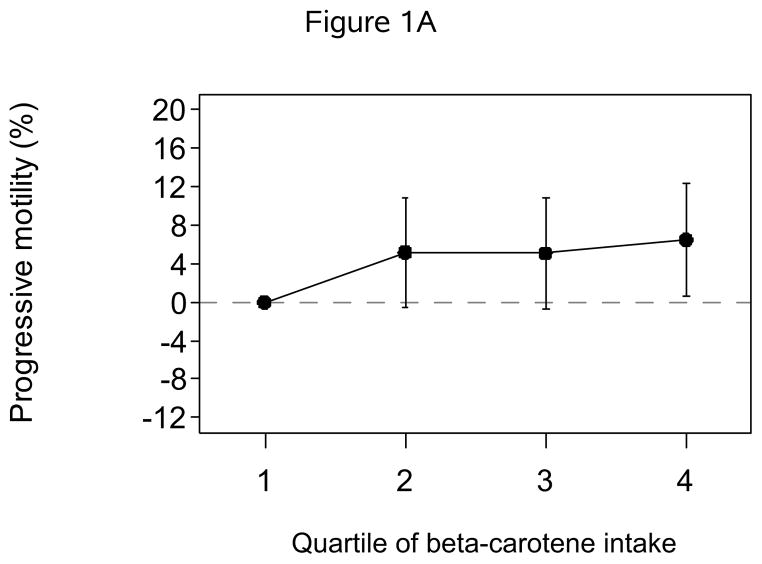
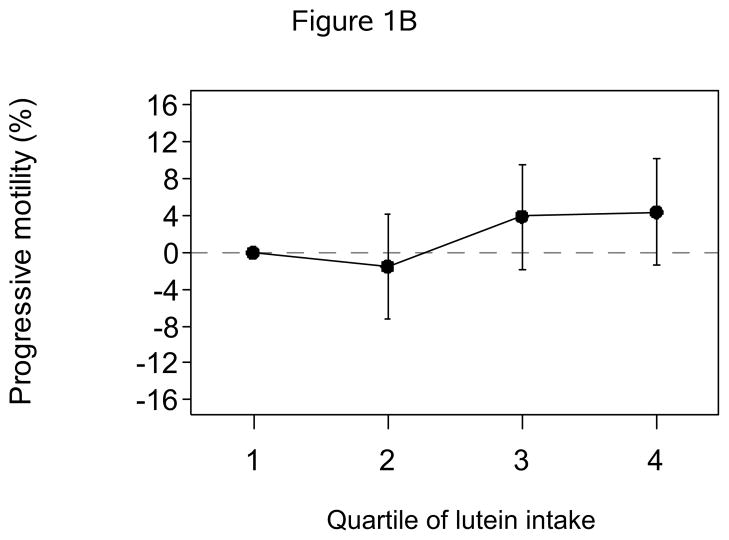
Result(s): Progressive motility was 6.5 (95% confidence interval [CI], 0.6, 12.3) percentage units higher among men in the highest quartile of β-carotene intake compared with men in the lowest quartile. Similar results were observed for lutein intake. Lycopene intake was positively related to sperm morphology. The adjusted percentages (95% CI) of morphologically normal sperm in increasing quartiles of lycopene intake were 8.0 (6.7, 9.3), 7.7 (6.4, 9.0), 9.2 (7.9, 10.5), and 9.7 (8.4, 11.0). There was a nonlinear relationship between vitamin C intake and sperm concentration, with men in the second quartile of intake having, on average, the highest sperm concentrations and men in the top quartile of intake having the lowest concentrations.
Conclusion(s): In a population of healthy young men, carotenoid intake was associated with higher sperm motility and, in the case of lycopene, better sperm morphology. Our data suggest that dietary carotenoids may have a positive impact on semen quality.
Keywords: Infertility; antioxidants; diet; sperm quality parameters; vitamins.
Copyright © 2013 American Society for Reproductive Medicine. Published by Elsevier Inc. All rights reserved.
Figures
References
-
- Agarwal A, Sharma RK, Nallella KP, Thomas AJ, Jr, Alvarez JG, Sikka SC. Reactive oxygen species as an independent marker of male factor infertility. Fertil Steril. 2006;86:878–85. - PubMed
-
- Kao SH, Chao HT, Chen HW, Hwang TI, Liao TL, Wei YH. Increase of oxidative stress in human sperm with lower motility. Fertil Steril. 2008;89:1183–90. - PubMed
-
- Gharagozloo P, Aitken RJ. The role of sperm oxidative stress in male infertility and the significance of oral antioxidant therapy. Hum Reprod. 2011;26:1628–40. - PubMed
-
- MacLeod J. The role of oxygen in the metabolism and motility of human spermatozoa. Am J Physiol. 1943;138:512–8.
-
- Lewis SE, Boyle PM, McKinney KA, Young IS, Thompson W. Total antioxidant capacity of seminal plasma is different in fertile and infertile men. Fertil Steril. 1995;64:868–70. - PubMed
Publication types
MeSH terms
Substances
Grants and funding
LinkOut - more resources
Full Text Sources
Other Literature Sources
Medical
